Family6 min read
My Daughter Said She Didn't Count
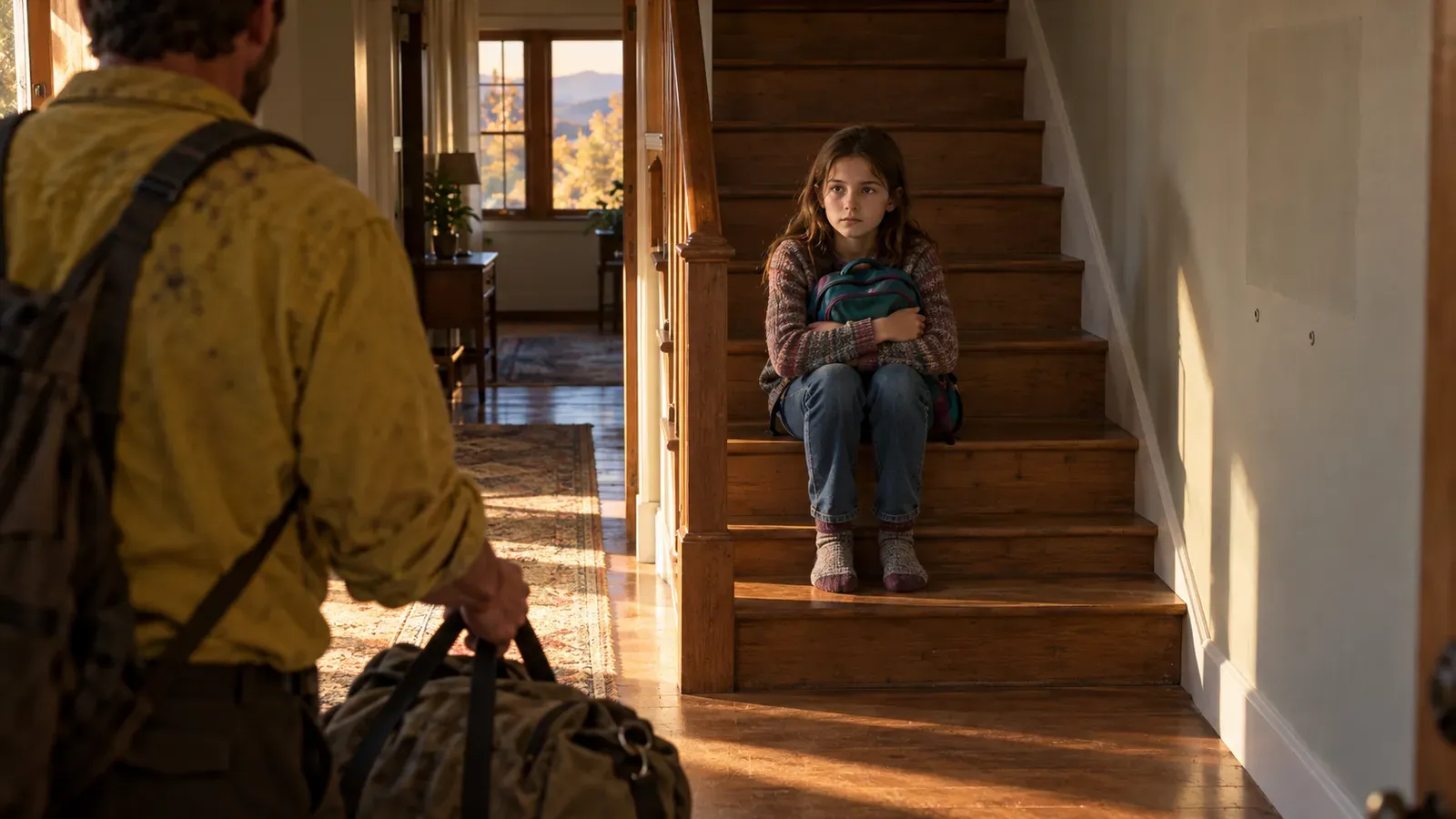
I came home from a Montana wildfire two days early and found my ten-year-old on the third stair, backpack on her knees, waiting to be allowed down in her own house. My wife, who runs a daycare downstairs, said it was a licensing thing and Bea was fine up there.
Chapter 4: Number Eight
At ten to five I put the binder back on the sign-in table, square to the edge, the way Renee had left it. Before I closed it I took two pictures with my phone: the line after Bea's name, and the gray print on the license by the door.
Renee came down at 5:25 in a fleece, hair still wet, and turned on every light on the ground floor. She found me in the kitchen with my boots on.
"You're up."
"Gear to turn in at the station."
That wasn't true. I'd turned all of it in the day before. She didn't know that and didn't ask. She was already looking past me at the window for headlights.
The first car came up the gravel at 5:31. An older woman in a work fleece got out with a boy asleep on her shoulder, green dinosaur boots hanging down past her elbow. Renee met her at the door and took him without waking him. The woman was back in her car and turning around before the door shut.
One adult, one child, one car. Same boots as yesterday. Different woman.
I left at 5:40, with the second set of headlights coming up the road.
Ridgeview Care Center is a long, low building on the north side of Helena with a side lot for staff. At 6:15 it was still full dark, and the sodium lights over the lot turned every car the same orange. Shift change. People in scrubs crossed between the cars with their hands in their pockets, some going in, most going home.
She came out a side door at 6:12 in navy scrubs with the gray hoodie over them and the lanyard around her neck. Keys, badge, zip pouch. She saw my truck and stopped, the way she'd stopped on my front walk. Then she came across, got in the passenger side and pulled the door shut.
"I'm sorry," she said. "I'm Tasha."
"Wade."
"I know." She held the lanyard in her lap with both hands. "I'm sorry. Your number's in the handbook."
She said it before every hard thing, I found out. Then she said the hard thing anyway.
She told it in order, like somebody who'd gone over it all night between rounds. Renee handed out the new fall handbook on Friday. That night, her night off, Tasha read it at her kitchen table and got to page three. Renee, provider. Me, emergency backup, away seasonally, wildland fire crew, Helena. My cell. No child.
"I'd been looking at your daughter on those stairs for six weeks," she said. "And the book said nobody lived there but the two of you."
She called my cell that night. It rang out. She didn't leave a message.
"I lost my nerve."
I took out my phone and went back to Friday. There it was, 9:47 p.m., a missed call from a number with no name. On the line you top a ridge and get a dozen things at once, and you don't look twice at a number you don't know. I hadn't. It matched the fuel receipt.
Saturday she called the fire dispatch center in town. "I didn't even know if that was a thing you could do. The lady was nice. She said she'd get it to your crew. She didn't say when." She looked at me. "I'm sorry about Sunday. I saw it ringing. I was putting Tobi down and I had to be at work at ten, and I just watched it ring."
"You texted."
"You were on the walk. I figured you came for a reason."
"Tell me about the stairs," I said.
She picked Tobi up at 5:45 every weekday. Since his first Monday there, Bea had been on the third stair every time, backpack on her knees. Tobi waved at her. Bea waved back. The first week Tasha asked Renee if Bea was sick, and Renee said, "She's on quiet time."
"I'm sorry. This is the part." She turned the lanyard over in her fingers. "When one of us comes in to get our kid, she stands up. Every time. She pulls her backpack in against her so you can get by, and she says sorry. To every one of us." She stopped. "In her own house. She's saying sorry to me in her own house."
I didn't say anything. I was doing a count I couldn't stop. Twenty-eight evenings, if you left out Labor Day and the two days I'd been home. Twenty-eight times my daughter had stood up on the third stair for somebody else's mother.
I'd been on a ridge or a road for every one of them.
"Show me the rest," I said.
She had her phone out already. Thursday, August 13, 8:14 p.m., Renee's name at the top of the thread.
Good news, I can take Tobi after all. Bea's off my count.
"In July she told me she was full," Tasha said. "I asked her in person. She said eight's eight, she was sorry. Then that. I thought somebody moved away." She put the phone face down on her knee. "I didn't know what it meant till Friday."
August 13. The day after the shoes.
She unzipped the pouch and took out a fold of white slips, held flat with a paper clip, and handed them to me. I counted them because I count. Seven. Every one in Renee's square hand, the same line as the yellow carbon on the pad by my front door.
Early hrs — 75.00 — cash — R.K.
Monday, August 31. Tuesday, September 8, the week of Labor Day. Then every Monday after that, through yesterday. Seven times seventy-five. Five hundred and twenty-five dollars.
"She said it was for the early opening," Tasha said. "Nobody else in the valley opens at 5:30. My mom has to be at work at six. She drops him on her way."
The woman in the work fleece.
Tasha took a folded sheet from behind where the slips had been. "I'm on assistance."
It was a notice to parents from the subsidy office, creased soft. She put her thumb under one line. A provider may not charge an assisted family any fee beyond the approved copay.
"I read that in August," she said. "I paid it anyway. Where was I going to go?" She folded the sheet back along its creases. "If they say I shouldn't have paid it, I don't know what they do to me."
I sat with the slips in my hand.
So that was the eighth place. Bea had been taken off the count with a form, and the place she left was sold, and seventy-five dollars a week rode on top of it in cash, into a gray box on a table by my front door. I don't count wasn't something my daughter felt. It was a number, and somebody had written it down.
"You've done enough," I said. "You can stop here. Nobody knows you called but me."
"I know."
"What do you want?"
She'd thought about that too. "I'm going to the subsidy office. Me. With those." She held out her hand, and I gave the slips back. "I'm not asking you to do it for me."
"Can I take pictures?"
"Yes."
I turned on the dome light. She laid the slips out one at a time across the dash, and I photographed each one, then the text on her phone, then the notice. When I was done she clipped the slips together again and zipped them into the pouch.
"Your note said not to tell her who called."
"I know." She looked out at the lot. A woman in scrubs was scraping frost off a windshield with a credit card. "I'm sorry. Tell her it was me. She'll know anyway."
She opened her door. Cold air came in, and the smell of the lot. She had one foot on the ground when I asked it.
"If I file something. What happens to Tobi?"
She didn't look surprised. She'd done the count herself, and before I had. Probably the same Friday night, at the same kitchen table, with the handbook open to page three.
"I'm sorry," she said. "If Bea counts, Tobi's number nine."
End of chapter 4