Family5 min read
My Father's Other Funeral
Three weeks after we buried my father, forty strangers held a second service for him—for a man they knew by another name. The Thursdays I resented my whole life turn out to have had an address, and a reason my mother spent thirty-one years refusing to say out loud.
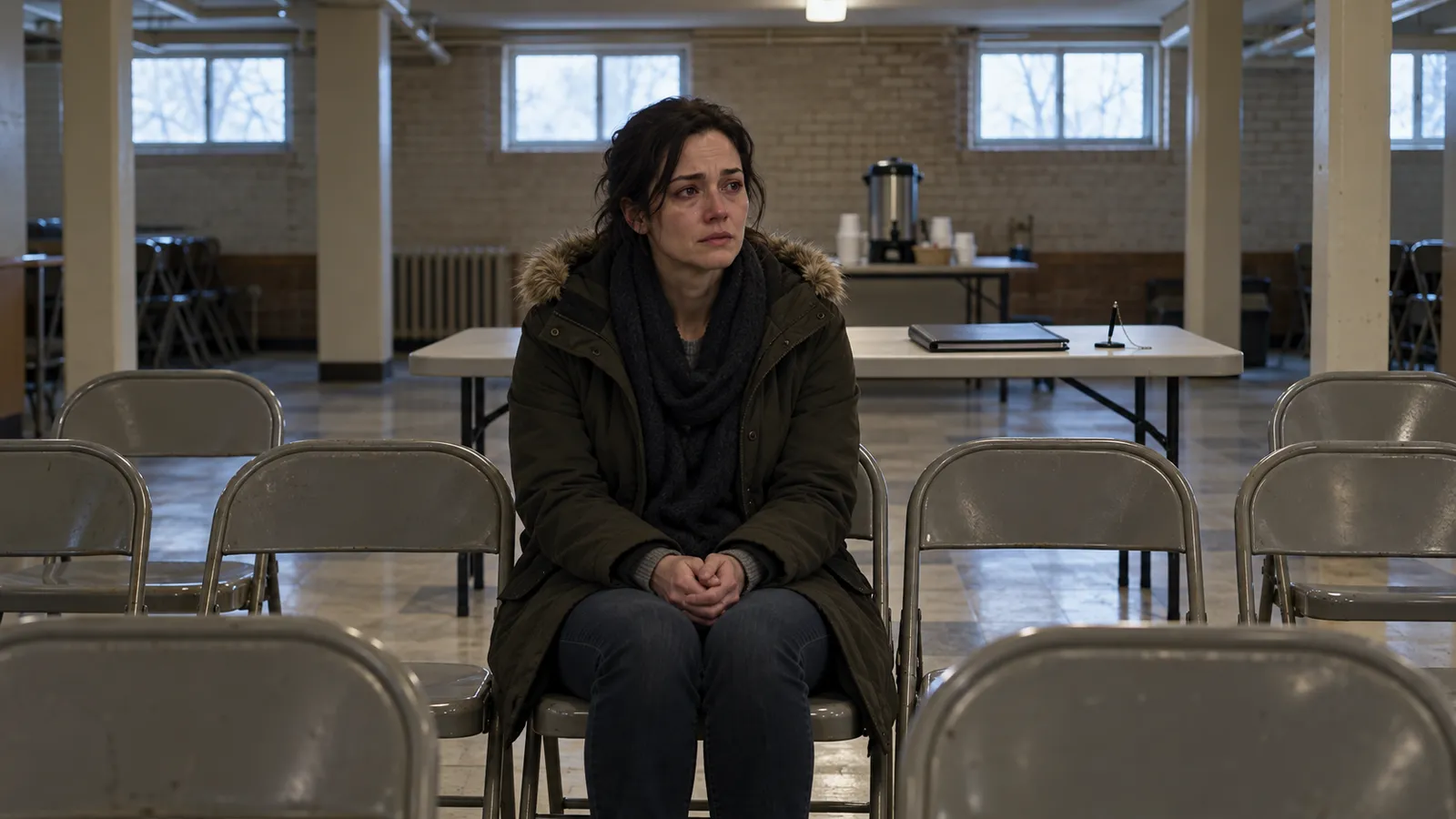
Chapter 1: The Second Service
Three weeks after we buried my father, forty strangers held a second service for him.
I counted the chairs because I did not know what else to do with myself. Forty folding chairs in four rows of ten, set up in the basement of a brick building on Ninth Street that used to be a church and now had a laminated sign by the stairwell that said RECOVERY AND TRANSITION CENTER and under that, in smaller letters, PLEASE SIGN IN.
Thirty-eight of the chairs were full. There was a card table by the stairs with a binder on it and a pen on a string, and because the sign told me to, I wrote my name in it. Then I took a chair in the back row and kept my coat on.
Sam had found the voicemail. He had gone to our mother's house on Thursday to carry the storm windows up from the basement, and the answering machine on the kitchen counter had a red light on it, and he pressed the button because he is the kind of person who presses buttons.
A woman's voice. Calm, unhurried, like somebody reading a chart.
This message is for the Fletcher family. My name is Mabel Prescott. I'm the director at the Ninth Street Center. Several of our members would like to hold a remembrance for Will on Saturday the fourth, at two o'clock, here. You're welcome. You don't have to speak.
He played it for me over the phone, holding his cell up to the machine so I heard it through two devices.
"Who's Will," he said.
"I don't know."
"She said Fletcher."
"I heard what she said."
The message was dated March twenty-eighth. Our mother had had it in her kitchen for six days and had not mentioned it, and when Sam asked her about it she said the machine picks up wrong numbers all the time.
So I drove forty minutes on a Saturday to find out who had my father's last name and somebody else's first one.
There was a coffee urn on a card table with a stack of styrofoam cups beside it and a hand-lettered sign that said DECAF AFTER SIX. There were no flowers. There was no program, no minister, no music. A woman with a lanyard full of keys stood up at the front and said we were glad to be there and that they would keep it simple, and then she sat down, and a man in a canvas jacket stood up without being called on.
"I'm Terrence," he said. "Will picked me up on Pratt Street in February of 2011. It was eleven degrees. I'd been out there four days."
He stopped and looked at the floor for a second.
"He didn't say anything the whole ride. He just had the heat on and a coffee in the cupholder that he didn't drink, because it was for me. That's all I wanted to say."
People made a low sound that wasn't quite agreement.
Then a woman named Delia, who said Will had sat in the hallway of the county hospital with her from two in the morning until six, and had not once asked her what her son had taken.
Then a man who only gave his first initial and said Will drove him to detox in Zanesville twice, and the second time he had been ashamed to ask, and Will said what he said the first time, which was What time.
Then a younger guy who said, "Thursdays. He was always here Thursdays. You could set your watch."
I wrote that down on the back of my hand. Thursdays.
My father had told us Thursday nights were a county maintenance shift. Boiler checks at the middle school, the high school, the two elementaries. Twenty-some years of Thursdays. When I was nine I asked why the boilers only broke on Thursdays and he said that's when they're scheduled, and that was the end of it, because that was always the end of it.
He ended conversations the way other men ended phone calls. All right then.
I sat in that basement and listened to six people describe a patient man. A man who waited. A man who showed up at four in the morning with the heat already on in the car. Not one of them said anything I recognized.
My father had come to exactly two things of mine. My high school graduation, where he stood at the back near the doors. My wedding, where he danced one song with me and hummed the whole time because he was nervous, two flat notes under the music, and then went and stood out by the cars.
At my mother's house there was a drawer in the kitchen with twelve years of school pictures in it that he never put up anywhere.
Somebody at the front said the name again — Will — and I realized my thumb was on my chin. On the seam of it, the pale line that runs along the left side of my jaw where the skin doesn't grow hair and doesn't tan. I have had it since I was four. I touch it the way other people check for their keys.
I stood up in the middle of a man's sentence and went up the stairs.
Outside it was bright and cold and the parking lot was half gravel. I got into my car and sat with my hands on the wheel and my father's keyring in my coat pocket, which I had been carrying since the ninth of March because nobody had told me where to put it. House key, truck key, a brass key the size of a fingernail, and a coin, bronze, worn so smooth on one face that you could not tell what had been stamped there.
The woman with the lanyard came out and stood a careful distance from my window until I rolled it down.
"You're Juliet," she said.
"How do you know that."
"You have his hands." She did not say anything about my chin, and later I would understand that she was being careful. "I'm Mabel Prescott. I'm sorry — I should have come to you before it started."
"Nobody in there knew his name."
"They knew the name he gave us."
"Warren," I said. "He was Warren Fletcher for sixty-three years."
Mabel Prescott held her keys so they didn't jingle. "He signed in here as Will F. every Thursday for twenty-one years," she said. "Your mother has known about this building since 2005."
End of chapter 1