Family5 min read
My Father's Other Funeral
Three weeks after we buried my father, forty strangers held a second service for him—for a man they knew by another name. The Thursdays I resented my whole life turn out to have had an address, and a reason my mother spent thirty-one years refusing to say out loud.
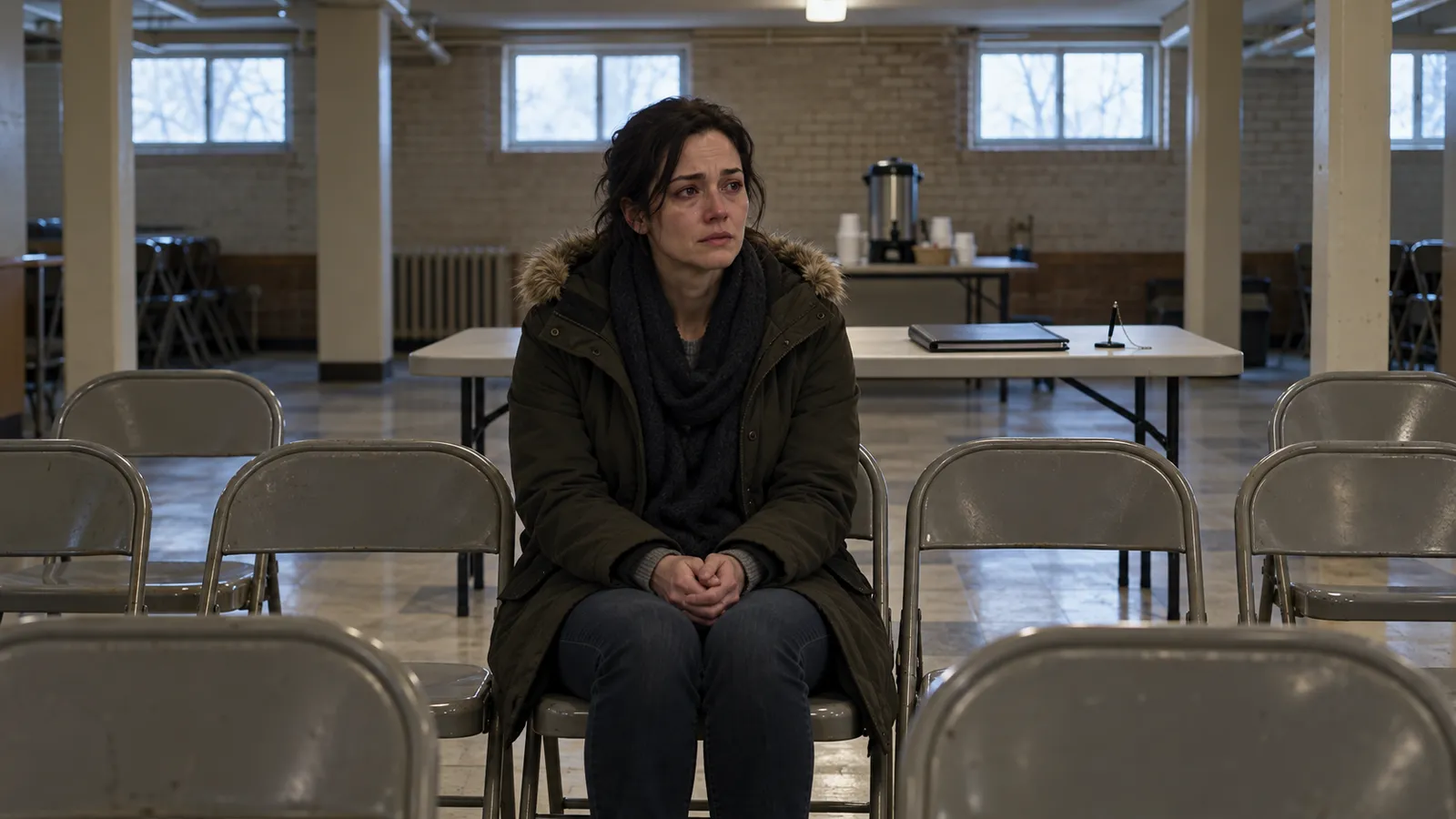
Chapter 5: Twenty-Four Notebooks
The key turned on the first try.
I had driven from Ninth Street to Ambler Street in twenty-five minutes without deciding to, parked on the street instead of the driveway, and gone in through the side door of the garage with my coat still on. Nine o'clock at night. The kitchen light was on in the house and I did not knock on the connecting door.
The drawer came out heavy and did not rattle.
Composition notebooks. The marbled black-and-white kind they sell three for a dollar at the start of the school year. Stacked in two rows, spines up, and on every spine a number in his block capitals, in marker: 1 through 24.
Behind them, a shoebox.
I got the work light on its hook over the bench and sat on his rolling stool, which is a thing I had never been allowed to do, and I took out notebook 24 first because I wanted to know what he had been doing most recently.
It was not a diary. I want to be clear about what these were, because Sam and I still disagree about it.
It was a ledger.
Jan 8. T. — 4 a.m., Pratt to Zanesville. 61 mi. Admitted.
Jan 8. Chairs. Urn descaled.
Jan 15. Nobody. Sat till 9:40.
Jan 15. D. called, no ride needed, talked 20 min.
Jan 22. R.M. out again, third time. Picked up at the Sunoco, took him home to his sister's. She wouldn't open the door.
Jan 22. Super 8, paid Tues–Thurs, $141.
Jan 29. Chairs. Coffee. Nobody.
Feb 5. L. at the hospital, 2:10 a.m. to 6:00. Son stable, did not ask.
Miles. Dollars. First names and initials. Nights where nothing happened, recorded with the same weight as nights where everything did. Four relapses in that one notebook, each one written down in the same hand as the descaled urn, no commentary, no I feel, no why does he keep.
Twice in twenty-four notebooks, the shape of a line changed. Notebook 9, from 2013:
Oct 18. T.K. died Sunday. Service Thursday at eleven, went. Nobody else from here went.
I read the way I read labels, out loud, half under my breath, because that is how I make sure I am not skipping a line.
I read for two hours.
Page after page of nothing but other people. Twenty-four notebooks and not one entry about my mother, not one about Sam, not one about me, not one about his knee or his job or the roof. He had kept a twenty-one-year record of his own life in which his own family did not appear.
That is the thing I keep coming back to, and I do not know what to do with it even now.
The shoebox was receipts. Hundreds of them, rubber-banded in bundles by year, and every one with writing on the back: gas, Zanesville run, $31. Motel for R.M., 3 nights. New urn gasket, $4.80, fits. The same habit I had seen my whole life on the backs of dryer-belt receipts, turned to this.
At the bottom of the drawer, under the shoebox, was notebook 1.
The cover was soft at the corners from being handled. The first page had no date at the top and no name, and only one line on it, pressed so hard the letters came through to page two:
11 — J., chin, Nov. 4, 1995.
I sat on my father's stool in my father's cold garage and looked at that for a long time.
My first thought was that it was a date he had marked to start counting from. People do that. There is a whole industry of people doing that.
My second thought, which came about a minute later and took the floor out from under the first one, was that 11 is not a date.
Eleven is a number of stitches.
I touched my chin. My fingers were cold and the scar is the one part of my face with no feeling in it, so I did not feel anything, which was almost funny.
Then I turned the page, and the second page was a name I did not know, and a date in November 2005, and a column of miles, and from there it was other people all the way to notebook 24.
He had opened the first page of a twenty-one-year ledger with my chin and then never mentioned me again.
The side door opened and Sam came in with his jacket over his pajama shirt and his phone already in his hand.
"Mom called me," he said. "She said you were out here."
"Did she tell you what's in the drawer?"
"She said it was Dad's paperwork."
I handed him notebook 14. He sat on an upturned bucket and read it, and I watched the thing happen to his face that I had been afraid of.
"Jules." He was eight pages in. "Jules, this is — do you understand what this is? Look at this. Picked him up at the Sunoco, sister wouldn't open the door, paid Tuesday through Thursday. He paid for a motel for a guy who relapsed three times. Out of his own pocket. He wrote down four dollars and eighty cents for a gasket."
"I read it."
"Twenty-one years." He was scrolling pages like a phone. "Nobody knew. He never told anybody. Jules, he was —"
"Don't say it."
"He was a good man."
"He was a man who did good things on Thursdays," I said, "and lied to his children on the other six days, and that's two facts, and I'm going to be holding both of them, and you're going to have to hold both of them too."
"Why." He actually asked it like a question. "Why do I have to hold the second one. He's dead. What is the second one for?"
"Because the second one is the one I lived in."
Sam put notebook 14 down on the bench, carefully, the way you put down something in a store you have decided not to buy.
"You know what I think you can't stand?" he said. "That he turned out to be better than you've been saying he was."
"Open notebook one."
"No."
"Open it and read me the first line."
He didn't. He picked up three notebooks, 1 and 2 and 14, and held them against his chest like schoolbooks, and said he was taking them home and that I could have them back when I was being reasonable.
My mother was standing in the connecting doorway in her robe. She did not come in. She looked at the open drawer, and the stacks, and the shoebox, and her face did something I had never seen it do, which was nothing at all.
"It's cold out here," she said, and went back inside, and shut the door.
I put the notebooks back in order on the bench and that is when I saw it, because the numbering is the kind of thing I am built to notice.
Twenty-four notebooks. Notebook 24 ended on February 26, with the urn and nobody, and he died on March 9.
There was one more Thursday in between, the fifth of March, and no notebook 25 in that drawer.
My phone rang at eleven forty with a number from a deposit slip in my coat pocket.
End of chapter 5