Family5 min read
My Father's Other Funeral
Three weeks after we buried my father, forty strangers held a second service for him—for a man they knew by another name. The Thursdays I resented my whole life turn out to have had an address, and a reason my mother spent thirty-one years refusing to say out loud.
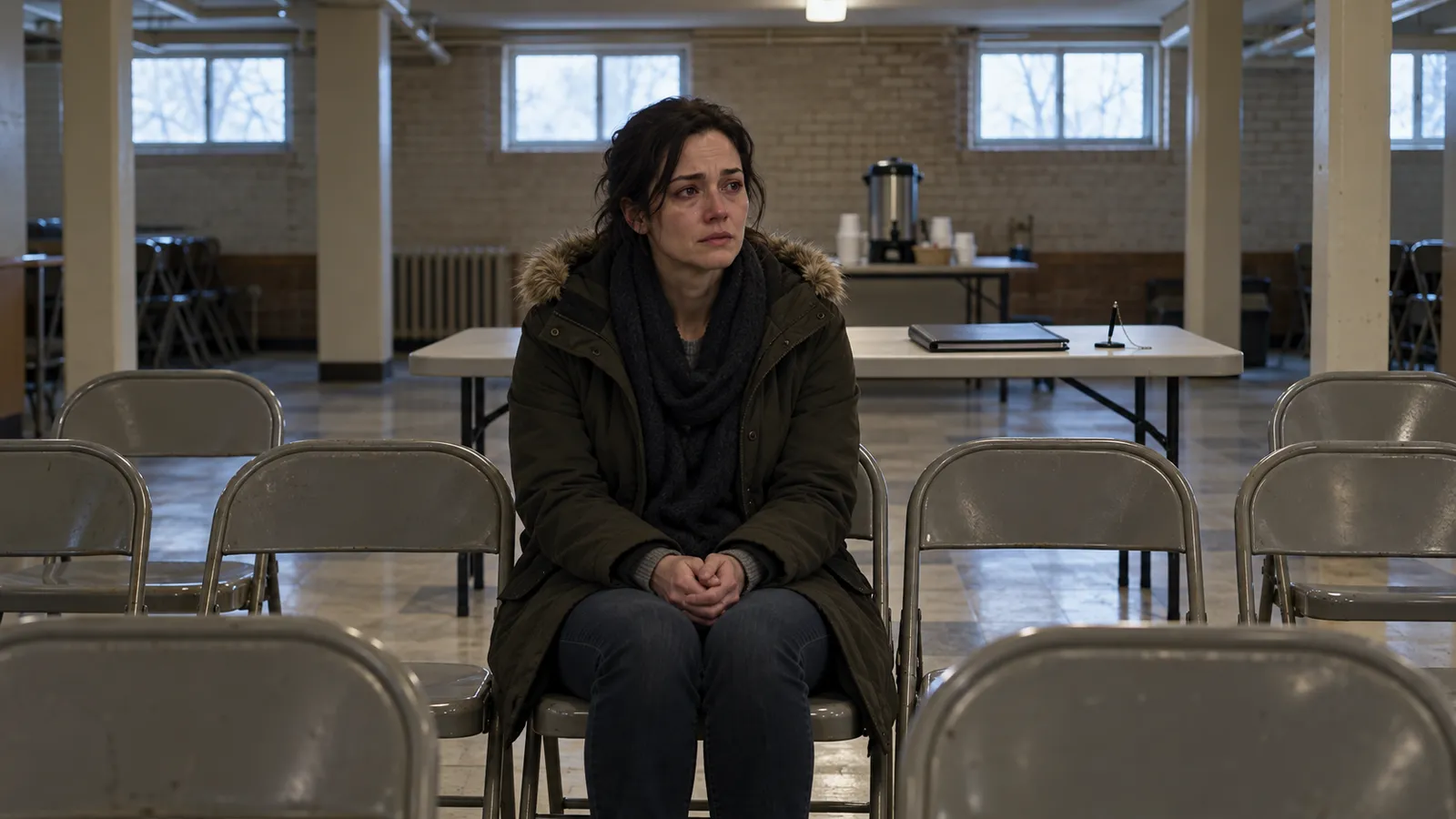
Chapter 6: What Will Said in Rooms
Ezra Donovan had the mounting bay at a tire shop on Route 9, the second bay from the road, and he did not stop working when I came in. He finished seating a bead with the machine, let the air out of the hose, and then wiped his hands on a rag that was not going to help, because the creases of his hands were black in a way that is permanent.
"You've got his jaw," he said.
"Everybody in that building says something about my face."
"Yeah." He set the rag on the tire. "I know."
He got two folding chairs from against the wall and set them in the bay where the sun came in, because he said the break room smelled like a microwave, and he sat down with his forearms on his knees.
"Mabel said you'd call. She said it a month ago, before he died. She said if anything happened to him, the daughter would come eventually."
"My father talked about me."
Ezra tapped a knuckle on the arm of the chair, twice.
"He talked about you in rooms," he said. "He didn't talk about you anywhere else. Not to me, not at the shop, not in a car. In a room, with the door shut, he talked about you most weeks for the nine years I was in there with him."
"What did he say."
And here is where it went wrong, and I do not blame him for it, because he had no way of knowing. He assumed I knew. Of course he assumed I knew. He had spent nine years with a man who stood up in a church basement and said this out loud to a room of strangers, and it did not occur to him that the one person in the world who had not heard it was me.
"He used it on guys who were lying," Ezra said. "That's what it was for. Somebody'd be sitting there telling the room how nothing really happened, he just lost a job, nobody got hurt, it's not like he's one of those guys — and Will would wait until the guy was done, and then he'd say, 'I put my daughter's face through a door frame and a sheriff's deputy drove us home.'"
The air hose ticked as it cooled. Somewhere in the next bay a radio was playing.
"Say that again," I said.
"Juliet—"
"Say the whole thing again."
He looked at me for a second, and I watched him understand, and the understanding went across his face like something being taken away from him.
"You didn't know," he said.
"Say it again."
He put his hands flat on his knees. He did not tap the chair this time.
"He'd say, November, a township road. He'd been at a neighbor's birthday. He had eleven years of practice telling himself four miles was nothing."
Ezra stopped, and then went on, because I had asked him twice.
"He went off the pavement. There was a culvert. You were four, you were in the back, and your chin opened on the door frame. Eleven stitches. He said the number every time."
He looked at the bay floor.
"He said the deputy was a man he knew from church. The deputy didn't test him. He put a deer in the report and drove them both to the hospital."
"The deer."
"He said there wasn't any deer."
I had my hand on my chin. I had to take it down with my other hand.
"How many people has he said that to."
"Over twenty years?" Ezra thought about it in a way I appreciated, like a man counting inventory. "Hundreds. It's an open room the first Thursday of the month. Anybody can walk in."
Hundreds of strangers in a basement on Ninth Street knew where my chin came from. My brother did not know. I did not know.
"He never gave a number of years," Ezra said. "Guys would say theirs, you know, eleven years, three hundred days, whatever. He'd say since a night in November. Mabel got on him about it once, said he was being dramatic. He said if he said the number it'd start sounding like an accomplishment."
"What was I to him," I said. "In the room. What was I for."
Ezra did not answer that fast, which was the only correct way to do it.
"The first year I knew him I thought you were a thing he used," he said. "A story that worked. Guys shut up when he told it."
He picked at the edge of the chair.
"Then in 2019 I went out. Eight days. He came and got me off a porch on Sixth with my own key in my hand and I couldn't make it work. He drove me to Newark." Ezra said it flatly. "On the way I said something. I said at least I never hurt a kid."
He wiped his palm on his jeans.
"He pulled into a church lot, put it in park, and he said, 'Don't do that. Don't use her to make yourself feel better. She's not a story, she's a twenty-eight-year-old woman who doesn't call me.'"
My face was wet. I did not do anything about it.
"He hummed," Ezra said, after a while. "Two notes, kind of flat, when he was waiting on something. In the car, at the hospital, every time. Drove me crazy for nine years."
And that was the detail that did it. Not the culvert, not the stitches, not the deputy from church.
The two flat notes under the music at my wedding, while he danced with me and watched the doors over my shoulder, were the same two notes he hummed in a hospital hallway at four in the morning holding a stranger's coffee.
It was the same man. There was only ever one of him. He did not have a second life. He had one life, and he had kept me on the other side of a wall inside it.
"Why didn't he tell me." I was not really asking Ezra. "He told hundreds of strangers and he never told me."
"I asked him that," Ezra said.
"And?"
"He said it wasn't his to tell anymore. He said he'd asked and been told no, and he'd made a deal a long time ago, and he wasn't going to break it from his side." He looked at the floor of the bay. "I figured he meant God or something. The way guys talk. I didn't think he meant your mother until right now."
I stood up. My legs were not great.
"Last thing," I said. "The deputy. Do you know his name?"
"Roy something. He said Roy."
I drove home and sat in my car outside my own apartment until the heat went out of the engine.
At six the next morning I was parked on Prospect Street, forty minutes before the county records annex opened, to ask a clerk for every traffic report filed in Dunlap Township in November of 1995.
End of chapter 6