Family5 min read
My Father's Other Funeral
Three weeks after we buried my father, forty strangers held a second service for him—for a man they knew by another name. The Thursdays I resented my whole life turn out to have had an address, and a reason my mother spent thirty-one years refusing to say out loud.
Chapter 2: Forty Strangers
I was back on Ninth Street at nine the next morning, which was Sunday, which meant the door was locked and I stood in the gravel lot for twenty minutes until a car pulled in and Mabel Prescott got out of it with a grocery bag of coffee filters.
"I thought you might," she said.
Her office was a converted Sunday-school room with a crank window and a radiator that knocked. There was a laminated fire-exit map on the wall and a bowl of something on the windowsill that I did not look at closely. She filled a chipped mug from an electric kettle, dropped in a wedge of lemon, and did not offer me one until I had sat down, at which point she asked, and I said no.
"I need his file," I said.
"There isn't a file."
"There's a sign-in sheet. There's a volunteer form. Somebody ran a background check on him before they let him drive people around."
"There's a form." Mabel set her mug down. "I can't give you that."
"He's dead."
"I know. I was at the service." She said it without any softness in it, which I appreciated more than I would have appreciated softness. "Juliet, I'm going to tell you what this place is, because you're entitled to that, and then I'm going to tell you what I'm not able to hand you, and I'd rather do them in that order."
So she told me.
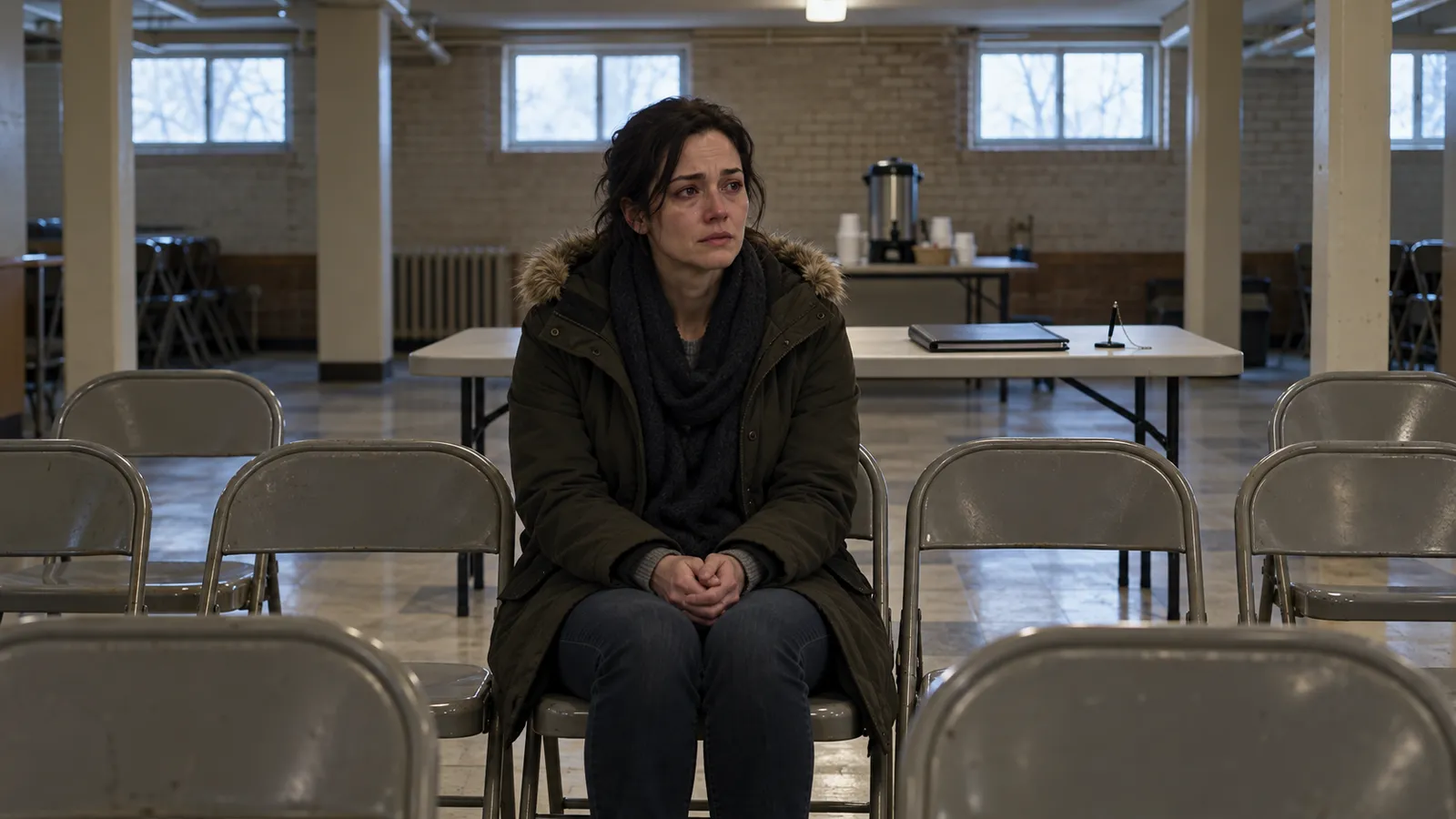
Ninth Street was not a treatment center. It had no beds and no doctors. It was a building where people in recovery came to sit in rooms with other people in recovery, and around that there had grown twenty-some years of unglamorous infrastructure: a phone line that somebody answered, a list of men and women who would get in a car at any hour, a connection to the detox unit in Zanesville and the one in Newark, a cabinet of canned food, a coffee urn, four hundred folding chairs over the years, replaced in batches.
"The rides are the backbone," she said. "Most people who want to stop don't have a car, or they have a car and no license, or they have both and nobody they're willing to be seen by. The hard hours are between midnight and five. That's when people call."
"And my father drove."
"Your father drove, and set up the room, and made coffee, and sat in hallways." She turned her mug a quarter turn on the desk. "He also did something harder than that, which is the part I can't discuss with you."
"Why not."
"Because the people he did it with are alive, and some of them have jobs, and custody arrangements, and a brother who doesn't know. Anonymity isn't a tradition we keep for charm. It's the reason the door gets used."
"He's my father."
"He's also a man who sat in that room and signed a confidentiality agreement with my name on it," she said. "He insisted on the strictest version of it. He asked me twice to make sure his name wasn't in the newsletter."
I looked at the window. "He didn't want you thanking him."
"He got angry about it once," Mabel said. "The only time I saw him angry. We put Thank you to our Thursday volunteers in a fundraising letter in 2013, no names in it at all, and he came in here and asked me to pull it."
I did not have anything to say to that.
"Here's what I can do." She stood, went to a metal shelf, and came back with a three-ring binder, the cheap kind with a clear plastic sleeve on the front. "The sign-in binder is a public document. People write their own names in it. It sits on a card table by the stairs with a pen on a string. You've touched it already — you signed it yesterday."
She put it in front of me and went out to deal with the coffee filters.
The binder was arranged by month. Each page was a grid, ruled by hand and photocopied, probably a thousand times: date across the top, names down the side, a column for arrival and a column for ride given — initials.
I started at the back, which was March.
Will F. — March 5. Arrival 6:20. Under ride, in a different pen, D.
My father wrote in block capitals and pressed hard enough to emboss the page behind. I had seen that handwriting on the backs of receipts my whole life. He wrote on receipts the way other people kept a diary: new belt for the dryer, $14, works. I used to think it was cheapness. It was the only kind of record he allowed himself.
Will F. — February 26. Will F. — February 19. Will F. — February 12.
I went backward through the binder with both hands and found him on every Thursday page there was. 2024. 2019.
The pages got yellower and the photocopying got worse. 2011, the year he picked a man named Terrence up off Pratt Street in eleven-degree weather. 2008. 2006.
The first one was October 2005. Arrival 6:20. In the ride column, nothing yet.
I counted the Thursdays in one year, 2016, out loud, under my breath, the way I count pills into a tray on the night shift when I can feel myself losing the thread. Forty-nine. He had missed three.
Twenty-one years. I did the multiplication on the inside cover with my thumb, not writing anything.
A thousand Thursdays, give or take.
I had spent thirty-one years being the daughter of a man who was not home, and I had always understood that absence as a kind of weather — something that happened to our house, that had no cause and no address. Now it had an address. It had a street number and an arrival time of 6:20 and a column where he wrote down who he had driven.
The thing I felt was not warmth. I want to be accurate about that. What I felt was the specific humiliation of discovering that the hole in my childhood had been load-bearing for somebody else.
There was a man in the hallway when I came out. Sixty, maybe, in a Carhartt coat, holding a bucket and a mop handle.
He looked at me and his face opened.
"You're Will's girl," he said.
"How does everybody here know that."
He gestured at his own jaw, left side, and then dropped his hand fast like he had touched something hot.
"Sorry," he said. "I'm sorry. I shouldn't have — I'll get out of your way."
He went into the room with the chairs in it and shut the door, and I stood in the hallway with my hand on my chin, and I had not told one person in that building about the scar, and I had not told them when I got it, and I had not told them it was on the left.
Mabel came back with the filters. I asked her for the name of one person who had known him.
"I can't do that either," she said. "But one man took himself out of that rule years ago, in writing, because he said he owed your father more than he owed the rule." She wrote a number on the back of a deposit slip. "Ezra Donovan. He's at the tire place on Route 9. Tell him Mabel gave you the number and that he's free to hang up."
End of chapter 2