Mystery4 min read
The Stranger on Mom's Porch
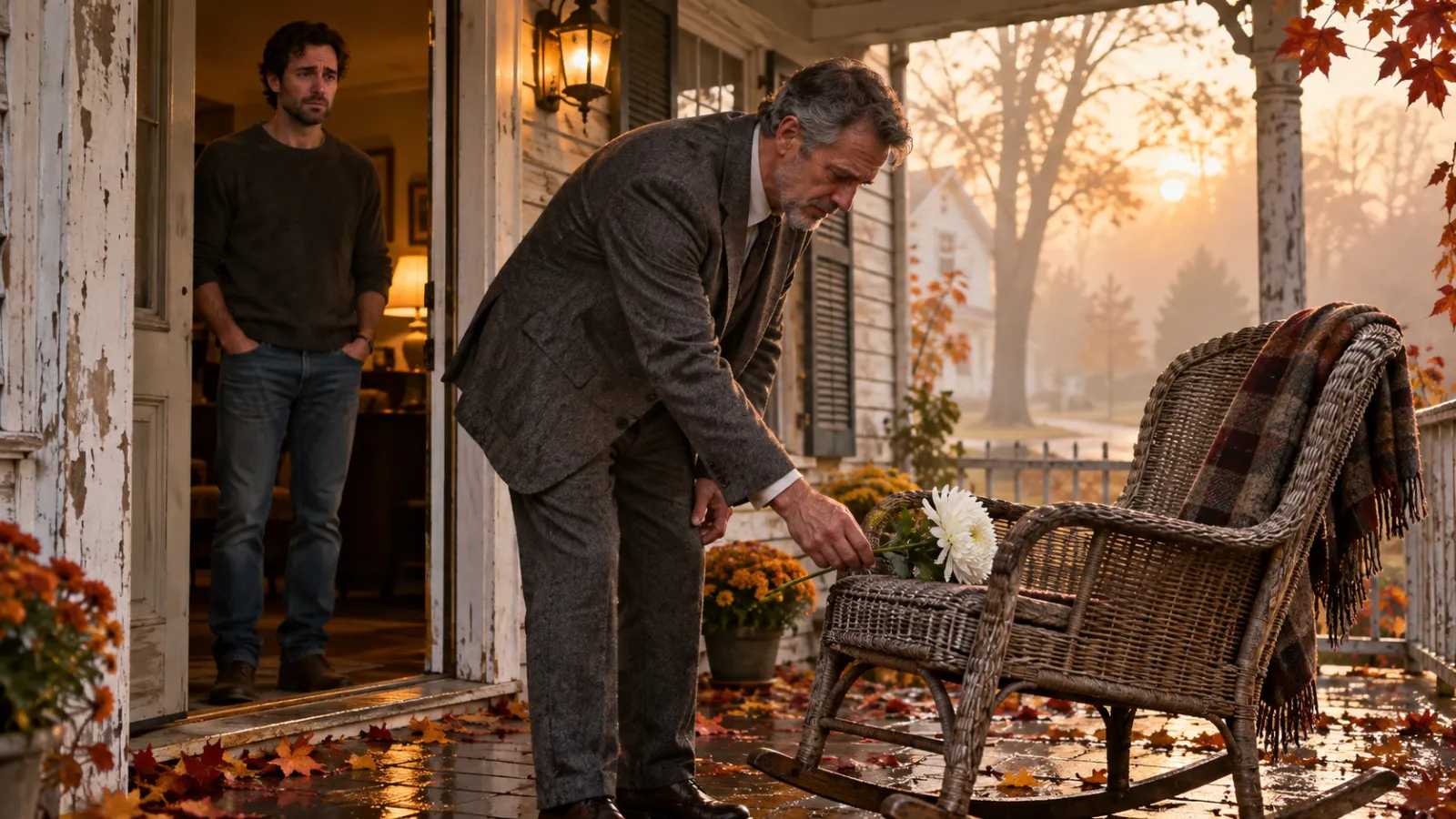
For an entire year after our mother's death, an unfamiliar man in a worn grey wool suit appeared on her Ohio porch every Monday at dawn with a single white chrysanthemum. On the fifty-second Monday, I finally caught him.
Chapter 1: The Fifty-Second Monday
For fifty-one consecutive Mondays, an older man in a faded grey wool suit walked up my late mother's driveway at seven in the morning, laid a fresh white chrysanthemum on her wicker chair, bowed his head, and vanished before I could reach the door.
The routine never varied by more than thirty seconds. My mother's house sat on Maple Street in Cedar Grove, an Ohio town where porches were built wide and neighbours noticed every stray dog. Mom had lived in that clapboard house for forty-two years, teaching piano and choir to three generations of local children.
When she died suddenly from a stroke last October, the front steps filled with casseroles, handwritten sympathy notes, and potted mums from the church choir. By November, the food containers had all been returned and the sympathy cards tucked into shoe boxes. Only the stranger kept coming.
Every Monday, precisely at seven, the iron latch on the driveway gate clicked shut. By the time I dropped my coffee mug, crossed the braided rug in the hallway, and pulled open the heavy oak door, the gravel path was empty. All that remained was the quiet sway of the porch swing, the damp morning fog curling off the lawn, and a single white chrysanthemum lying diagonally across the painted wicker cushion.
"It is not normal, Liam," my sister Sarah said, slamming her coffee mug onto the laminate kitchen counter.
Sarah had driven up from Columbus on Sunday afternoon, her small sedan packed with financial folders and estate tax forms. At thirty-three, two years younger than me, she dealt with grief through spreadsheets and brisk declarations. She stood by the kitchen window with her arms crossed over her fleece vest, staring down the driveway toward the road.
"Normal people send flowers once, maybe twice," Sarah continued, turning to look at me. "They sign a card. They tell you they were in her choir class of nineteen ninety-four. They do not conduct a fifty-one-week surveillance campaign on an elderly woman's house without saying a single word."
"He isn't surveilling anything," I answered, scraping toast crumbs into the sink. "He walks in, puts the stem down, and leaves. He never touches the doorknob. He never peeks into the living room windows."
"That makes it worse," she said, tapping her index finger against the table. "What if he had some unresolved grudge against Mom? What if she failed him in seventh grade and he has nursed a fixation for forty years? Or worse, what if he was involved in some private dispute she never told us about? People hide debts. People hide old arguments."
The thought felt ridiculous to anyone who had known Martha Vance. Mom's entire life was an open ledger of choir recitals, church bake sales, and Sunday potlucks. She kept her front door unlocked during summer afternoons so neighbourhood kids could run in for ice water while riding their bicycles. If she had an enemy in Cedar Grove, they had kept remarkably silent during her seventy-one years.
Yet the sheer persistence of the stranger was impossible to brush aside. Fifty-one weeks meant fifty-one separate mornings through freezing sleet, blinding January blizzards, muddy April rain, and humid August dawn. He had never missed a single Monday.
"Tomorrow is Monday fifty-two," Sarah pointed out, her voice dropping into the quiet of the kitchen. "It marks exactly one year since her burial at Oak Ridge. If he comes back tomorrow, Liam, I am calling Sheriff Miller. We have an uninvited trespasser approaching this porch every seven days. We need a cruiser parked by the mailbox."
"No," I said firmly. "We are not calling the sheriff."
Sarah stared at me as if I had lost my mind. "Why on earth not?"
"Because Sheriff Miller will roll up with flashing blue lights and scare him off down Route 4," I said, looking out toward the front porch. "If this man has walked up our driveway fifty-one times without breaking a twig or taking a single brick, there is a reason. A cruiser will only scare the truth away, and we will spend the rest of our lives wondering what he wanted."
"Then what do you propose we do?" she demanded. "Hide behind the lace curtains and wave politely?"
"I am going to sit on the porch," I said. "Before six in the morning. Before he reaches the front gate."
Sarah frowned, studying my face to see if I was bluffing. When she realised I meant every word, her expression softened from defensive irritation into genuine worry. She pulled a wooden chair out from the kitchen table and sat down across from me, resting her hands on the polished oak.
"You've spent this entire year trying to hold this house together," she murmured. "Teaching high school history five days a week, mowing Mom's lawn on Saturdays, dusting her sheet music every Sunday evening. You don't have to carry every question by yourself, Liam."
"I'm not carrying it by myself," I told her gently. "You're here. But tomorrow is fifty-two weeks. If he has something to say to Martha Vance, her family will be there to hear it."
Sarah looked down at the table, running her finger along a groove in the wood where our mother had dropped an iron skillet thirty years ago. Finally, she nodded.
"Set your alarm for five," she said quietly. "I'm staying up with you."
End of chapter 1