Mystery4 min read
The Stranger on Mom's Porch
For an entire year after our mother's death, an unfamiliar man in a worn grey wool suit appeared on her Ohio porch every Monday at dawn with a single white chrysanthemum. On the fifty-second Monday, I finally caught him.
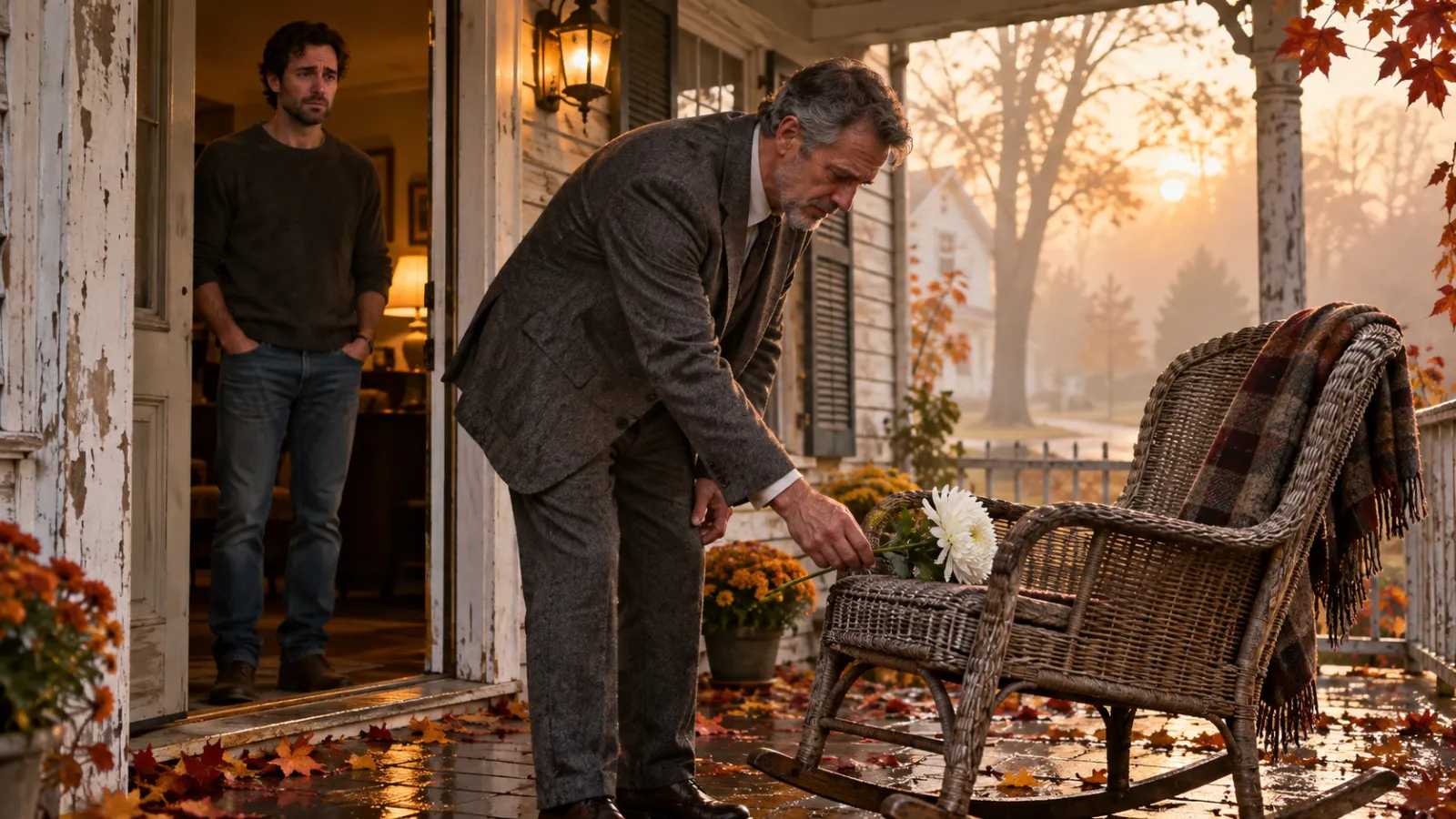
Chapter 2: White Chrysanthemums on Wicker
We stayed awake in the living room until past two in the morning, listening to the wind rattle the old storm windows.
The house still smelled faintly of lavender furniture wax and cinnamon tea, the scents our mother had worn like an invisible shawl. Her upright Baldwin piano stood against the interior wall, polished and silent. On the music desk rested an open score of Gabriel Fauré's choral requiem, her pencil markings still visible along the margins in neat blue cursive: softer here, hold the breath, let the choir carry the light.
"Do you remember the call from the emergency room?" Sarah asked, staring at the piano keys. She sat tucked into the corner of the floral sofa, her knees pulled up to her chest under a knitted afghan.
"Every second of it," I said.
It had happened on a bright Sunday in mid-October. Mom had been standing at the kitchen island peeling Honeycrisp apples for a skillet pie when the aneurysm ruptured without warning. By the time the ambulance reached the county hospital, her pupils were fixed and her brainwaves flat. Two young doctors in green scrubs had guided Sarah and me into a windowless consultation room with a box of tissues on the table.
They had spoken softly, explaining that while her brain had ceased functioning, the rest of her body remained remarkably healthy because she had never smoked, walked three miles every morning, and ate simple meals. Then the transplant coordinator stepped into the room with an official donor registry file.
Mom had signed the back of her Ohio driver's license when Sarah was three years old. She had told us both around the dinner table when we were teenagers that when her time came, she wanted nothing wasted in the ground that could keep another human being breathing. Sarah and I signed the consent forms with shaking hands at two in the morning, listening to the steady mechanical sigh of the ICU ventilator down the corridor.
By noon on Monday, the surgical teams had departed for medical centres across the state. Our mother was gone, leaving us with an empty house and an overwhelming silence.
"I brought something down from the hall closet," I told Sarah, standing up from my chair.
I walked to the hallway cupboard and retrieved a flat cardboard archive box. When I set it gently on the coffee table and lifted the lid, Sarah let out a soft gasp.
Inside lay fifty-one dried stems, arranged in neat parallel rows on sheets of parchment paper. The petals had faded from crisp snow to brittle parchment, but every bloom remained intact. Each stem had been sliced cleanly at a forty-five-degree angle with sharp bypass pruners, the mark of someone who understood flowers.
"You kept every single one?" Sarah whispered, reaching out a hesitant finger to touch the edge of the nearest blossom.
"I couldn't throw them into the compost bin," I said, sitting beside the table. "Not when somebody walked through winter gales and driving rain to leave them on her porch. Look at the cuts. Whoever brought these didn't snatch them from a park flowerbed or rip them out of a neighbour's yard in the dark. He bought them from a florist or cut them from his own greenhouse."
Sarah lifted one of the older stems from January. "Could Mom have had someone special before she met Dad? Or maybe a friend from her college choir days who lost touch and only heard about her passing months later?"
"Mom met Dad when she was nineteen at Ohio State," I answered. "And after Dad died twelve years ago, her idea of a wild Friday evening was watching public television documentaries and playing four-hand sonatas with Mrs. Gable from church. There were no secret romances."
"Then who is he, Liam?" Sarah asked, her voice cracking with fatigue. "Why her porch? Why Mondays? Why white chrysanthemums?"
"White chrysanthemums mean truth in traditional floriography," I said, recalling an afternoon spent searching library references. "In many cultures, they signify grief and profound respect. That is all I know for certain."
We sat in silence as the grandfather clock in the hallway chimed four times, then five.
By five-thirty, a steady October drizzle began tapping against the glass. The temperature outside had dropped into the low forties, wrapping Cedar Grove in a heavy, cold fog that clung to the damp lawns and obscured the streetlights.
I stood up, walked into the entryway, and pulled on my dark wax-canvas field coat over two wool sweaters. I laced my waterproof work boots and checked the porch view through the sidelight beside the front door.
"Stay behind the living room curtain," I told Sarah. "Keep the porch light off. If anything feels unsafe, lock the deadbolt and dial the emergency line immediately."
"I'll be right by the window," she promised, her fingers gripping her phone. "Be careful, Liam."
I eased the heavy front door open, stepping out into the chilly autumn air. The wet wooden floorboards were silent under my rubber soles. The rain fell in a fine mist, glistening against the white paint of Mom's empty wicker rocking chair.
I moved quietly to the far corner of the porch, slipping behind the wooden lattice trellis where thick honeysuckle vines formed a natural, dense screen. From this vantage point, I had an unobstructed view down the gravel driveway and out toward Maple Street, while remaining completely hidden in the damp morning gloom.
I checked my wristwatch in the faint grey light. It was six-fifteen.
End of chapter 2