Mystery4 min read
The Stranger on Mom's Porch
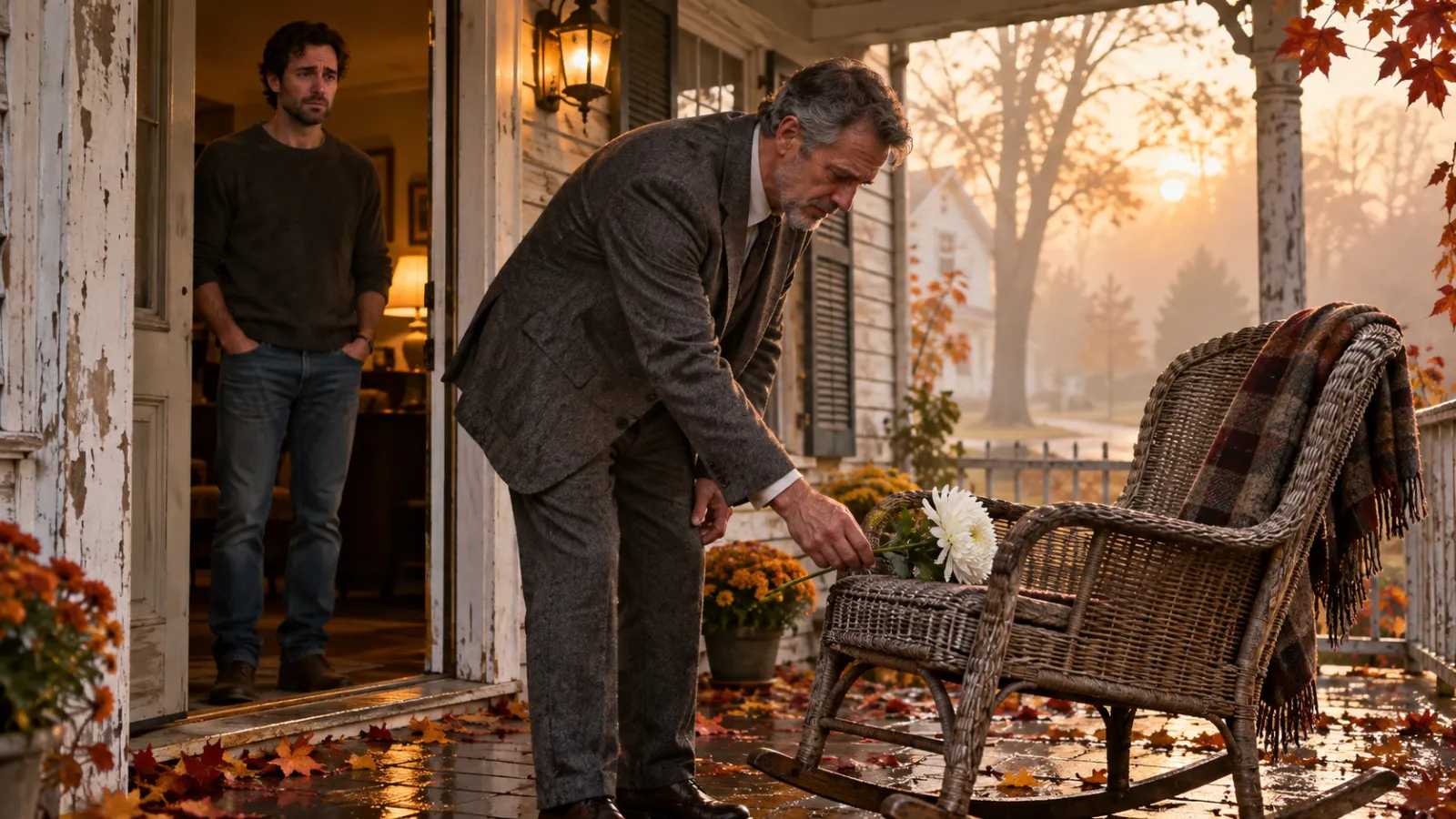
For an entire year after our mother's death, an unfamiliar man in a worn grey wool suit appeared on her Ohio porch every Monday at dawn with a single white chrysanthemum. On the fifty-second Monday, I finally caught him.
Chapter 5: A Second Rhythm
The words hung in the chilly morning air between us, as clear and sharp as cracked glass.
Sarah stood completely still beside the doorframe. The tension that had held her shoulders rigid all morning broke away, leaving her small and fragile in her fleece vest. Her right hand loosened, and her mobile phone slipped an inch before she caught it against her leg. She stared at Thomas Albright's chest, her mouth parting in silent wonder, before tears began streaming down her cheeks.
I looked at the documents in my hands, then up at the man standing before me.
He was fifty-eight years old, breathing the cold Ohio fog into lungs that worked without a rattle. His cheeks had color. His hands, though calloused from decades of handling parcel sacks, were warm and steady. He was alive because thirty years ago, our mother had signed a paper at the bureau of motor vehicles, and because twelve months ago, Sarah and I had signed consent forms under the fluorescent lights of an ICU corridor.
"Why didn't you knock, Mr. Albright?" I asked, my voice barely louder than a whisper against the tapping rain. "Why didn't you send a card through the hospital coordinator? Why walk up our driveway fifty-two times in the dark?"
Thomas pulled his jacket a little closer against the damp wind, looking down at his polished shoes.
"The transplant guidelines are very strict about contact," Thomas explained softly. "Both parties must agree in writing, and the process takes months of reviews. But more than that, I was afraid of intruding on your grief. I know that my miracle was born directly out of your family's tragedy."
He looked up, meeting my eyes with painful honesty.
"Every single morning that I wake up beside my wife, every Sunday dinner I share with my grandchildren, I know someone had to die for me to have that day. I knew Martha Vance had children. I knew you were walking through this house trying to learn how to live without her voice. I didn't want to force you to look at the man who was walking around with what she lost."
"So you brought flowers instead," Sarah said, her voice shaking as she wiped her eyes with the sleeve of her sweater.
"When the hospital discharged me on a Monday morning late last October," Thomas said, "I walked out through the automatic doors into the autumn chill. I could feel a strong, steady rhythm in my ribs that hadn't been there in five years. I made a solemn promise right there in the clinic parking lot. I promised that for every week of my first year of life, I would bring a white flower to her doorstep. Not to demand an audience, not to ask for forgiveness, but simply to say thank you to the ground she walked on."
He gestured toward the wicker rocking chair where the fresh chrysanthemum rested on the cushion.
"Today is week fifty-two," he continued. "My first full year of borrowed life is complete. I was never going to come back after today. I was going to leave this final blossom and let your family have your peace."
Sarah let out a choked sob, covering her face with both hands.
I took a slow breath, looking from the white petals on the chair to the man in the threadbare wool suit. For twelve months, Sarah and I had treated our mother's death as an ending. We had preserved her house like a museum, kept her piano shut, and guarded her memory against the world. Yet all along, our mother had not ended. Part of her was standing right here on the wet cedar planks of her front porch.
Thomas reached into his outer jacket pocket.
"I brought something else with me this morning," he said quietly. "My transplant cardiologist gave it to me during my first month of rehab so I could monitor my morning heart rate and listen for valve murmurs at home."
He withdrew a stainless-steel acoustic stethoscope with flexible black rubber tubing. He held it out toward me across the porch, the polished metal disc catching the grey daylight.
"If you want to hear her," Thomas whispered, his voice trembling with reverent tenderness, "she is right here. She has never missed a single beat."
My throat tightened until I could barely breathe. I stepped across the damp floorboards until I stood directly in front of him.
I took the rubber earpieces with trembling fingers and placed them into my ears. The sound of the morning rain instantly muted into a hollow, distant roar.
Thomas unbuttoned the remaining horn button of his charcoal jacket and pulled aside the lapel of his crisp white shirt, exposing the skin directly over his sternum. A faint surgical scar ran vertically down his chest, pale and healed.
I reached out with my right hand and pressed the cold metal diaphragm against his chest, right over his left ventricle.
Through the black rubber tubes, the sound rushed into my ears.
Lub-dub. Lub-dub. Lub-dub.
It was not faint. It was not struggling. It was strong, steady, resonant, and vibrant, beating with an unmistakable, magnificent cadence.
End of chapter 5