Mystery4 min read
The Stranger on Mom's Porch
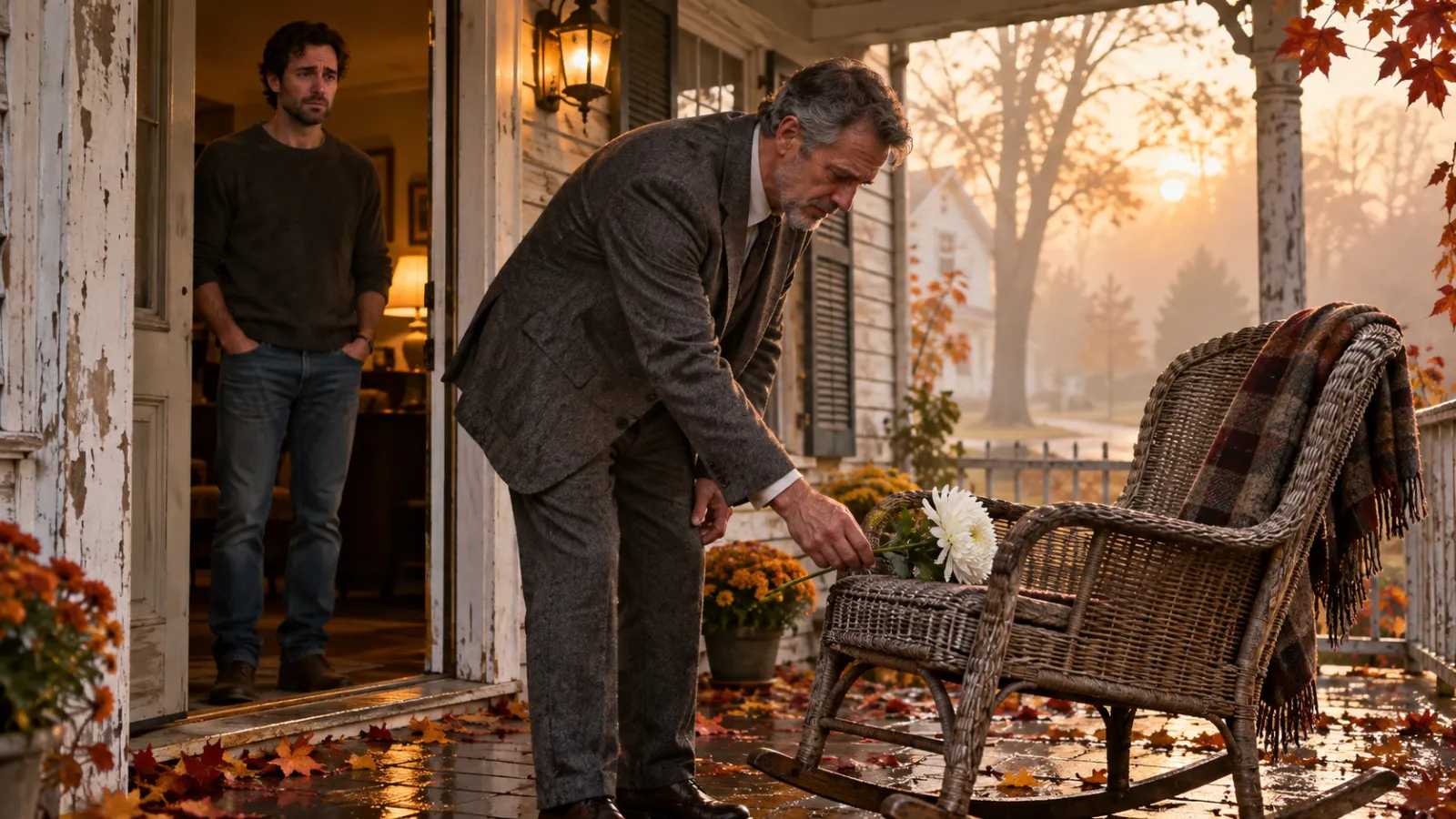
For an entire year after our mother's death, an unfamiliar man in a worn grey wool suit appeared on her Ohio porch every Monday at dawn with a single white chrysanthemum. On the fifty-second Monday, I finally caught him.
Chapter 4: The Envelope in the Overcoat
Sarah stepped onto the porch with her chin raised and her phone gripped tightly in her right hand, her thumb hovering over the emergency screen.
"Step away from that chair," she commanded, her voice cutting through the damp morning air with the authority of an auditor discovering fraud. "Who are you? Why have you been coming onto our property every single week for an entire year?"
The man did not flinch, nor did he argue. Slowly, he lifted both hands to shoulder height, palms open and empty, showing us he held nothing dangerous. Rain dripped from the brim of his collar, running down the rough charcoal wool of his lapel.
"My name is Thomas Albright," he said. His voice was deep, soft, and slightly raspy, like dry leaves scraping across pavement. "I am fifty-eight years old. I live forty miles north of here, in Akron."
"Akron?" Sarah repeated, her eyes narrowing with suspicion. "What is a man from Akron doing on Maple Street at seven in the morning? Did our mother owe you money? Was there some unpaid contractor bill or an old debt from the school board? Why sneak onto our porch like a thief?"
Thomas lowered his hands slowly, resting them against his sides. There was no resentment in his posture, only an immense, sorrowful patience.
"Your mother owed me nothing, ma'am," Thomas replied quietly. "Martha Vance did not have a single debt in this world. In fact, every debt belongs entirely to me."
"Did you know her?" I asked, watching the gentle steadiness in his eyes. "Were you a student of hers? A colleague from the county music festivals?"
"I never had the honour of meeting her while she lived," Thomas said, shaking his head. "We never exchanged a handshake, a telephone call, or a single word of conversation. I didn't even know her name until three months ago, when the registry forwarded my initial correspondence."
"Then why are you here?" Sarah demanded, her voice rising with exasperation. "Fifty-two Mondays in a row! You've walked up our gravel path through snowstorms and sleet just to drop flowers on an empty wicker chair! If you didn't know her, that makes you a trespasser!"
"Sarah, wait," I said, raising my hand to quiet her.
Something about the man's demeanor defied every category of menace. An intruder watched through windows; a trespasser looked for valuables or probed door locks. Thomas Albright stood before us with his shoulders bowed, his dark eyes brimming with unshed tears, looking at Martha's empty rocking chair as though it were the most sacred altar in North America.
"Mr. Albright," I said, keeping my tone measured. "Tell us why you came."
Thomas looked at me, then at Sarah. His breath formed small, pale clouds in the cold drizzle.
"May I reach inside my coat?" he asked politely. "I have papers. I brought them this morning because I knew today was week fifty-two. I knew there was a chance one of you might be waiting."
I nodded slowly, keeping my eyes fixed on his hands. "Go ahead."
Moving with deliberate care, Thomas unbuttoned the top two horn buttons of his charcoal wool jacket. He reached into the deep interior breast pocket and withdrew a thick, moisture-resistant manila envelope sealed with a plastic clasp. Across the top left corner, embossed in crisp navy blue lettering, was the official crest of the Cleveland Clinic Transplant Institute, alongside the green emblem of Lifebanc, the Northeast Ohio organ procurement network.
Sarah stopped talking. The sharp anger in her stance evaporated, replaced by sudden bewilderment.
With trembling fingers, Thomas opened the envelope flap. He pulled out a laminated white wallet card and two official medical summary letters printed on hospital letterhead. He stepped forward and handed the documents to me across the porch railing.
I looked down at the top page. The clinical letterhead listed surgical procedure codes, donor compatibility indices, and recipient recovery milestones. Across the centre of the page, in dark block print, was the formal certification from the regional transplant committee.
"I worked thirty years as a mail dispatcher for the regional postal depot," Thomas said, his voice trembling slightly. "Five years ago, a viral infection attacked my heart muscle. Dilated cardiomyopathy, the specialists called it. By last October, my ejection fraction had dropped below twelve percent. I was confined to bed in the cardiac intensive care ward in Cleveland, wired to intravenous drips, waiting on the emergency list with less than forty-eight hours left to live."
He paused, swallowing hard against a dry throat. He looked directly at the white chrysanthemum resting on the wicker cushion.
"On the night of October thirteenth of last year, my coordinator came into my room and told me a donor had become available down in Summit County. A seventy-one-year-old retired music teacher whose children had honoured her lifelong donor registration. They wheeled me into surgery at midnight."
Thomas pressed his right hand firmly against the centre of his wool jacket, his eyes shining with profound emotion.
"Your mother gave me her heart," he whispered. "It has been beating inside my chest for three hundred and sixty-five days."
End of chapter 4