Mystery4 min read
The Stranger on Mom's Porch
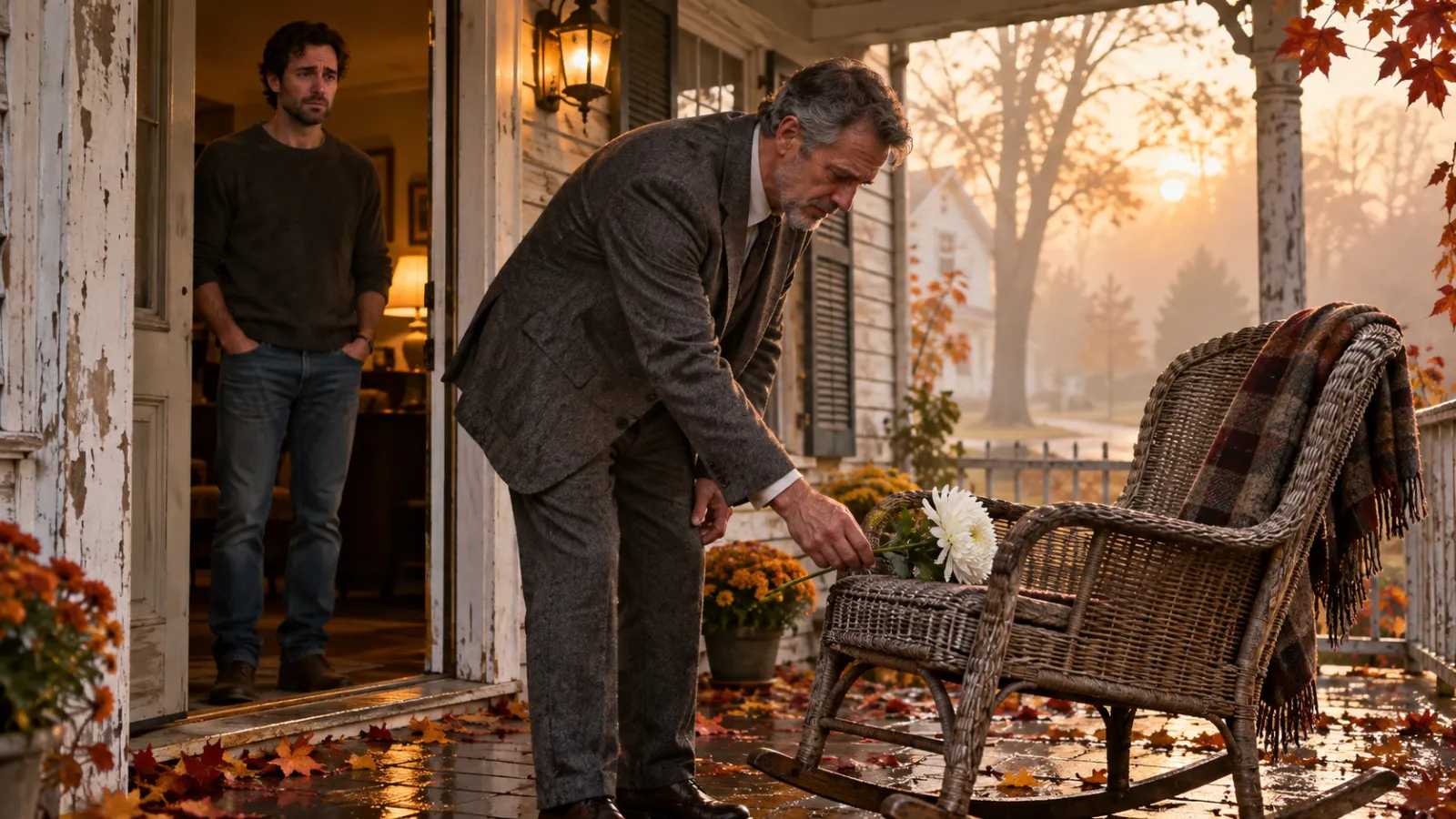
For an entire year after our mother's death, an unfamiliar man in a worn grey wool suit appeared on her Ohio porch every Monday at dawn with a single white chrysanthemum. On the fifty-second Monday, I finally caught him.
Chapter 6: Still Beating in Ohio
For forty years, our mother had lived by the discipline of rhythm.
Whenever a nervous middle school student stumbled through a piano sonata or rushed ahead during choir rehearsal, Mom would tap her wooden metronome against the Baldwin music desk. One, two, three, four. Keep the tempo steady, she would tell them with a warm smile. Music does not rush, and it does not panic. It only carries the song forward.
Now, listening through the rubber tubing of the stethoscope, that exact tempo filled my ears. Strong, steady, unhurried, and full of life. It was the rhythm that had carried Sarah and me through childhood fevers, broken bones, college graduations, and our father's funeral. It was the heartbeat of Martha Vance, pumping living blood through the veins of a living man.
Tears blurred my sight as I carefully eased the earpieces from my ears. I turned to look at my sister.
"Sarah," I said softly, holding out the stethoscope. "Listen."
Sarah took the earpieces with trembling hands, fitting them into her ears. She stepped across the wet floorboards, her sneakers squeaking against the painted cedar, until she stood directly before Thomas Albright.
With careful reverence, she placed the cold metal chestpiece against the open lapel of his shirt.
The moment the sound reached her ears, Sarah let out a sharp cry. Her knees buckled slightly, but Thomas reached out his steady hands and gently caught her by the forearms, supporting her weight. She closed her eyes as the steady lub-dub filled the silence of her mind.
Then Sarah let the stethoscope drop against her chest, threw her arms around Thomas Albright's neck, and buried her face into the damp charcoal wool of his coat.
She wept with a deep, liberating sorrow that washed away twelve months of bitterness, suspicion, and unresolved grief. Thomas held her gently, his own chin trembling as tears rolled down his weathered cheeks into his grey collar.
"Thank you," Thomas whispered into her hair, his voice breaking with gratitude. "Thank you for letting me live. Thank you for giving me my daughters and my mornings."
I stepped forward and placed one hand on Sarah's shaking shoulder and my other hand on Thomas's arm. The autumn drizzle had softened into a gentle, misting haze that drifted through the honeysuckle vines.
"Come inside out of the rain, Thomas," I said. "Please. Let us make you a cup of tea."
He hesitated for a second, then nodded humbly. He wiped his face with a clean cotton handkerchief from his pocket, slipped off his muddy oxford shoes on the porch mat, and stepped across the threshold in his stocking feet.
Inside, the house felt warm and welcoming. I turned on the kettle and brewed a pot of hot black tea with cinnamon sticks, pouring it into Mom's favourite handmade ceramic mugs. We sat together around the oak kitchen table where Sarah and I had argued only twelve hours earlier.
Thomas looked around the parlour, his eyes resting on the upright Baldwin piano and the framed photographs along the hallway wall. He studied the picture of our mother directing the middle school spring choir, her silver hair catching the stage lights as she smiled with open arms.
He told us about his life in Akron. He spoke about his thirty years sorting regional mail, his two grown daughters, and his four-year-old grandson Henry. He explained that Henry was only three when his heart began failing, and doctors had warned him he would never see the boy enter kindergarten.
"Because of your mother," Thomas said, his voice thick with emotion, "I taught Henry how to ride a tricycle this summer. And I grew those chrysanthemums in two raised garden beds behind my garage, covering them with glass frames when the frost came in November so they would never wilt before Monday morning."
He set his empty teacup down on the saucer and straightened his shoulders.
"My fifty-two weeks are finished," he said softly. "I promised myself I would not become a burden on your family after today. I will not come back to your porch."
Sarah reached across the table and placed her hand firmly over his calloused fingers.
"You are not a burden, Thomas," Sarah said, her voice clear and resolute. "You are carrying our mother's heart. You are never allowed to sneak up our driveway at dawn again like an unwelcome stranger. But you are coming through our front door next month for Thanksgiving dinner."
A bright, disbelieving smile broke across Thomas's face, transforming his weathered features with pure joy.
"I would be honoured," he said. "More honoured than words can say."
By eight-thirty, the rain clouds parted over Cedar Grove. Pale autumn sunlight broke through the mist, illuminating the wet asphalt of Maple Street and turning the fallen maple leaves to blazing gold.
Sarah and I walked Thomas out to the front steps to say our goodbyes.
As his car turned out of the gravel driveway and headed north toward Route 4, Sarah slipped her arm through mine. We stood side by side on the wet porch, looking at Mom's white wicker rocking chair.
Resting on the green cushion was the fifty-second white chrysanthemum, its pristine petals glistening with fresh raindrops and glowing in the morning sun.
Our mother was not gone. Her music had not ended.
Right here in Ohio, her heart was still beating.
The end