Revenge5 min read
The Thirty-Day Notice
The notice to vacate was taped to my door on the morning of my husband's funeral. The apartment came with his job as the building's super, and he had been dead nine days. What I did not know was what he had been keeping in the boiler room for eleven years.
Chapter 1: The Notice
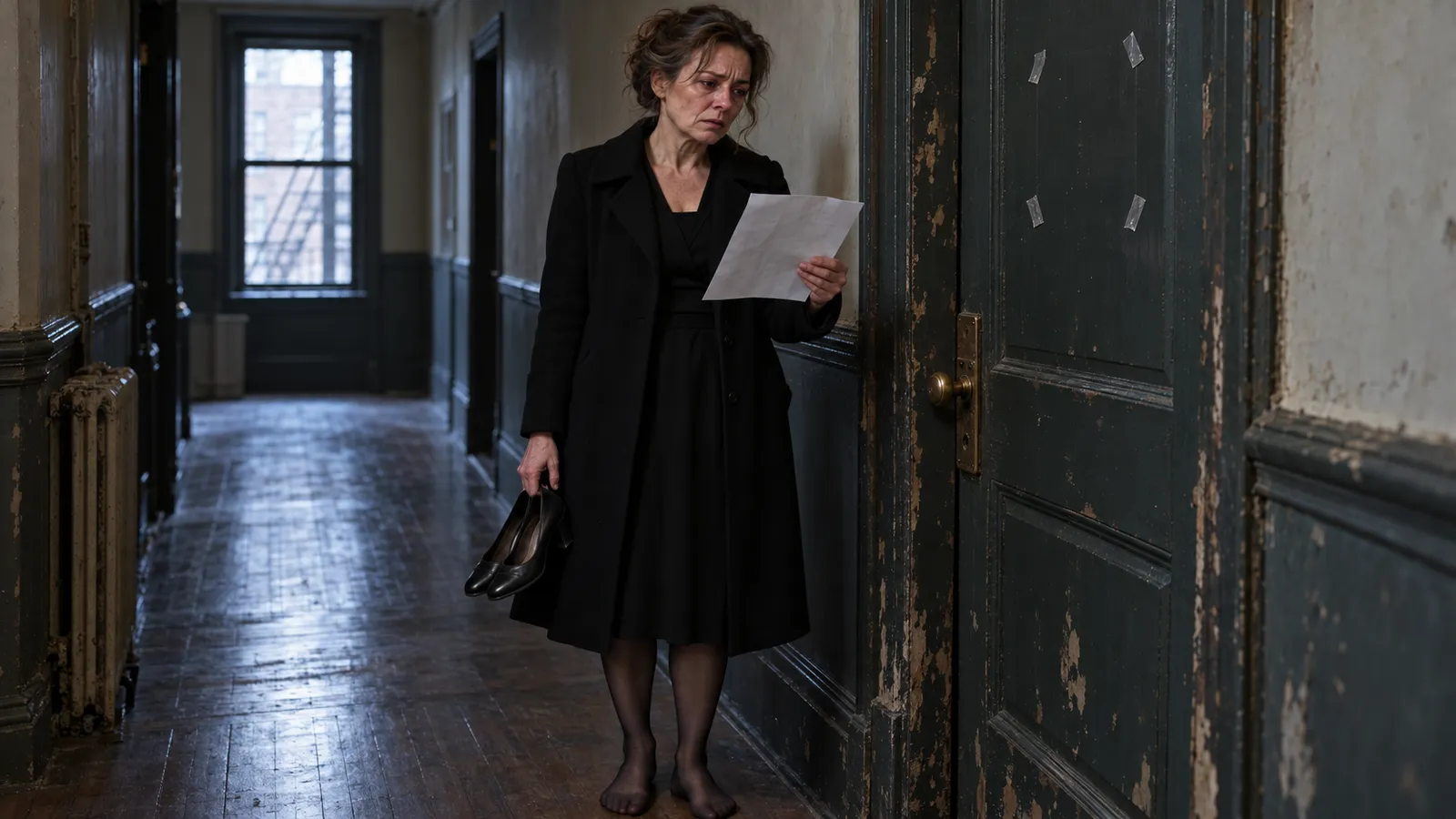
The notice to vacate was taped to my door on the morning of my husband's funeral. Thirty days, it said, in a polite font, under the name of the man who had sent the flowers.
I read it twice standing in the hallway in my stocking feet, holding my shoes.
Pursuant to the termination of employment of Emmett Kincaid, occupancy of Unit 1A is terminated. Please vacate on or before November 14.
Four pieces of tape, one at each corner. Somebody had pressed them down flat with a thumb.
I took the paper inside and put it on the kitchen table and wrote the date in the top right corner, because that is what I do with paper. October 15. Then I put my shoes on and went to bury Emmett.
The funeral home on Pell Avenue had a room that held sixty people and a parking lot that held nine cars. Fifty-one people came. I counted. I have counted things since I was twenty-four years old and sitting at a desk in the billing office at St. Clement's, and I did not stop when they laid me off at fifty-four, and I did not stop that Saturday.
Nineteen of them were from the building. That surprised me. Emmett had been the superintendent at 1140 Faraday Street for eleven years, and in eleven years I had learned maybe six of their names.
Teddy came from the hardware store in his good jacket, which was a windbreaker. He held both my hands in both of his and said my name twice and then said, "He wasn't sleeping."
"Since when?"
"Since about a year." Teddy looked at the carpet. "He'd come in at seven when I opened. Buy nothing. Stand by the paint."
I did not know what to do with that, so I put it somewhere to deal with later, the way you do with an envelope you are not ready to open.
Antonia Garrison from 3C sat in the back row with her coat on. Eighty-one years old and she had walked. She did not come up to me. When I looked over during the second hymn she was looking straight ahead with her chin up like someone waiting to be called into an office.
Sheldon Lowell came at eleven forty and stayed twenty minutes.
He owns the building. He owns four of them. He is fifty-two and he wears the kind of coat that does not wrinkle, and when he took my hand he put his other hand on top of it.
"Ruthanne," he said. "There is no version of this that isn't terrible."
The flowers behind him were his. White, expensive, a card with his name on it in fountain pen, the ink gone slightly thick where he had pressed. His father's pen, he'd told Emmett once. Blotted when he wrote fast.
"Thank you for the lilies," I said.
"And the sandwiches are handled. Don't let anybody charge you for the sandwiches."
"Thank you."
He looked past my shoulder at the room for a second. Then he said, "Do you have his keys?"
I thought I had misheard him.
"His keys?"
"The building set. There's no rush." He smiled, apologetic, a man embarrassed by his own practicality. "It's just that fourteen units and one copy of every key. I have a liability conversation twice a year about it."
"They're in the dish by the door."
"Whenever you're ready." He let go of my hand. He got as far as the doorway, and then he turned around and came back three steps.
"Ruthanne. The full ring, when you look. Not just the apartment ones."
Then he asked how I was eating, and told me to call his office if I needed anything at all, and left.
Fifty-one people, nineteen from the building, four pieces of tape, thirty days.
I sat at the kitchen table that night with the notice and a legal pad and the lamp on and I did the only thing I know how to do when I am frightened, which is to turn the fear into columns.
Savings: four thousand, one hundred and six dollars. The burial had taken two thousand of it.
Income: my social security was two years away. February taxes for eleven regular clients, which is a thousand dollars in a good year and comes in February.
Rent for a one-bedroom six blocks north, over the laundromat on Dunne: twelve hundred a month, plus first and last and a deposit.
Rent I had paid for apartment 1A in eleven years: nothing. That was the arrangement. The apartment came with the job. Emmett got a small check and a free unit, and for eleven years he was never off duty, because a man who lives in the building is always in the building. At two in the morning when the boiler locked out, he was the one who went down.
There had never been a lease. I knew that before I looked, and then I looked anyway. The folder in the file box held a letter from 1987 letterhead, signed by Lowell's father, offering the superintendent's unit as part of compensation, and that was all. Eleven years and the only paper was a letter from a dead man about an apartment.
At eleven o'clock I went down the hall for the dish by the door and brought the whole ring back to the table.
There were twenty-two keys on it. I know because I counted them, and then I laid them out in a line on the legal pad and labeled what I could.
Fourteen apartment keys, brass, each one scratched with a unit number. The front door. The vestibule. The mail panel. The roof hatch, square-headed. A padlock key for the trash enclosure. Two I could not place at all, and then the last one.
The last one was flat and heavy and older than the others, and somebody had stamped four letters into the shoulder of it with a metal die, one letter at a time, slightly crooked.
BOIL.
Emmett's block capitals were on the paper tag looped through it, the way he wrote everything, in the same hand that had filled out eleven years of work orders I had never once read.
I turned the key over twice.
In eleven years I had never been inside the boiler room.
End of chapter 1