Revenge6 min read
The Thirty-Day Notice
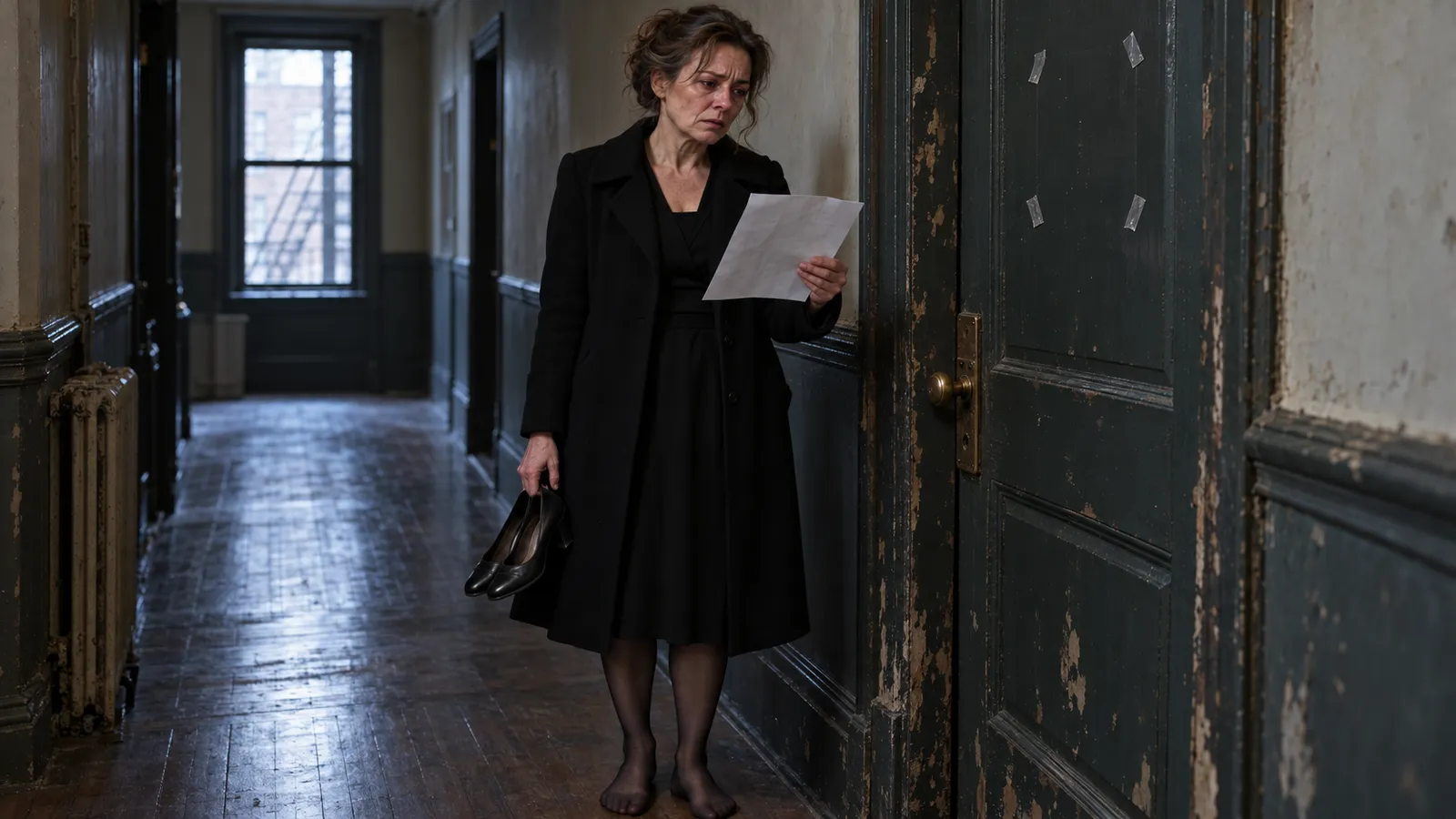
The notice to vacate was taped to my door on the morning of my husband's funeral. The apartment came with his job as the building's super, and he had been dead nine days. What I did not know was what he had been keeping in the boiler room for eleven years.
Chapter 5: Hearing Room 2
Hearing room 2 was on the fourth floor of the housing office and it had a folding table, eleven chairs, and a water pitcher with a paper napkin over the top of it.
Five weeks and three days after the funeral. A Tuesday. Everything that mattered to me by then happened at folding tables.
We came up in the elevator together: Priya with a banker's box, Jo in a blazer she had bought on Sunday, Paulette, Marisol with her coat still buttoned, and Antonia Garrison in a hat.
She had taken the bus. She had been up since five. She had her own copy of her own page in her purse, in a freezer bag, because of the rain.
Sheldon Lowell came alone with a lawyer and sat four feet from me and said, "Ruthanne," quietly, and I said, "Sheldon," and that was the entire conversation.
The hearing officer was a tired woman with reading glasses pushed up into her hair who said at the start that she had forty minutes and three other matters and would appreciate it if nobody made speeches. Nobody made speeches. That was, I think now, the whole reason it worked.
The thirty-one exhibits went in by number. She read them. She stopped at the handrail one, #0912, and read it out loud, the whole line, including instructed 11/20 by S. Lowell: defer to spring budget, and then she looked up over her glasses at the basement stair handrail's owner and said, "Is the anchor repaired?"
"I'd have to check with my—"
"Is it repaired."
"No."
She wrote something down. There is no sound in the world like a woman writing something down.
Then Priya put the brown ledger on the table and asked him whose handwriting it was.
I watched him look at it. I had wondered for five weeks whether he would lie, and he did not, and the not-lying was worse, because it meant he had never once thought of it as something to be ashamed of.
"That's Emmett's," he said. "Emmett Kincaid. He was my superintendent for eleven years. He was a friend of mine."
"And the notation on the inside cover?"
"That's his writing too."
"Read it, please."
"'Per S.L., four-fourteen. Office book stays clean. Keep this one here.'"
"Who is S.L.?"
"I am."
"And the entries?"
And then he explained it, line by line, for eleven minutes, in the reasonable voice of a man describing a reasonable arrangement: four units, cash, no leases, a rent he had held flat for nineteen years in Mrs. Garrison's case, which he pointed out twice, and the building lost money on paper, and his father's handshakes had all been like this, and he had inherited them along with the boiler.
The hearing officer asked him if he had provided receipts. He said no. She asked if the units appeared in the office ledger. He said they did not.
She asked why, and he said, "Because that's how it had always been done," which was the truest thing anybody said in that room.
Then she turned to me and asked me to confirm, for the record, that the handwriting in the exhibit was my late husband's.
"It is," I said. "He kept that book for nine years. He started keeping copies of it two years in."
"Do you know why he started?"
"No, ma'am." My hands were flat on the table the way Antonia's had been on her oilcloth. "He never told me about any of it. I only know what the dates say."
And that is all I will ever have, and I said it out loud in a room with a stenographer in it, and that is as close as I am going to get to an answer.
Antonia spoke last and spoke for ninety seconds. She said her unit number, and the year she moved in, and the amount, and that she had never had a piece of paper in nineteen years, and then she picked up her purse to show she was done, and on her way up out of the chair she said:
"I never minded the rent. I minded that if I died in there, there'd be no proof I'd ever been."
The hearing officer took her glasses out of her hair.
In the recess, out in the hallway by the water fountain, Sheldon Lowell asked me for two minutes.
"Ninety days," he said. "Through the end of January, not the fourteenth of November. And I'll pay your moving van."
"Why."
"Because this is going to end with a consent order either way. My lawyer has already told me what it's going to cost, and he's told me I look worse fighting a widow than I do fixing a handrail." He put his hands in his pockets. He looked, for the first time since the funeral home, like a man who had not slept. "Ruthanne, I want you to understand something. I never told him to do anything he didn't understand. He could have said no to me. He said no to me about the roof, once, for three years."
"I know. It's in the book."
"Then you know what kind of a friend he was."
"I know what kind of an employee he was." I took the ninety days. I am not going to pretend I was noble about it. I had four thousand dollars and a laundry basket full of evidence and sixty extra days is sixty days.
The order came out eleven days later, and it was not a verdict, and nobody banged a gavel.
Thirty-one items with repair deadlines, the first six in thirty days, the handrail and the north landing tread in fourteen. An inspection date that could not be rescheduled. A written lease for Antonia Garrison at six hundred and ten dollars, two years, her name spelled correctly, signed and dated and a copy in her freezer bag. Written leases offered to 2A, 1B and 4C. The 1140 Faraday Street Tenants Association, recognized, with Jo as secretary, because she was the only one of us who could type.
My apartment was not in it. There was never going to be a line in that order that gave me back my kitchen or my husband.
The eighteen hundred dollars in the envelope marked ROOF, IF HE WON'T went to the association, in an account with Jo's name and Paulette's on it and not mine. The roof is item nineteen on the order, due in the spring. I will not be living under it.
I packed 1A over the last week of January. The new man started the first of February. He was twenty-nine and his name was going on the door by Friday.
The last thing I did was go down the fourteen steps with his key.
The bright brass lock had been changed back, or changed again; by then my key worked, and I have never asked why, and I have decided not to.
I put the work-order books back in the third drawer in order, 1 through 11. I put the brown ledger with them, because it belongs to that building and not to me.
Then I sat down in the folding chair with the flat cushion and took out work order #1142, the one that stops after four words, and I finished it in my own handwriting, which does not look anything like his.
#1142. 10/06. BOILER. PRESSURE — NEEDLE AT 19. BLED AND RESET 1/30 UNDER CITY ORDER.
And under his initials I wrote mine. R.K. And the date, in the top right corner.
I taped the BOIL key to the inside of the drawer where he kept his spares, where the next person would find it if they thought to look, and I pulled the steel door shut behind me.
On my way out through the vestibule I stopped at the panel and read the strip of tape on 1A, and it had somebody else's name on it already, in somebody else's writing, which is how it should be.
The end