Revenge5 min read
The Thirty-Day Notice
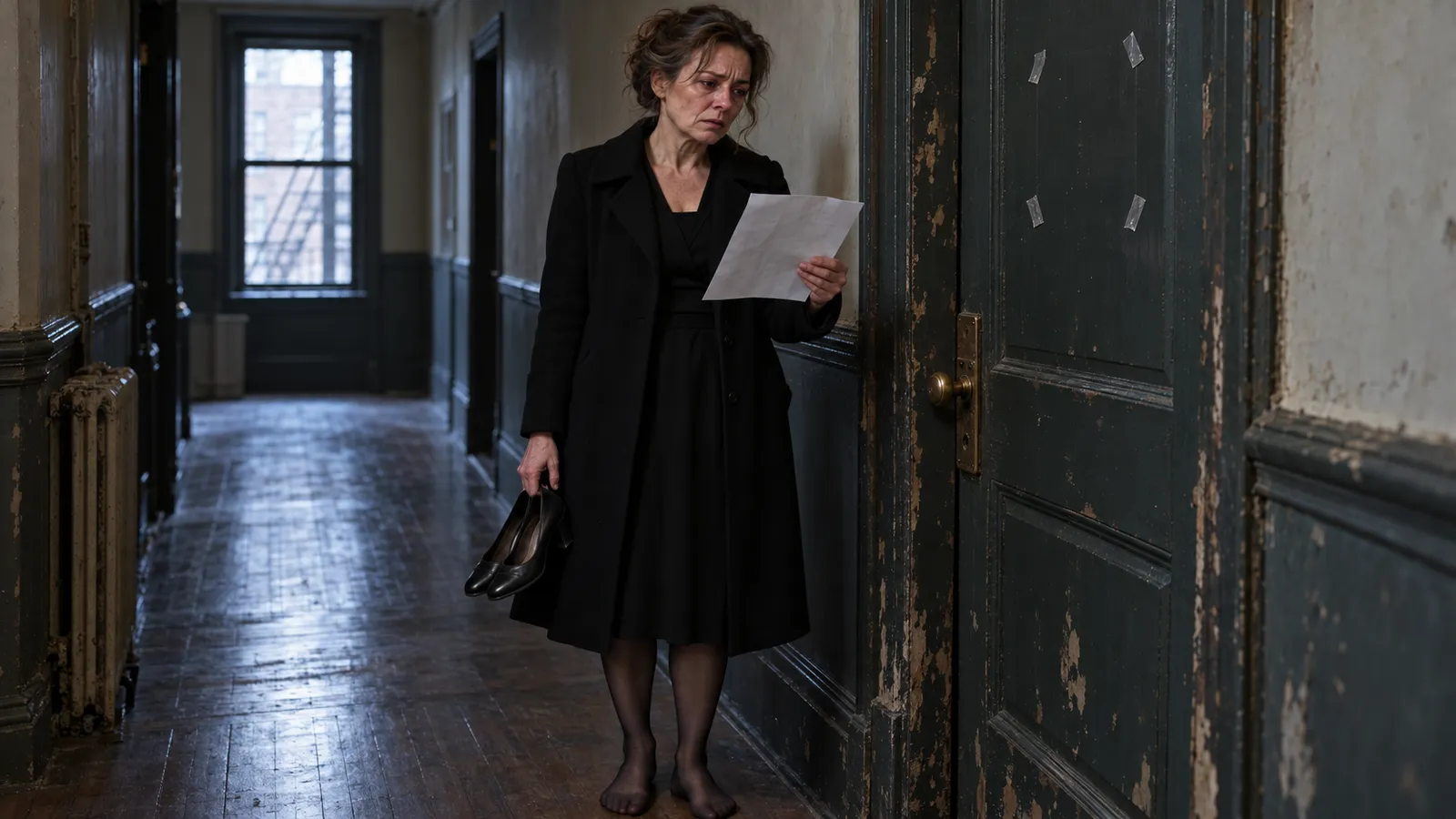
The notice to vacate was taped to my door on the morning of my husband's funeral. The apartment came with his job as the building's super, and he had been dead nine days. What I did not know was what he had been keeping in the boiler room for eleven years.
Chapter 4: What You Can Actually File
The free tenant clinic on Wexler ran out of a storefront that had been a travel agency and still had a poster of Lisbon in the window. You took a number from a dispenser by the door. Mine was 31, which I noted, because by then every number in my life had started to look like it meant something.
I waited an hour and ten minutes with the laundry basket on my knees. Jo came on her break at eleven and sat next to me eating a sandwich and said nothing, which I appreciated.
Priya was maybe thirty-five and had a folding table and a legal pad and a stack of other people's problems four inches high. She listened to me for nine minutes without writing anything. Then I put the work-order books on the table and she pulled her chair in.
She read for a long time. She turned pages back and forward and compared two of them against each other and made a small sound.
"Okay," she said. "Before we go any further, I'm going to tell you what this isn't, because people come in here with a box and I let them talk for an hour and then I break their heart, and I'd rather break it in the first ten minutes."
"Go ahead."
"Nobody is getting arrested. This isn't a fraud case and I'm not a prosecutor and the office that handles that will not look at a shoebox from a widow." She tapped the ledger. "You don't get money. There's no payout at the end of this. Nobody is going to find you a reason to stay in 1A either — the apartment was tied to his employment and there's no lease, and I have read this letter from 1987 twice and it will not save you. You should assume you are moving."
Jo stopped chewing.
"That's the whole left-hand column," Priya said. "Do you want the right-hand column?"
"Yes."
"The right-hand column is good." She laid her hand flat on the stack. "This is thirty-one dated maintenance refusals, with the instructing party named, written contemporaneously by the person who was told. I have been doing this for nine years and I have never once had that. Usually I have a tenant who says I called about it in the spring and a landlord who says she never called. You have a book."
She started making a list on her legal pad, and I turned it around so I could read it upside down, which I can do, from twenty-two years of handing forms across a counter.
"One. You file to be recognized as a tenants' association. Nine of fourteen is more than enough. That matters less than people think legally and more than people think practically, because after that, he is answering a group instead of answering Mrs. Garrison.
"Two. Code complaint. Every one of these thirty-one goes in as a numbered exhibit with its date. The stair tread, the handrail, the sash cords, the window your husband screwed shut in your own bedroom. They send an inspector. That gets you an inspection he cannot reschedule, and I notice from this folder that rescheduling is something he is practiced at.
"Three." She put her pen down on the brown ledger. "This one. Mrs. Garrison has no lease, no receipts and nineteen years. This is the only document in the world that proves her tenancy. It's in your husband's handwriting and it is dated and it is consistent. With that book she is a long-term tenant with rights. Without it she is a woman in an apartment with nothing."
Nobody said anything for a second. The Lisbon poster had a corner curling off the glass.
"There's a cost," Priya said. "I want you to look straight at it. If I attach that ledger, then the record will show that for nine years the superintendent of that building collected and recorded off-book cash rent at the owner's direction. The owner is going to be asked about it. So is your husband's name. He's not here to explain himself and I can't protect a dead man's reputation, and anyone who reads the file is going to see a man who did it for two years before he ever started keeping a copy."
Jo looked at me.
I sat there in a former travel agency with a number 31 in my coat pocket and I thought about the folding chair with the flat cushion, and the card on the boiler that said call me first, and a man standing by the paint at seven in the morning in Teddy's store buying nothing for a year.
"Attach it," I said. "Don't redact his initials."
"You're sure."
"He wrote down who told him no. He could have stopped at that and been a good man in a book nobody read." I pushed the ledger across the table. "He kept the copies so somebody could do this. He just didn't get to be the one."
Priya made a note. "Then that's what we file."
We filed on a Wednesday. It took four hours, most of it waiting, and the clerk's window was number 6, and the stamp came down on three copies: association petition, code complaint with thirty-one exhibits, and a tenancy claim naming Antonia Garrison.
The docket number was HC-26-4471. I wrote it on the back of my hand because I was afraid of losing the receipt, and then I wrote the date in the top right corner of the receipt, and then I stood in the hall and cried for ninety seconds and stopped.
Priya's last instruction, at the door: "At the hearing, bring the person. Not just the paper. They read paper all day. Bring her."
Lowell's answer came the following Monday, three envelopes in one day, one to me and one to Priya's office and one, certified, to the third floor.
Mine said the vacate date stood.
The certified one was a holdover petition. It said the occupant of 3C had no written lease and no tenancy and was asked to leave by December 1.
It was signed with a fountain pen, and the ink had blotted on the downstroke of the L, and under his name somebody at his office had typed the words Antonia Garrison, occupant.
End of chapter 4