Revenge6 min read
The Thirty-Day Notice
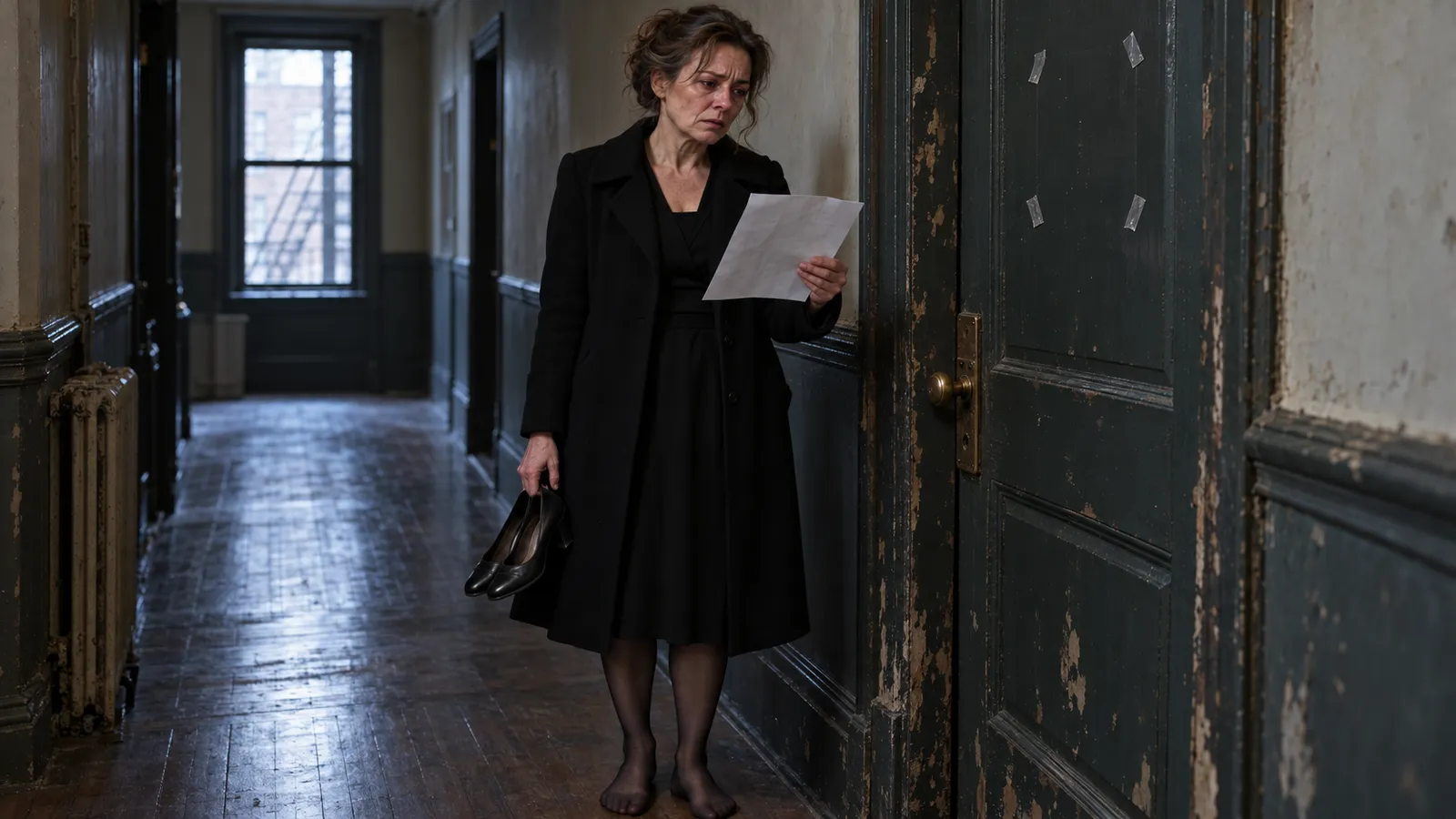
The notice to vacate was taped to my door on the morning of my husband's funeral. The apartment came with his job as the building's super, and he had been dead nine days. What I did not know was what he had been keeping in the boiler room for eleven years.
Chapter 2: The Drawer
It took me until Monday to go down the basement stairs, because he died on them.
Eleven days earlier a tenant from 2B had found him on the fourth step from the bottom at six in the morning with a flashlight still on in his hand. His heart, they said. Fast, they said, which is the thing people tell you.
I stood at the top with the BOIL key in my fist and counted the steps to make myself move. Fourteen. One for every unit, which meant nothing, but counting got me down them.
The fourth step from the bottom is just a step. That is the part nobody warns you about.
The boiler room is behind an unmarked steel door at the bottom of the stairs, and the key turned like it had been turned ten thousand times.
Inside it was warm and loud and smelled like hot iron and dust burning off a pipe. The boiler took up the far wall, a green tank with a pressure gauge and a hand-lettered card taped beside it: IF THE NEEDLE PASSES 18 CALL ME FIRST, DO NOT BLEED IT. Block capitals. His.
Under the window well there was a workbench. A coffee can of washers sorted by size. A radio with a wire hanger for an antenna. A folding chair with a flattened cushion, the kind of chair a man sits in for an hour at a time.
He had a chair down here. In eleven years he had never said, I have a chair down there.
And against the pipe wall, painted the same gray as everything else so you would walk past it, a four-drawer steel filing cabinet.
The top drawer held parts. Faucet cartridges in labeled bags, a bin of thermocouples, a coil of pull chain.
The second held manuals. Boiler, intercom panel, the 1962 mail boxes, each one with a strip of masking tape on the spine and the unit it applied to.
The third drawer held the work-order books.
There were eleven of them, spiral-bound, carbonless duplicate, the kind you buy at a contractor supply for nine dollars. Yellow copy stays, white copy goes. He had numbered them on the cover, 1 through 11, one for each year, and inside, every page had a number in the top right corner and a date beneath it in his block capitals.
I sat down in his chair with book 11 across my knees.
#1119. 10/02. 3C GARRISON. REPL KITCHEN FAUCET CARTRIDGE. PARTS 6.40. EK.
#1120. 10/02. 4A. BUZZER PANEL, UNIT WIRE LOOSE AT TERMINAL. 20 MIN. EK.
#1121. 10/04. ROOF DRAIN NORTH, CLEARED LEAVES. EK.
Hundreds of them. Eleven years of a man's hands in a building, written down in the same even capitals, two inches of paper. I turned pages until the furnace noise stopped being noise and became the sound of someone working, and at some point I stopped reading for information and just read, the way you read letters.
That is when I found the second kind of entry.
They were in the same books, in order, nothing hidden about them. Only the shape of the words changed.
#0803. 3/11. NORTH LANDING STAIR TREAD, SPLIT, LIFTS UNDERFOOT. QUOTED 240 CARPENTER. INSTRUCTED BY S. LOWELL 3/11 PHONE: HOLD. NO AUTH. NOT DONE. EK.
#0847. 5/06. 2A WINDOW SASH CORD BROKEN BOTH SIDES, SASH FALLS. INSTRUCTED 5/07 BY S. LOWELL: SECURE WITH SCREW, REVISIT NEXT YEAR. SCREWED SHUT. TENANT ADVISED. EK.
#0912. 11/19. BASEMENT STAIR HANDRAIL LOOSE AT TOP BRACKET, ANCHOR PULLED. INSTRUCTED 11/20 BY S. LOWELL: DEFER TO SPRING BUDGET. NOT DONE. EK.
I read that one three times.
Then I took a pencil out of his coffee can and a sheet of his paper and I went back to book 8 and started a list, because a thing you can count is a thing you can carry.
It took me two hours and forty minutes.
Thirty-one. Thirty-one work orders in four years that said not done, each one with the date he was told, the person who told him, and the phrase he used every time, which never varied: instructed by S. Lowell. Two of them were in our own apartment. The 1A bathroom fan, the 1A window he had screwed shut in September and told me he would get to.
He had not been protecting the building from Lowell. He had been writing down who said no, in a book, in a basement, with the radio on.
The fourth drawer was locked.
The BOIL key did not open it. Nothing on his ring opened it. It took me twenty minutes to find the flat key taped to the underside of the bench, which is where he kept the spare for our door too, which is why I thought to look, which is the first thing that made me cry in that room.
Inside were four things.
A folder of inspection notices. Four scheduled city inspections, each with a rescheduling letter stapled behind it, each letter signed with a fountain pen that had blotted on the downstroke of the L.
A sealed envelope with a bank statement for an account I had never seen, which turned out to hold eighteen hundred dollars, which turned out to be labeled on the front in his capitals: ROOF, IF HE WON'T.
Work order #1142, dated the Thursday he died, written as far as four words and then stopped.
#1142. 10/06. BOILER. PRESSURE
And under it, a brown hardbound ledger, cloth corners, the kind they used to sell at a stationer's.
I opened it on my knees.
Fourteen column headings across the top of the left page. Down the left margin, unit numbers. Inside the grid, in his handwriting, going back nine years, were the amounts people paid in cash.
3C GARRISON — 610 — 610 — 610 — 610 — for one hundred and eight months.
Six hundred and ten dollars. Everybody in that building knew Antonia Garrison paid less than she should and everybody had a theory about why, and the theories were all about kindness, and none of them were about a column.
2A MARISOL — 740. 1B DEREK — 690. 4C PAULETTE — 580.
Four units. Four households whose names were in a book that did not exist in any office, written down by a man who went up those stairs every month to collect it and then came back down here to record it where it would stay.
On the inside cover, one line, undated, in the same careful capitals: PER S.L. 4/14 — OFFICE BOOK STAYS CLEAN. KEEP THIS ONE HERE.
Nine years of it. And the yellow carbon copies he had started keeping only seven years ago, which meant that for two years he had kept this book and nothing else, and then something had changed in him and he had started making copies of his own handwriting.
That is when I understood what Sheldon Lowell wanted back, and why he had asked me for it twice in a funeral home with his hand on top of mine.
He did not want fourteen brass keys.
Above me the basement door opened and a voice came down the stairs saying my name, warm and easy, the way you call to someone you have known a long time.
"Ruthanne? Is that you down there?"
I closed the brown book and held it flat against my chest under my cardigan.
Eleven years of work orders in the third drawer could save this building. The brown ledger in my arms could bury the man who wrote both of them, and he had written both of them in the same hand, on the same bench, in the same block capitals he used on the tag of the key I had let myself in with.
End of chapter 2