Revenge6 min read
The Thirty-Day Notice
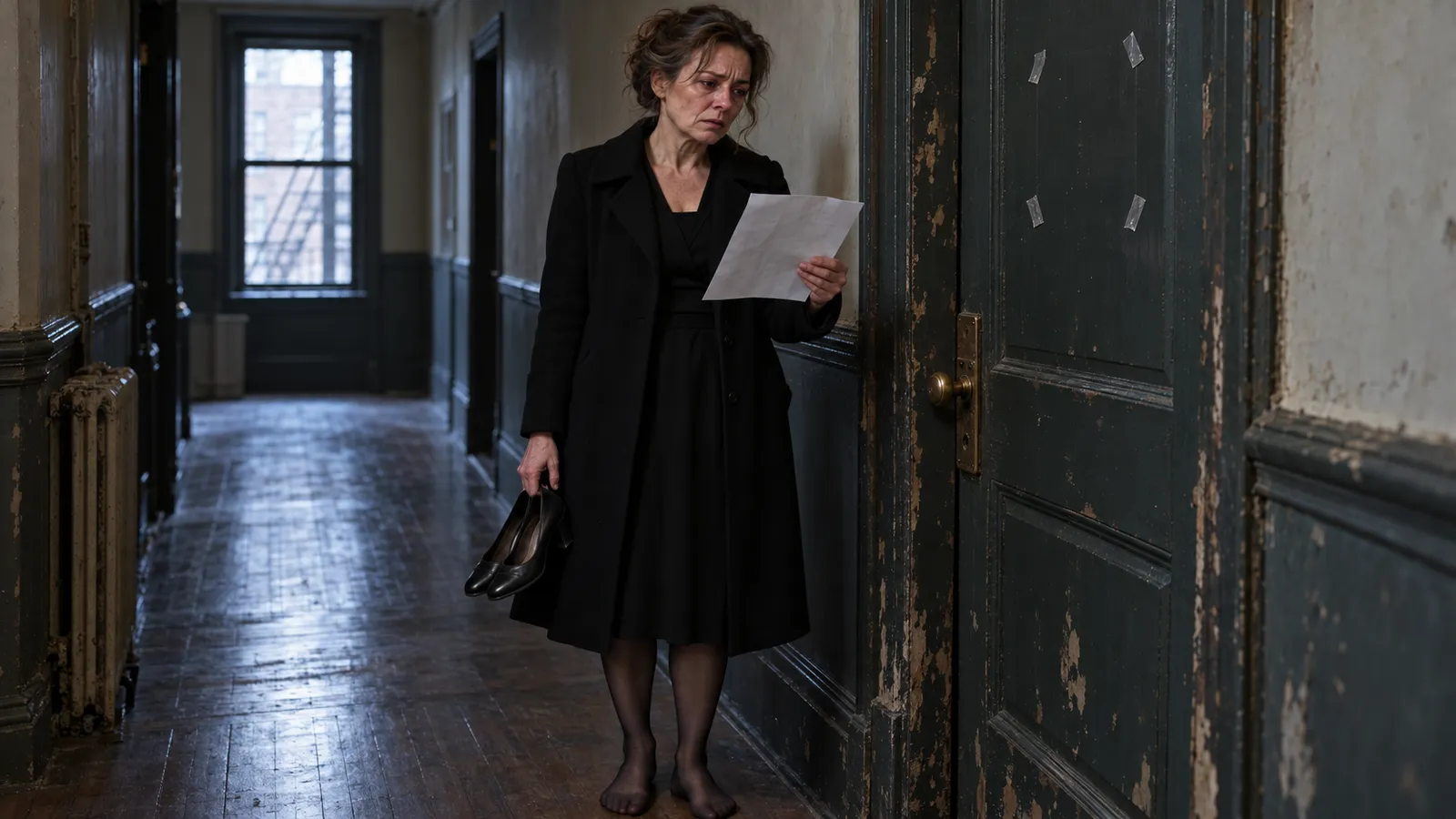
The notice to vacate was taped to my door on the morning of my husband's funeral. The apartment came with his job as the building's super, and he had been dead nine days. What I did not know was what he had been keeping in the boiler room for eleven years.
Chapter 3: Nine of Fourteen
I told Sheldon Lowell I had been looking for Emmett's gloves.
He stood three steps up in his good coat and did not come down into the heat, and he said that was the trouble with basements, everything you want is in them, and he hoped I was sleeping. He said if I ever wanted help clearing out he had a man with a truck. He did not look at the cabinet once, which was how I knew he had already looked at it a hundred times.
I went up past him with my arms folded over my cardigan and the brown ledger flat against my ribs underneath it.
That was Monday. On Tuesday I emptied the bottom two drawers into a laundry basket and carried them up to my apartment under a towel in three trips — eleven work-order books, the inspection folder, the envelope, and the brown ledger — and the originals never went back down those stairs again.
On Tuesday evening I climbed to the third floor and knocked on 3C.
Antonia Garrison's kitchen had a pink telephone bolted to the wall with the cord stretched all the way to the window, so she could stand and look down at Faraday Street while she talked. There was a bowl of dry food by the radiator for a cat that was not hers and never came in while anybody was watching.
She made tea I did not want and asked about the sandwiches at the funeral and whether there had been enough, and about my sister in Erie, and about the weather coming. Nineteen years in that building and I had never sat in that chair.
Then I put the brown ledger on her table and opened it to her page.
Her hands went flat on the oilcloth.
"Where did you get that."
"My husband's filing cabinet."
"That's not mine."
"Your name is in it a hundred and eight times."
"That's not a thing I signed." She pushed back from the table and stood at the window with her back to me, and her voice came out small and furious. "I never signed anything. His father put me in here in '07 and said six hundred ten and don't be late and don't ask for repairs. No lease. No receipt. You know what a signature cost me in 1979, Ruthanne? My husband signed a thing he didn't read and I paid on it for eleven years."
"Mrs. Garrison—"
"Antonia."
"Antonia." I turned the book around so the page faced her. "I thought the same thing you did when I found it. I thought this is the book that gets you put out."
"It is."
"It's one hundred and eight months of paper that says you live here." I put my finger on the first entry. "In his handwriting, dated, every month, nine years, and four more years before that in the first book. You have no lease. You have no receipts. Until Thursday you had nothing in this world that proved you have lived on the third floor since 2007. Now you have this."
She did not turn around.
"And if I say so out loud, he puts a lock on my door."
"He might try." I closed the book. "I have thirty days anyway. I have nothing left he can take."
She stood at the window a long time. The cat that was not hers came up the fire escape and looked in and went away again.
"Jo in 4A," Antonia said finally, not turning. "She works at the copy place on Wexler. She put a paper up in my mailbox about rats in July and nobody called her back." A pause. "She's got a loud mouth. You want a loud mouth."
Jo was twenty-seven and let me in the back door of the copy shop at nine fifteen at night and said, before I had explained anything, "Is this about my deposit? Because it's been fourteen months and I already know the answer."
I put the laundry basket on the counter and took the towel off.
She read work order #0803 about the north landing stair tread, the one that lifts underfoot, the one I had tripped on twice and sworn at and never once thought about as a decision somebody had made on a telephone.
She read it twice. Then she said a word I will not write down.
"He wrote the name of the guy who told him no."
"Every time. Thirty-one times."
"Thirty-one." She was already walking to the big machine against the wall, the one with the sheet feeder. "Okay. Okay. These are carbonless, I can run the yellows without tearing them, it'll take two hours, I'm making two sets. One for you, one stays in my mother's garage in Dunmore, because if a pipe breaks in your apartment next week, which is a thing that happens, I don't want to be standing here with my thumb in my mouth."
She looked up. "Sorry. I talk fast when I'm mad."
"Keep talking."
It took until eleven forty. Four hundred and twelve pages, twice. She would not let me pay for the toner. While the machine ran she pulled a flyer off the corkboard by the register, the kind nobody reads, a free tenant clinic on Wexler, Fridays, nine to one, a woman's name on it: Priya.
"They do this," Jo said. "Buildings. Associations. There's a form. I don't know the form."
"I know how to fill out a form," I said. "That is the one thing I am actually good at."
The rest of it was shoe leather and bad coffee and it took nine days.
Marisol in 2A said no on Wednesday in the doorway with her hand on the frame, because she has two kids and a window screwed shut in a bedroom they sleep in, and no, and she closed the door. On Friday she came down to 1A with a plate of food and said, "Does it say my rent in there?" and I said yes, and she said, "In his writing?" and I said yes, and she signed on the kitchen table and borrowed my pencil and took the pencil home with her.
Derek in 1B said no and meant it. He drives nights and he has a cousin on a lease at one of Lowell's other buildings and he said, "I'm not putting my name on a thing with his name on it," and that was all, and I did not push him, because he was not wrong about what it costs.
Paulette in 4C signed in the hallway without sitting down, read nothing, said, "Forty years in this city, honey," and then went and got 4B and 2C for me.
By the following Thursday there were nine signatures out of fourteen units on a sheet of legal paper with the date in the top right corner.
Nine of fourteen. I wrote the fraction at the bottom and circled it and then I could not stop looking at it, because the number meant that it had stopped being me.
That Thursday morning I went down the basement stairs to get his radio.
The steel door had a new lock in it. Bright brass in gray paint, and a fresh hasp, and the screws still had the dust on them from the drill.
The BOIL key went in an inch and stopped.
I want to be honest about what I felt, which was not fear. He had put a lock on an empty drawer nine days late, and I had carried the contents up in a laundry basket under a towel on a Tuesday afternoon while he was at his office signing letters with his father's pen. Standing in front of that bright brass I understood that Sheldon Lowell did not actually know what was in his own building. He only knew that Emmett had known.
And at the top of the stairs behind me, in his coat, with his keys already in his hand, Sheldon Lowell said he had been meaning to call me about the apartment.
End of chapter 3