Family4 min read
The Voice in the Antique Radio
Six months after my father passed away, I powered up his restored 1948 Zenith radio and heard his voice speaking through the static. What seemed impossible was actually his final gift: a concealed transmitter leading me to his hidden workshop safe and decades of unspoken love.
Chapter 1: Dust on the Dial
When I finally repaired the filament in my late father's 1948 Zenith radio and heard his voice whisper through the static, my hands froze over the dials. I thought grief was driving me insane until I discovered the miniature transmitter he had soldered inside before he died.
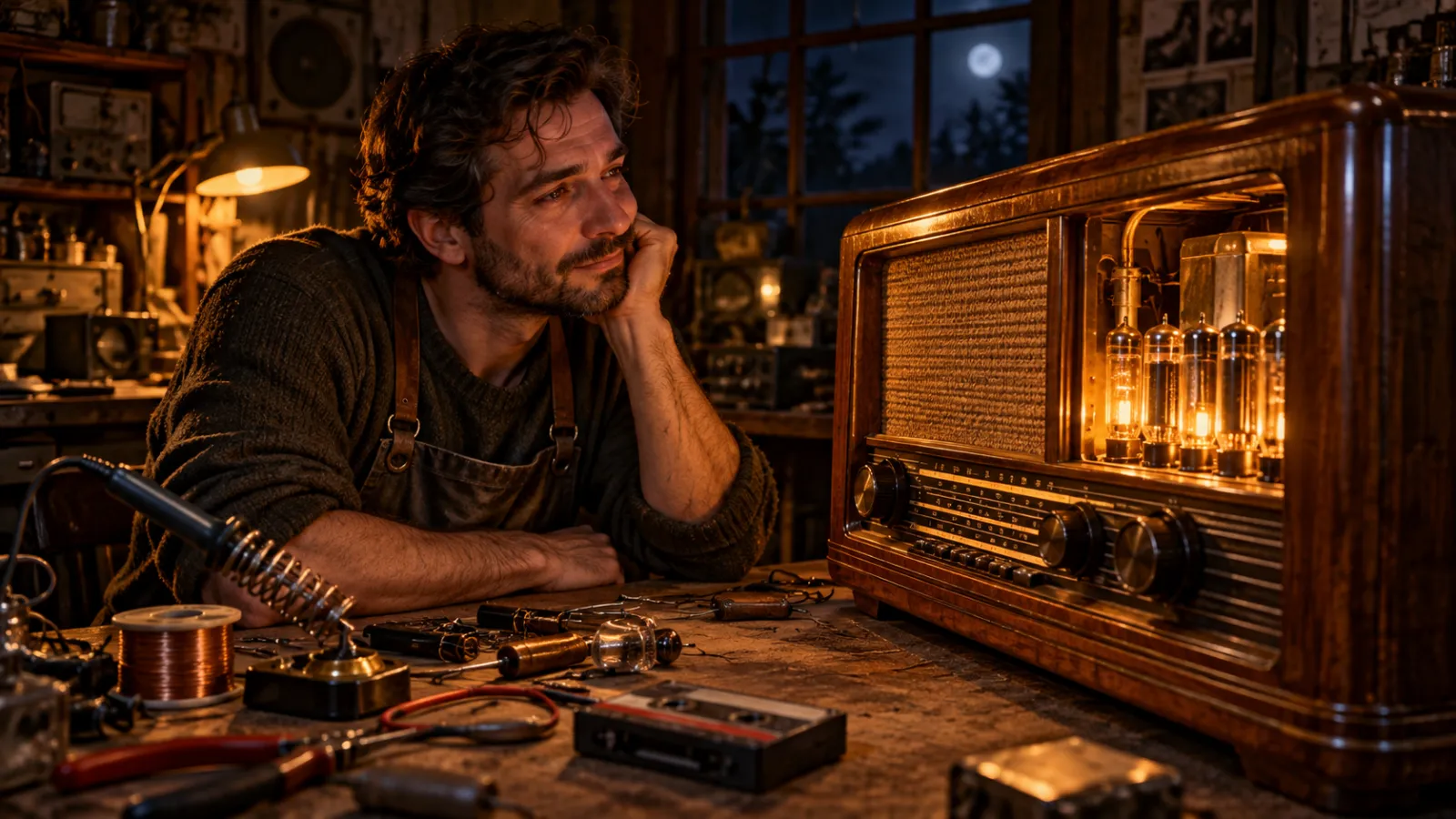
Six months had slipped past since the funeral service at the foot of the Craggy Mountains. Six months of quiet afternoons during which I avoided the detached garage behind our house in Black Mountain. My father, Thomas, had spent thirty-five years directing passenger airliners across the congested flight corridors of the Southeast. When he retired from the Federal Aviation Administration, he did not take up golf or travel the coast. Instead, he retreated into this concrete-floored sanctuary, surrounded by wall-mounted oscilloscopes, signal generators, and rows of glass vacuum tubes arranged like miniature towers.
To the rest of the world, Thomas was a man of few syllables. He spoke in clipped, standard aviation jargon where every word carried the weight of radar separation and fuel reserves. At dinner tables, he listened more than he spoke, nodding slowly while his eyes drifted toward the horizon. Even when I opened my own audio repair business downtown, fixing vintage turntables and tube amplifiers, he never offered direct praise. He simply dropped off old technical manuals on my porch, each volume bookmarked with yellowed index cards containing handwritten circuit diagrams.
On a cold Tuesday evening in late October, the mountain wind rattled the loose windowpanes of the shed. I pushed open the heavy wooden door, flipping the overhead fluorescent lights. The harsh white tubes flickered twice before illuminating the long oak workbench. The air smelled of damp pine, old resin, machine oil, and cold iron. In the far corner, covered by a stiff painter's canvas tarp, sat the massive object that had haunted my childhood.
I stepped across the floor and pulled the tarp away with both hands. A cloud of gray dust caught the light as the fabric slid to the floor.
Standing before me was a 1948 Zenith Model 12H090 console radio. The cabinet was crafted from solid American walnut, five feet tall and nearly three feet wide, with fluted corner pillars and an arched acoustic grille. My father had bought it at an estate auction in Hendersonville when I was seven years old.
He always swore he would bring it back to singing condition, but it had remained silent for decades. Its circular brass dial, once bright gold, had darkened to the color of tarnished pennies. The amber glass window showed the long-wave, broadcast AM, and shortwave amateur frequency bands marked in weathered cream lettering.
"You are actually going to touch it tonight," a gentle voice said from the doorway.
I turned to see Evelyn leaning against the frame, holding two ceramic mugs. Steam rose into the chilly air between us. She stepped inside, careful not to trip over the thick coaxial cables coiled along the baseboards. She handed me a mug filled with black coffee and smiled softly.
"I need to know why he kept it right here," I said, running my thumb across the fluted wood. "Every other receiver in this shop was tagged, calibrated, and operational. He kept his modern ham transceivers spotless. But he kept this console sitting dead on the main bench for forty years."
Evelyn rested her hand on my forearm. Her fingers were warm against my chilled skin. "Your father never kept anything without a reason, Leo. You know that better than anyone."
"He was stubborn," I murmured, taking a sip of the bitter coffee. "He would spend three weeks tracing a single ground loop rather than admit a transformer was dead. When he got sick last winter, he spent his final good days locked out here alone. I thought he was just hiding his weakness from us."
"He was not hiding from you," Evelyn said quietly, looking at the dark amber dial. "He just didn't know how to speak without a microphone in his hand."
She kissed my cheek and left me to the quiet workshop. I set my mug on a clean wooden coaster and looked at the Zenith with fresh eyes.
The finish on the top surface was checked with fine spiderwebs of cracked lacquer. The heavy rotary knobs for tuning, band selection, tone, and volume were carved from solid dark bakelite. I crouched down and peered through the ventilated cardboard back cover. Thick layers of cobwebs stretched between the glass envelopes of twelve vacuum tubes. The power transformer sat like a black cast-iron block on the corner of the chassis, covered in decades of accumulated soot.
I reached behind the cabinet and retrieved the original two-prong power cord. The brown rubber insulation had dried and cracked, exposing bare copper strands that would have caused a violent short circuit if plugged into a modern outlet. Thomas had deliberately clipped the wall plug off forty years ago to prevent anyone from applying line voltage before the chassis was rebuilt.
I pulled my tool roll from my canvas bag and unrolled it across the workbench. My diagonal wire cutters, needle-nose pliers, soldering iron, and digital multimeter lay in neat rows under the task lamp.
Restoring an antique high-fidelity radio was not merely a mechanical task. It was a forensic excavation of someone else's intentions. I took a deep breath, gripped the wooden chassis rails, and prepared to loosen the mounting bolts that held the receiver in place. For the first time in six months, the workshop did not feel like a mausoleum. It felt like a station waiting for an incoming transmission.
End of chapter 1