Family4 min read
The Voice in the Antique Radio
Six months after my father passed away, I powered up his restored 1948 Zenith radio and heard his voice speaking through the static. What seemed impossible was actually his final gift: a concealed transmitter leading me to his hidden workshop safe and decades of unspoken love.
Chapter 2: Glowing Tubes at Midnight
By midnight, the rest of Black Mountain had settled into deep sleep, but my workshop remained wide awake under the hum of fluorescent lighting. I had cleared the center of the workbench, spreading a thick rubber mat across the oak planks to protect the heavy steel chassis.
Removing the chassis from the walnut cabinet had required nearly an hour of patient labor. Four rusted lag bolts secured the frame to the lower wooden shelf, each one fighting my socket wrench with a dry, metallic screech. When the final bolt gave way, I gently slid the thirty-pound assembly out through the open back. The weight was concentrated in the massive iron-core power transformer and the heavy steel tuning condenser, both caked in decades of undisturbed Appalachian dust.
I used a soft horsehair brush and a handheld shop vacuum to clean the upper surface. Beneath the grime, the cadmium-plated steel chassis reflected a dull, silvery sheen. Twelve octal tube sockets were arrayed in neat rows, each holding a glass or metal envelope with faded yellow silk-screened logos.
I plugged in my father's vintage Hickok tube tester, waiting for its internal reference meter to warm up. Testing vintage vacuum tubes was a ritual he had taught me when I was twelve years old. He would sit on a wooden stool beside me, watching my hands with quiet scrutiny, correcting my socket alignment before I could bend a fragile copper pin.
One by one, I pulled the tubes and seated them in the tester. The 6SK7 radio frequency amplifier tested strong, its green needle swinging smoothly into the good sector. The 6SA7 pentagrid converter mixer and the 6SQ7 detector-preamplifier both passed with high transconductance scores.
The problem surfaced when I reached the audio output stage. The Zenith used push-pull 6V6 beam power pentodes to drive its twelve-inch electrodynamic speaker. When I inserted the primary 6V6 tube and engaged the filament continuity switch, the meter needle remained completely flat.
The tungsten heater filament inside the glass envelope had burned open. Without a continuous heater circuit, the cathode could never reach operating temperature, and no electrons could flow across the vacuum gap. The tube was effectively dead.
I turned the chassis onto its side and clipped a wooden wedge beneath the transformer to keep it stable. Looking into the underside of an unrestored 1948 receiver was like peering into a lost civilization. Dozens of wax-dipped paper capacitors hung between terminal strips like melted yellow candles. Their paper casings were brittle, cracked from heat, and leaking dried paraffin.
I pulled out my digital capacitance meter and tested the main power supply filter can. The dual fifty-microfarad electrolytic capacitor had completely dried out over four decades of inactivity. If I had applied full household voltage without replacing those capacitors, the unit would have hummed violently before blowing the power transformer in a cloud of toxic smoke.
"Measure twice, solder once," my father's favorite rule echoed in my thoughts. He never tolerated rushed repairs or sloppy joints. Every connection had to be mechanically crimped around the terminal lug before any lead-tin alloy touched the heated copper tip.
I spent the next two hours methodically clipping out the degraded wax capacitors. In their place, I installed modern high-voltage polypropylene orange-drop capacitors rated for six hundred and thirty volts. I twisted each lead securely around the brass eyelets and flowed fresh rosin-core solder into the joints until each connection formed a concave, mirror-bright fillet.
From my father's wooden organizer cabinet on the wall, I located an original new old stock RCA 6V6GT tube in its red-and-black cardboard box. The pristine glass envelope was flawless, its internal getters flashing a dark silver mirror against the top dome. I aligned the center guide pin and pressed the replacement tube firmly into its ceramic socket.
Before plugging the chassis directly into the wall, I retrieved the variable autotransformer from the bottom shelf. Bringing a sixty-year-old radio back to life required gradual voltage increments to reform the internal dielectric layers and prevent sudden electrical shock.
I wired a temporary grounded power cord to the primary fuse holder, plugged the line into the Variac, and set the rotary voltage dial to zero.
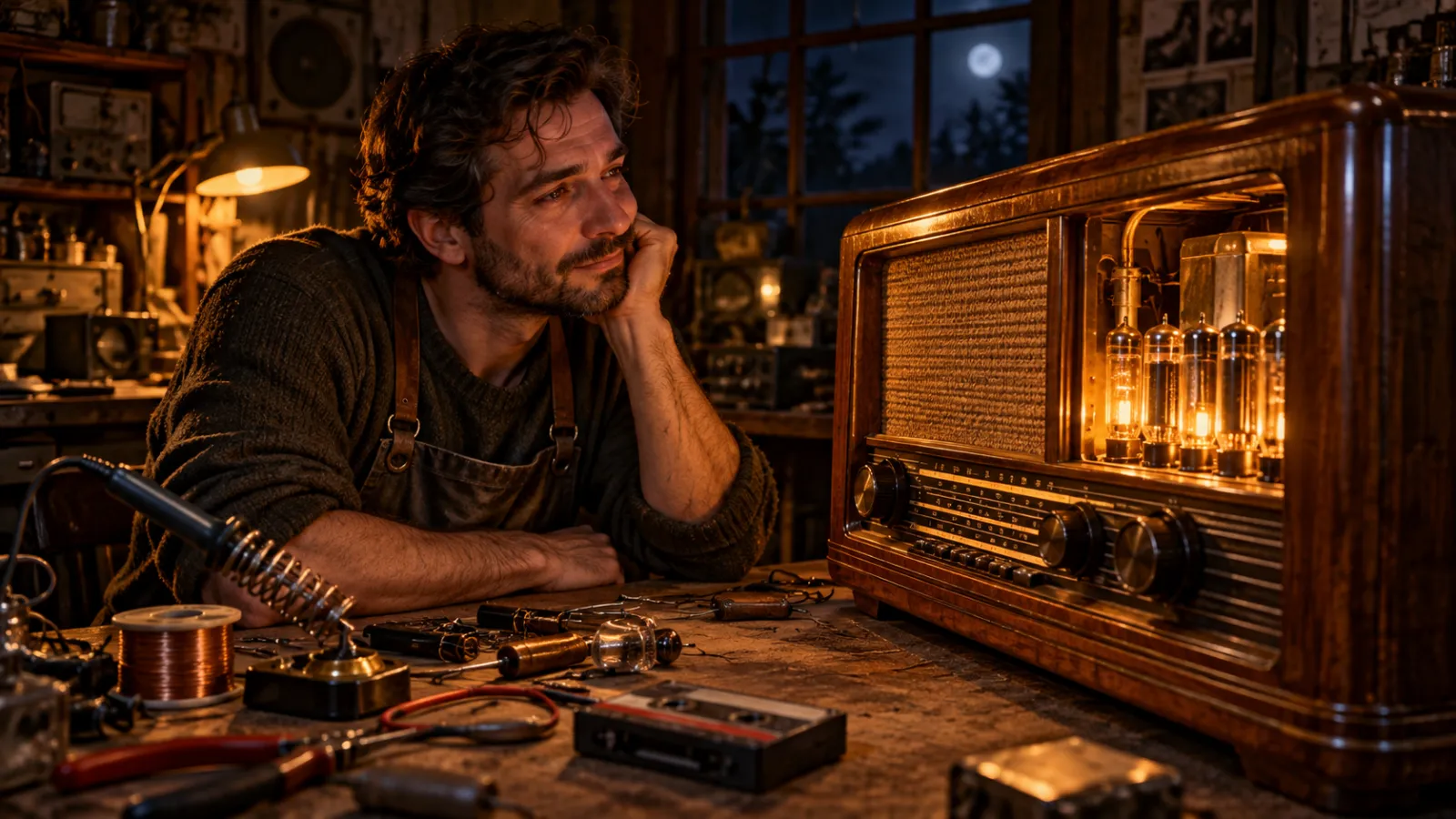
I reached up and clicked off the overhead fluorescent lights. The room plunged into near total darkness, illuminated only by the faint green pilot indicator on the isolation transformer and the cool moonlight slanting through the high windows.
My hand touched the heavy knob of the Variac. I slowly rotated the dial clockwise.
Thirty volts. A quiet magnetic hum vibrated through the steel core of the transformer.
Sixty volts. Inside the glass envelopes, the tiny coiled tungsten heaters began to stir.
Ninety volts. Then, with a gentle click, I brought the dial to full line voltage.
A warm amber glow blossomed across the center of the workbench. Twelve filaments ignited like miniature campfires in the dark room, casting soft orange halos across the polished steel chassis and the tools scattered beside it. The glass envelopes radiated gentle heat, warming the cool night air around my hands.
The tubes were alive. The circuit was complete, waiting for the first wave of audio to travel through the warm glass.
End of chapter 2