Family4 min read
The Voice in the Antique Radio
Six months after my father passed away, I powered up his restored 1948 Zenith radio and heard his voice speaking through the static. What seemed impossible was actually his final gift: a concealed transmitter leading me to his hidden workshop safe and decades of unspoken love.
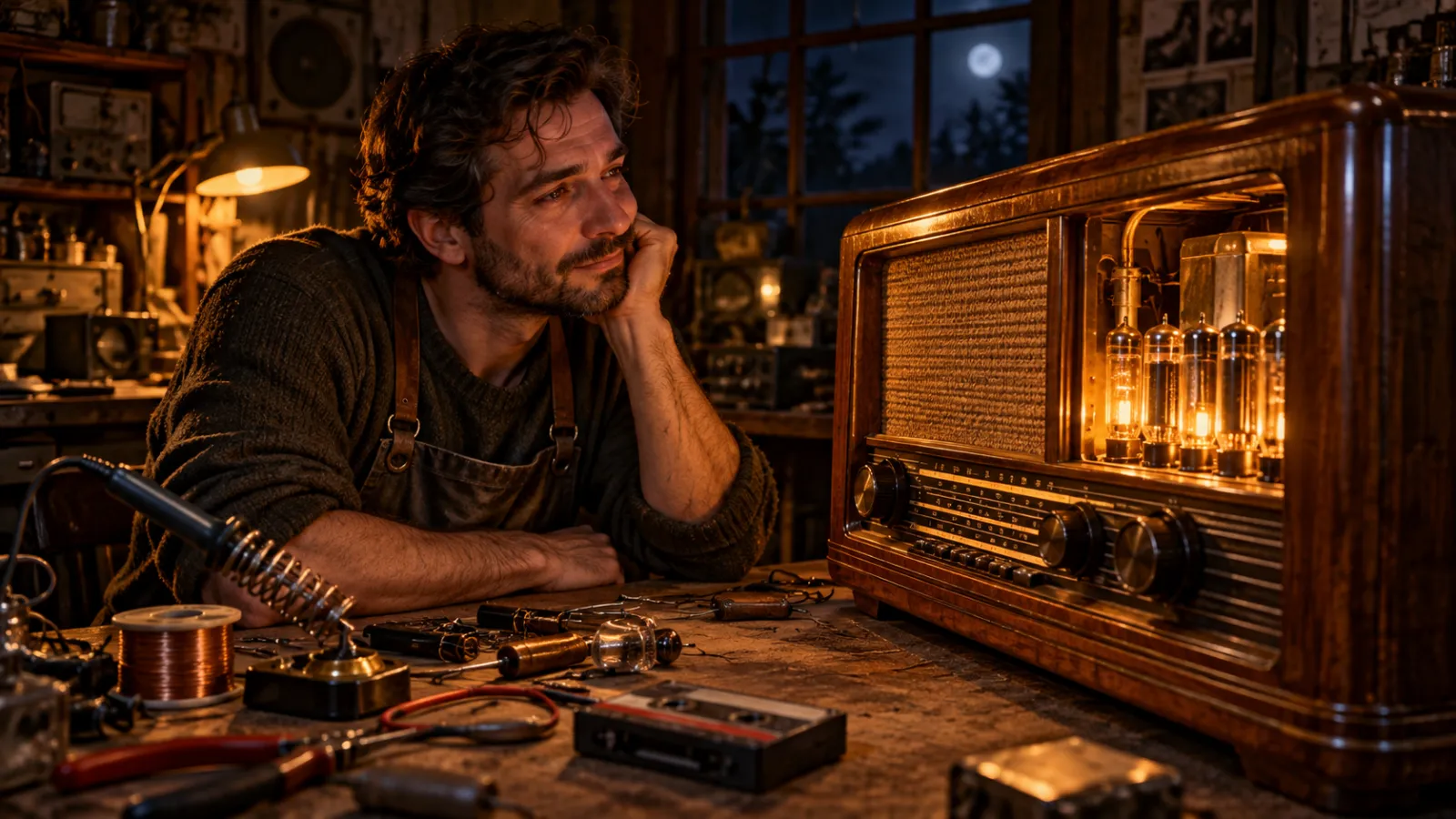
Chapter 3: Faint Static on Seven Megahertz
I stood in the amber glow of the workbench, watching the heat shimmers rise from the tops of the glowing glass envelopes. The workshop was dead quiet except for the low, hypnotic sixty-hertz vibration humming from the power transformer.
To hear the receiver sing, I needed to reconnect the original electrodynamic speaker. Unlike modern permanent-magnet speakers, this 1948 Zenith utilized a massive field coil that doubled as a heavy-duty choke in the high-voltage smoothing circuit. Running the chassis without that coil connected would have spiked the plate voltages and destroyed my brand-new capacitors within minutes.
I leaned into the cavernous rear opening of the walnut cabinet. The twelve-inch paper cone was suspended by a ribbed cloth spider, remarkably preserved without tears or rodent damage. I aligned the four-prong bakelite speaker plug with the chassis socket, pressing the thick brass pins into place until they seated with a solid thud.
Instantly, the acoustic nature of the workshop changed.
A soft, velvet rush of pink noise poured from the arched grille cloth. It was not the harsh, sterile hiss of modern silicon transistors, but the deep, organic breathing of vacuum tubes idling in pure analog equilibrium. I attached a long coil of insulated copper wire to the antenna terminal screw, tossing the far end over the rafters to catch stray radio waves.
I reached for the heavy tuning knob and spun it gently. The weighted brass flywheel inside the chassis gave the mechanism an elegant, effortless glide. A thin pointer with a glowing red pilot lamp swept across the curved glass dial.
On the standard AM broadcast band, between 540 and 1600 kilohertz, the receiver came alive with astonishing clarity. A clear nighttime signal from an AM transmitter in Charlotte delivered a bluegrass banjo breakdown, followed by an Asheville station reading the midnight mountain weather forecast. The bass notes resonance shook the heavy oak workbench. The fidelity was deep, warm, and remarkably full.
Yet my father had never spent his evenings listening to commercial pop music or late-night talk shows. Thomas was a creature of the high frequencies, a licensed amateur operator who held an Extra Class ticket and spent decades scanning the ionosphere under his callsign, W4KZT.
I reached for the rotary band-selector switch on the left side of the brass bezel. The solid brass detent clicked firmly into place as I engaged the shortwave amateur band covering seven megahertz.
The warm music vanished, replaced immediately by the raw, crackling wilderness of the shortwave spectrum. High-pitched heterodyne whistles drifted like phantom birds through the speaker. Distant Morse code operators tapped out rapid staccato messages from across the Atlantic, their rhythmic tones fading in and out on the ionospheric breeze.
I turned the fine-tuning knob slowly, listening to the static rise and fall.
Seven point zero five megahertz. Pure white noise.
Seven point one zero megahertz. A Spanish language utility broadcast drifting in from the Caribbean.
Then, right at seven point one five zero megahertz, the ambient background noise dropped into a sudden, unnatural silence.
In radio terminology, it was a quiet carrier. A transmitter had keyed its microphone, suppressing the random atmospheric static with a powerful local radio-frequency wave. There was no skip fade, no phase distortion, and none of the metallic echo typical of signals bouncing off the upper atmosphere.
A short, dry clearing of a throat came through the speaker cone.
My fingers locked on the bakelite dial. My breath caught in my throat.
"CQ, CQ, this is Whiskey Four Kilo Zulu Tango," a voice spoke from the center of the walnut cabinet.
The tone was gravelly, firm, and deliberate. It was the exact voice that had called me to supper every evening of my childhood. It was the voice that had guided thousands of jet aircraft down safely through zero-visibility fog over the Blue Ridge peaks.
"Leo, if you are hearing this transmission, the primary filament is warm," the voice continued without hesitation. "And that means you finally stopped looking at the wood and started looking at the circuits."
I dropped my insulated alignment screwdriver onto the workbench. The plastic tool bounced twice on the rubber mat and clattered onto the concrete floor.
My skin prickled with cold shock. The voice was not a memory playing tricks in the dark. It was coming directly from the twelve-inch speaker cone, shaking the delicate paper surround with clear acoustic energy.
"You always were too careful with the exterior finish, son," the recording went on, accompanied by the faint background rustle of paper notes being turned. "You thought this radio was a museum piece. But an instrument that doesn't transmit or receive is just kind of a fancy coffin. Listen carefully to what I have to tell you."
The transmission paused for three seconds, followed by a soft mechanical click. Then the recording looped back to the beginning:
"CQ, CQ, this is Whiskey Four Kilo Zulu Tango... Leo, if you are hearing this transmission..."
I backed away from the glowing console, my shoulders hitting the steel tool cabinet behind me. My father had been dead and buried in the cold earth for six months, yet his voice was repeating in an endless cycle inside his darkened shed.
End of chapter 3