Family4 min read
The Voice in the Antique Radio
Six months after my father passed away, I powered up his restored 1948 Zenith radio and heard his voice speaking through the static. What seemed impossible was actually his final gift: a concealed transmitter leading me to his hidden workshop safe and decades of unspoken love.
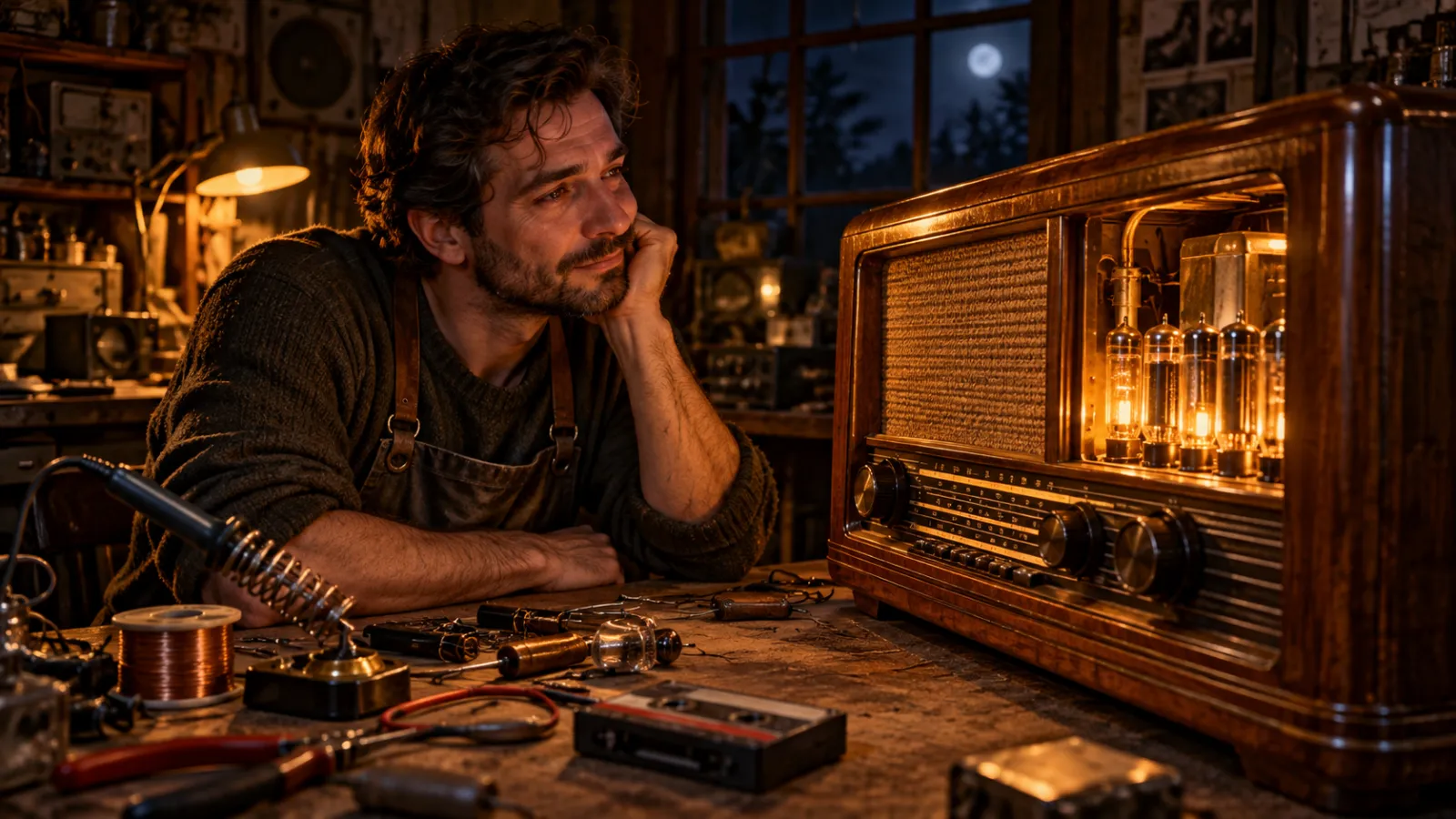
Chapter 5: The Wire Beneath the Speaker Cone
Harold held the high-intensity inspection light while I unbolted the lower acoustic baffle of the console. The heavy twelve-inch electrodynamic speaker occupied the center of the wooden cabinet, held in place by four carriage bolts threaded into hardwood blocks.
As I loosened the wing nuts, the smell of aged pine sawdust and vintage shellac drifted up from the enclosed cabinet chamber. The speaker frame was forged from heavy stamped steel, painted industrial wrinkle-black. Behind the paper cone sat the massive iron cylinder containing the electromagnetic field coil.
"Look right along the lower mounting flange," Harold said, pointing his narrow flashlight beam toward the bottom edge. "Look at that wiring run."
I leaned in closer, my magnifying head visor pulled down over my eyes. Running alongside the heavy cloth-braided harness was a modern pair of copper wires wrapped in brown vintage friction tape. The tape was aged to look like original 1948 cloth insulation, but the clean edges and fresh rosin residue gave it away.
The twin wires disappeared into a recessed cavity carved into the solid pine bottom shelf, directly beneath the heavy speaker magnet.
"He routed it into the dead space beneath the acoustic chamber," I whispered, reaching my fingers into the narrow gap.
My fingertips touched cold sheet metal. I used a magnetic stubby screwdriver to remove two brass wood screws securing a rectangular copper enclosure. When the metal casing slid free into my palm, Harold let out a soft whistle of admiration.
"Would you look at that handiwork," Harold murmured, leaning over my shoulder. "Classic Thomas Miller engineering."
The copper box was no larger than a deck of playing cards, built from double-sided circuit board stock and soldered together at the seam edges to form a perfect radio-frequency shield. On one side of the box, Thomas had affixed a piece of yellowed masking tape with a notation in his familiar, sharp drafting script: Project Beacon. 7.150 MHz AM. Filament Interlock Active.
I brought the little box over to the workbench under the magnifying lamp. Using a desoldering braid and my iron, I carefully melted the seal along the top lid and lifted the cover.
Inside was a masterpiece of miniature electronics. Thomas had combined vintage radio theory with modern solid-state microcircuitry.
At the input stage sat a miniature bridge rectifier and a five-volt voltage regulator, wired to step down the receiver's alternating-current heater line. In the center was a crystal-controlled seven-megahertz oscillator chip connected to an ultra-low-power radio-frequency amplifier stage. Beside the transmitter sat a micro-cassette audio player module modified with an endless continuous tape loop.
"See how he took the power feed, Leo?" Harold asked, tracing the copper leads with the tip of his wooden alignment stick. "He tapped directly into the six-point-three-volt heater circuit of that primary six-vee-six audio output tube."
The realization hit me with the force of an electrical jolt.
"He deliberately waited for me to fix the filament," I said, looking back at the glowing glass tubes on the chassis.
"Exactly," Harold nodded, his weathered eyes crinkling at the corners. "Your father knew this radio had been dead for forty years with a burned-out output tube and blown filter capacitors. If anyone else had plugged this console in, the fuse would have popped instantly, or the transformer would have burnt out. The only way this little transmitter could ever receive electrical power was if someone sat down, diagnosed the open filament, replaced the six-vee-six, recapped the power supply, and brought the chassis up to full working potential."
"He knew I was the only person who would do that," I said quietly.
"He knew you were the only one who could do it," Harold corrected firmly. "Your father was never a man to leave an open letter on a kitchen counter or make an emotional speech at a family dinner. He treated communication as a technical discipline. He built a test that only his son could solve."
Harold pointed to a tiny toggle switch mounted on the side of the copper module.
"The short transmission we have been hearing on the loop was just the beacon signal," Harold explained, pointing to the miniature playback head. "That was just the carrier loop designed to catch your attention while you calibrated the dial. There is a secondary track recorded on this micro-cassette."
I inspected the miniature toggle switch. Above it, Thomas had stamped a single word into the copper lid: RELEASE.
"He set it so that when you flip that switch," I said, studying the printed traces, "the module disengages the repeating loop and plays the full master track directly through the speaker."
"Go ahead, son," Harold said softly, stepping back from the bench and folding his arms across his flannel coat. "You earned every syllable on that tape."
I wiped my palms on my denim work apron, took a deep breath, and reached my index finger toward the miniature toggle switch.
End of chapter 5