Family4 min read
The Voice in the Antique Radio
Six months after my father passed away, I powered up his restored 1948 Zenith radio and heard his voice speaking through the static. What seemed impossible was actually his final gift: a concealed transmitter leading me to his hidden workshop safe and decades of unspoken love.
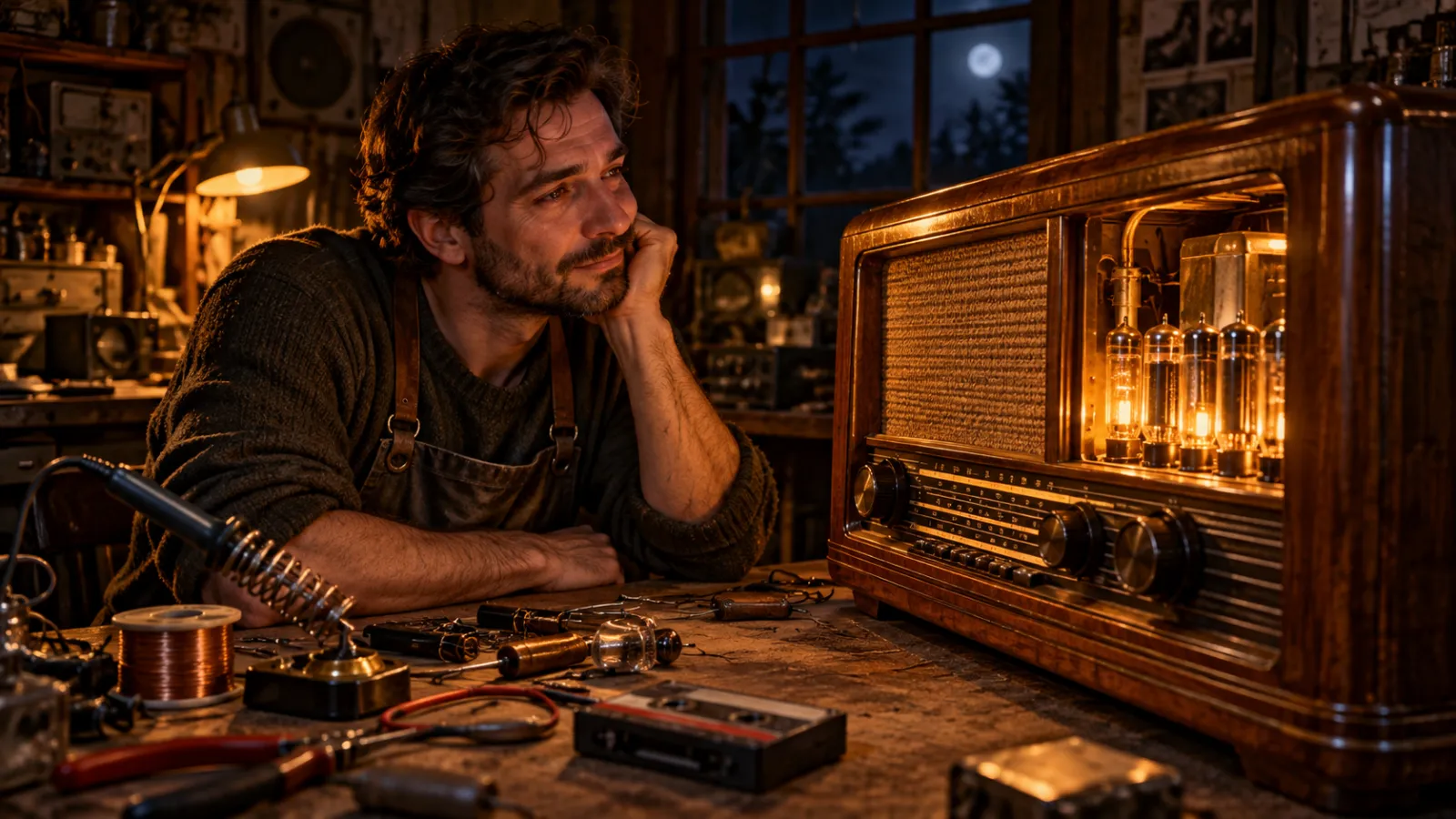
Chapter 4: A Familiar Frequency
I did not sleep that night. I sat on the wooden stool six feet away from the console, watching the looping audio trace on my oscilloscope until the gray dawn broke over the eastern ridge. Every sixty seconds, the sharp click repeated, followed by my father's calm baritone announcing his callsign.
At seven in the morning, I dialed Harold Vance.
Harold was seventy-two, a retired telecommunications engineer and my father's closest comrade in the Blue Ridge Amateur Radio Club. For four decades, the two of them had spent weekends stringing long-wire dipoles across pine branches and competing in international Morse code relays. If anyone understood Thomas's technical mind and his peculiar sense of humor, it was Harold.
When Harold pulled his battered pickup into the gravel driveway twenty minutes later, he was carrying a canvas technician's satchel. He wore a faded flannel work coat and an old ballcap with his callsign, K4HV, embroidered across the crown.
"Evelyn texted me before breakfast, Leo," Harold said gently, stepping into the workshop and wiping his boots on the mat. "She told me you spent all night out here staring at your father's old Zenith."
"Listen to it before you say anything, Harold," I said, my voice hoarse from lack of sleep. "Just stand right here and listen."
Harold gave me a look of deep, paternal concern. He walked over to the workbench, set his satchel down, and leaned closer to the arched acoustic grille.
The sixty-second loop reached its cycle point. The faint mechanical click popped softly.
"CQ, CQ, this is Whiskey Four Kilo Zulu Tango," my father's voice spoke into the chilly morning room. "Leo, if you are hearing this transmission, the primary filament is warm. And that means you finally stopped looking at the wood and started looking at the circuits."
Harold froze where he stood. The wrinkles on his forehead deepened, and his mouth fell open in utter disbelief. He reached out with a trembling hand, touching the edge of the walnut cabinet as if expecting it to be warm with life.
"Sweet mother of heaven," Harold whispered. His blue eyes filled with sudden moisture, reflecting the pale morning light from the window. "That's Tom. That is absolutely Tom."
"Is it a pirate broadcast?" I asked, pacing the concrete floor. "Could someone have gotten hold of an old cassette recording of him from the club archives and set up an illegal micro-transmitter down the mountain?"
Harold shook his head slowly, his expression shifting from shock to sharp professional focus. "Tom's voice wasn't recorded on any club tape talking like that to you, Leo. That was recorded specifically for your ears."
He unzipped his technician's satchel and pulled out a modern portable spectrum analyzer and a calibrated radio-frequency field-strength wand. He flipped the power switch on the handheld instrument, and the liquid crystal display lit up with a clean digital grid.
"Let's see what we are dealing with," Harold muttered, adjusting the center frequency to 7.150 megahertz.
He held the antenna wand near the Zenith's chassis. A sharp, needle-like spike rose immediately on the analyzer screen, peaking at an amplitude of minus fifteen decibels.
"Look at that trace," Harold said, pointing his pen at the screen. "There is zero Doppler shift, zero ionospheric multipath distortion, and absolutely no ground-wave flutter. That is a pure, unadulterated shortwave carrier wave."
Harold began walking backward toward the open garage door, keeping the antenna wand extended in front of him. With every step he took, the signal spike on the screen plummeted drastically. By the time he reached the gravel threshold eight feet away, the signal had completely disappeared beneath the ambient noise floor.
"A five-milliwatt micro-transmitter," Harold declared, turning back toward the workbench with an appreciative grin breaking across his weathered face. "Its range isn't more than fifteen feet. The signal isn't coming from Asheville, and it isn't coming from down the street. It is originating right here, within arm's reach of this bench."
"Inside the cabinet?" I asked, stepping up beside him.
"Inside the cabinet itself," Harold confirmed, tapping the side of the wooden case. "Your father knew modern ham receivers can scan all bands automatically, but he didn't broadcast this on an open ham channel where half the state could hear it. He wanted you to find it where you had to earn it with a soldering iron."
Harold patted my shoulder with a heavy, steady hand. "When Tom got his terminal diagnosis last November, he stopped coming to the weekly radio breakfasts. He told us he had an urgent private engineering project to finish in his shop before his strength ran out. We all thought he was working on his antenna arrays. But he was building this for you."
I looked down at the amber glow of the dials, the lump in my throat growing tighter. "Then we need to pull the speaker baffle and find where he hid the circuit."
"Get your flashlight and your nut driver," Harold said, his eyes gleaming with old excitement. "Let's see how the master operator wired his final message.
End of chapter 4