Family4 min read
My Brother Put a Price Tag on Mom’s Kitchen Table
Six weeks after Mom’s death, I came home to help clear her rented house. My brother had already sold her kitchen table, and the buyer was at the door.
Chapter 1: Forty Dollars
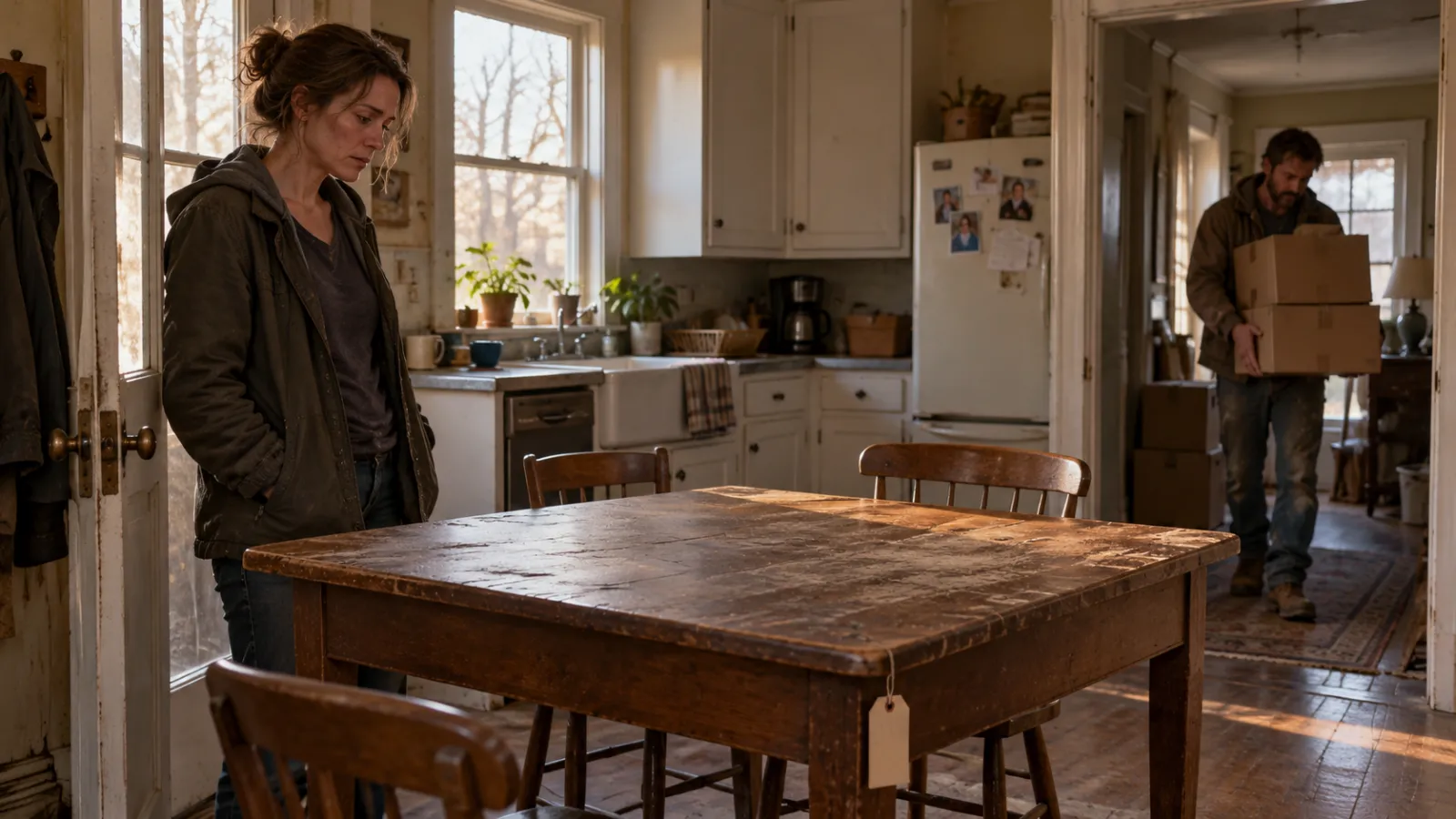
My brother had put a forty-dollar price tag on Mom’s kitchen table. Before I could tear it off, a woman at the door said she had already paid for it.
I kept my fingers around the string. The woman had one foot on the porch and a folded furniture blanket under her arm.
“Owen?” she called past me. “Is this a bad time?”
My brother came out of the hallway carrying a box of towels. He set it against the wall instead of answering.
“That’s Denise,” he told me. “She came this morning.”
“This morning?” I had driven three hours to get there. My overnight bag was still beside the door. “You couldn’t wait until I arrived?”
“You said noon. It’s almost three.”
There had been traffic, but not three hours of it. I had stopped for coffee and sat in the parking lot after it went cold. I had not wanted to come into this house without Mom in it.
She had been dead six weeks.
Denise lowered the blanket. “I can step outside.”
“No,” Owen said.
“Yes,” I said, at the same time.
She looked between us, then put the blanket on the porch rail. “I’m going to give you a minute. But I borrowed a vehicle for this.”
The screen door clicked shut behind her. It still caught halfway, the way it had when Mom carried groceries through it. I used to kick the frame gently to make it close. Now the little noise sounded like something we should have kept.
“You’re selling her table,” I said.
“I’m clearing the house.”
“Those aren’t the same thing.”
Owen rubbed a red mark on his forearm. He was forty-three, five years older than me, and that afternoon he looked older than five years could account for. His work shirt had a pale square where a name patch had been removed.
“The landlord gave us through Monday,” he said. “Not another month. Monday.”
“I know she rented. You don’t have to explain that.”
“I sent you the date twice.”
Around the kitchen, cupboards stood open. The hook for Mom’s calendar was empty. There were clean rectangles on the refrigerator where photographs had been, and a trash bag tied so tightly its plastic neck had turned white.
I had expected the house to be sad. I had not expected it to look efficient.
On the table, the burn from a hot pan sat just inside the edge. Mom had blamed Owen for it for years, although I remembered putting the pan down myself. When she caught me tracing it with my thumb, she used to say the table had survived worse than dinner.
“I could take it,” I said.
“In your car?”
“I could rent something.”
“It’s sold, Rachel.”
“You sold it for forty dollars.”
“That was the price.”
I pulled the tag upward. The string caught beneath the lip of the tabletop, and the whole corner moved toward me. Owen put his hand flat on it.
“Don’t lean on that side. The leg’s loose.”
Of course he knew which leg. He knew which kitchen drawer stuck, too. I knew the stories attached to the furniture. He knew what needed fixing.
That thought irritated me enough to say, “Did you sell everything else for gas money?”
His hand came off the table.
“The sale money is being recorded,” he said. “It isn’t gas money.”
Beside the packing tape lay a small notebook and a folder thick with envelopes. I saw a utility logo, then a red line across the corner of a bill. Owen moved the folder away from a coffee ring without looking at it.
“Forty dollars,” I repeated, because I did not know what else to accuse him of.
He picked up the towel box. “If you wanted to choose things, you could have come last weekend.”
“I had work.”
“So did I.”
Neither of us moved. Through the kitchen window I could see Denise checking her phone beside an old van. She had not left the engine running. I took that as evidence she intended to wait us out, although all she had done was buy a table.
I opened the screen door.
“I’m sorry,” I said. “My mother died recently. This table matters to me.”
Denise put her phone in her pocket. “I’m sorry about your mother.”
“Could you take something else? There are chairs. I could give your money back.”
“I need a table.” Her voice stayed level. “My kitchen’s narrow. I measured this one.”
I had imagined someone hauling it away for a rental property or breaking it up for craft wood. Her plain answer left me with nowhere useful to put that anger.
“I understand,” I said, though I was still blocking the doorway.
Owen stepped behind me. “We’ve got a problem with one leg. I should have checked it properly before you came.”
Denise looked at the table through the screen. “Is it repairable?”
“Yes,” he said. “But I don’t want you moving it like that.”
“When?”
“Monday morning. We’ll deliver it.”
She glanced back at the van. “I can borrow this again Monday. I can’t keep chasing you.”
“You won’t have to,” he said.
I wanted him to stop making arrangements. I wanted a night in which nothing else disappeared. Instead, I asked whether she could wait while we repaired it.
“That’s what he’s offering,” Denise said gently. “Not canceling.”
I nodded once. It was not agreement with everything. It was enough to let her come back inside.
She set her blanket on an empty chair, reached into her jacket, and unfolded a receipt. Owen’s handwriting crossed the top. Below it was the date, the amount, and the words paid in full.
Denise held the paper out to me.
“Here,” she said. “So we’re all talking about the same thing.”
End of chapter 1