Family4 min read
My Brother Put a Price Tag on Mom’s Kitchen Table
Six weeks after Mom’s death, I came home to help clear her rented house. My brother had already sold her kitchen table, and the buyer was at the door.
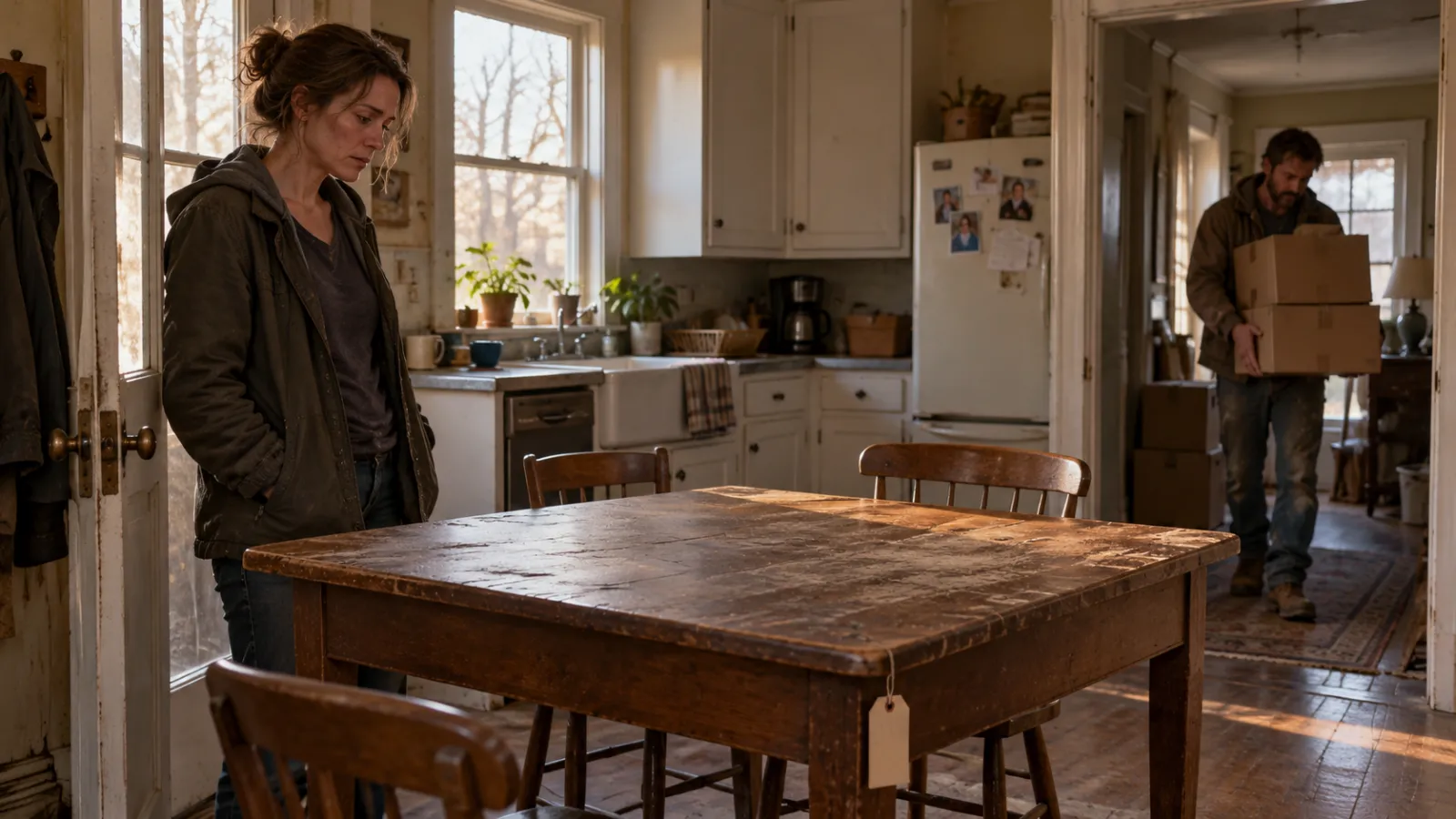
Chapter 2: The Receipt
I took the receipt from Denise and read the words beneath paid in full.
Kitchen table. Forty dollars. Pickup Friday.
There was no betrayal written there, no description of Sunday dinners or the place Mom kept her sewing basket. Just an ordinary sale, completed before I arrived.
Owen asked for a pen. He crossed out the pickup line, wrote Monday morning delivery after leg repair, and initialed it. Denise added hers, then photographed the page.
“Send me the time Sunday,” she said. “I’ll bring the van here.”
She tucked the receipt away. I stepped aside without making her ask.
After she left, Owen wrote in his notebook. I watched his hand, expecting him to hide the forty dollars somewhere. Instead, he opened a small envelope marked household sales and put two twenties beside an entry for a lamp.
“Those go in the estate records,” he said.
“Along with everything in that folder?”
He followed my eyes to the bills. “Different things.”
“Can I see?”
He slid the folder across the table, carefully avoiding the loose corner. “You can see. But don't start with the last page.”
I started with the last page.
The credit-card statement showed a balance a little above eighty-four hundred dollars. I had a checking account, a small savings account, and no idea how I would react to opening that envelope every month.
“You owe this?”
“Yes.”
“For Mom?”
“Some of it.”
“You were going to pay it with furniture?”
Owen looked at the tag still dangling from the table. “Forty dollars wouldn't cover the interest. I'm selling things because this house has to be empty.”
I set the statement down. He turned the folder around and pulled out a worksheet with lines drawn in pencil. There were agency invoices clipped to payment confirmations, receipts for supplies, and dates beside transfers from his bank.
On one side he had written what he paid. On another, what Mom paid from her income. My transfers appeared in their own column.
Two hundred dollars a month. Eight months. Sixteen hundred dollars.
I had sent the money on payday and felt useful every time. Seeing the whole contribution fit in one narrow column made me want to explain what else had been happening in my life.
Instead, I checked the addition.
“Sixty-four eighty,” I said.
“After your money. That's what I can support with the records I've got. Not the card balance.”
An invoice listed twelve afternoon visits. Another listed overnight help. I read the dates twice. During those same weeks, Mom had told me she was doing better.
“Why didn't you say?”
“I said the help cost more than we thought.”
“You didn't say six thousand dollars.”
“I didn't know where it would stop.”
The refrigerator hummed behind us. I pulled a chair out and sat, but he stayed standing with both hands on the back of another chair.
“Is this something the estate pays you back?” I asked.
“Maybe some. Not because I wrote it down.”
He showed me an email confirming an appointment for limited legal help. He had been gathering documents for it. No one had promised reimbursement. Mom's bank balance, final bills, sale proceeds, and whatever came back from the rental deposit needed accounting before anybody talked about what remained.
“What about the house?” I asked, then heard myself.
“The house belongs to the landlord, Rachel.”
“I meant the deposit.”
He didn't argue about what I'd meant. “We don't know until they inspect it.”
I turned back to the invoices. Some entries were not agency bills at all. There was mileage, a replaced tire, groceries purchased with Mom's prescriptions, things that would need separating rather than putting one total at the bottom.
“And your own bills?”
“In the card balance. Not on that sheet.” He tapped the worksheet. “Rent at my place, ordinary groceries. Interest. There were weeks I used the card for those because I'd already paid for her help.”
I folded one loose receipt in half before realizing it wasn't mine. I smoothed it with my palm.
“I thought insurance paid for home care.”
“It paid for visits. Not somebody in the kitchen every afternoon.”
I looked at the kitchen door, measuring the distance from the chair to the stove. Mom had moved so slowly near the end. On my last visit, I had carried her tea and asked if she needed anything else. She had asked me to move the cup within reach.
I had moved it and driven home.
“You should've told me how bad it was,” I said.
Owen pulled the chair out at last. “You keep saying that like it would've made you come.”
“I would've helped.”
He looked down at his hands. There was glue dried along one thumbnail, although the table repair hadn't begun.
“I don't want to do this by guessing,” he said. “Neither of us.”
I wanted to take offense. The folder kept me from doing it cleanly. Every invoice had a date I could compare against my own calendar.
“Let me take pictures,” I said. “So I can go through them.”
He nodded. “Keep the account numbers out of anything you send around.”
“I wasn't going to send them around.”
“I know.”
It was the first thing he'd given me that afternoon without a correction attached.
I photographed the worksheet, then the invoices. Beneath the last clip lay Mom's calendar, taken down from its hook. Owen had used it as a cover so the paper wouldn't bend.
Across three Thursdays, Mom had written one word in her round, crowded handwriting.
Extra.
I put the phone down and opened the calendar flat.
Beside one of the Thursdays was a pharmacy pickup time, crossed out and written an hour later. Beside another was my name with a question mark. I remembered that week: a staff shortage at work, a call I had let go to voicemail, a text I had answered after dinner.
Owen reached for the empty coffee cups. I kept my hand on the page.
“Wait,” I said. “I need to read this.”
End of chapter 2