Family4 min read
My Brother Put a Price Tag on Mom’s Kitchen Table
Six weeks after Mom’s death, I came home to help clear her rented house. My brother had already sold her kitchen table, and the buyer was at the door.
Chapter 4: The Hours He Didn’t Bill
Saturday morning, Owen handed me a wrench instead of a story.
“Hold that nut underneath,” he said. “Don't turn it yet.”
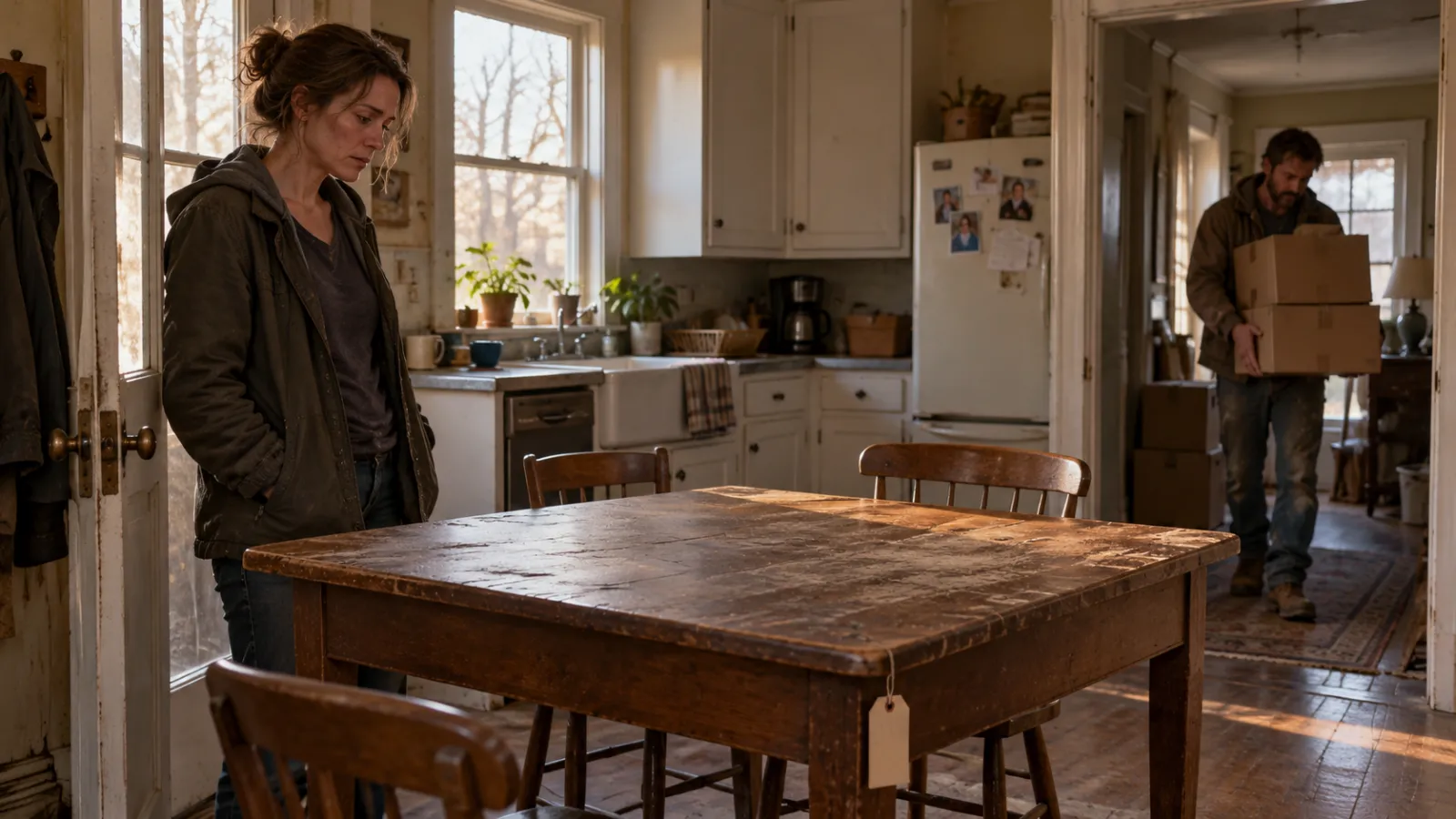
We had tipped the table onto a blanket. Without plates or bills on top, it looked smaller. Its underside was rough and dark, marked with the places people had wiped their sticky hands instead of getting up for a napkin.
The loose corner had a split wooden brace. Owen loosened the hardware and laid each piece in a saucer. He showed me where a new brace needed to go, then had me measure it twice.
“You remember where the hardware store is?”
“Yes.”
“Get that cut to size. Don't buy a whole bundle.”
I took the measurements and left. At the store, I stood in line behind someone returning a faucet and resisted sending Owen a photograph asking if the piece was right. I could read the dimensions on a label.
When I came back, he was folding Mom's sheets into a donation bag. He had set aside a thin blue blanket on the counter.
“Keeping that?” I asked.
“Used it when I stayed over.”
I set the new brace beside the table. “That Thursday?”
He folded another sheet. “I used it a lot of Thursdays.”
I waited. He told me the shift change had come with two days' notice. He had asked me first because the agency didn't always have someone available for nights. After my answer, he called again and booked the overnight block.
“Then why were you here?”
“She got upset when I said somebody new was coming. I stayed until she settled. Left late for work.”
“What did they say?”
“Docked the time. I didn't lose the job.”
The second sentence sounded like an answer he'd practiced for Mom.
He shook out a pillowcase. “I came back after my shift. The woman had to leave. Mom wanted breakfast, but not what we had.”
“What did she want?”
“Toast cut into little squares. Then she said they were too small to butter.”
I laughed before I could stop myself. Owen's mouth moved at one corner.
“She could be impossible,” I said.
“Yep.”
I had been careful not to say anything like that since the funeral. Hearing him agree made her more recognizable, not less loved.
He described another morning, waiting for transportation that came forty minutes late while Mom kept insisting she could walk to the car. He had sat with her through the appointment, then bought groceries, then gone home to shower before another shift.
I tried to picture the spaces between those tasks. I usually heard only the appointment result: no change, new medicine, another visit in a month.
“What about sleeping?”
“Some nights she slept.”
“And the others?”
He set the pillowcase down. “I'd hear her feet and get up. She'd say she didn't want to bother me. While standing in the hall.”
He did not make it a funny story that time.
I held the donation bag open. He pushed the sheets inside and tied it.
“Why don't you write those hours down?” I asked.
“For what?”
“I don't know. So it counts.”
“It happened. I don't need to price it.”
“I wasn't saying—”
“You want a number you can do something with. I get it. But I wasn't working for her by the hour.”
The bag handles dug into my hand. I set it down.
“I wanted a number yesterday, too,” I said. “Forty dollars was easier to fight about than all this.”
He picked up the blue blanket. There was a rubbed place in its binding, a little gray patch I remembered Mom rubbing between her fingers when she watched television.
“I shouldn't have sold the table without talking to you first,” he said.
I almost answered too quickly. Exactly. I bit the inside of my cheek and let him finish.
“I needed decisions made. I was angry at you. Both things were true.”
“You called me late on purpose?”
“I didn't call you about it at all.”
That correction hurt more because it was accurate.
“I knew you were mad,” I said. “I kept waiting until you weren't, so visiting would be easier.”
He looked at me. “How was that supposed to work?”
“It wasn't.”
We returned to the table. Owen fitted the brace, spread wood glue along the split, and set the clamps. I steadied the leg while he checked that it sat square. He explained what needed drying time and which screws would hold the repair.
I offered to pay for the supplies. He said to keep the receipt for the sale records. I put it in the household-sales envelope, not the care folder.
“Can I do the document scanning?” I asked. “You can keep the originals. I'll sort dates, match payments, make a list of what's missing.”
“For the lawyer?”
“Yes. Not to decide everything ourselves.”
He considered it, then gave me the folder.
“The email came yesterday evening,” he said. “We can go through it tomorrow. It isn't a promise they're paying me.”
“I understand.”
“I don't think you do yet.”
I wanted to tell him he could stop saying that. Instead, I asked where he kept the charger for the old printer.
By late afternoon, I had scanned the paid invoices and labeled the files. Two receipts were too faded to support what he'd written beside them. I put them on a separate page instead of guessing.
Owen brought the blue blanket to the door when we loaded the donation bags into my car. For a second I thought he was giving it away, too.
He folded it onto the passenger seat of his own car.
“Keeping that one,” he said.
I shut my trunk and didn't ask him to share it.
End of chapter 4