Family4 min read
My Brother Put a Price Tag on Mom’s Kitchen Table
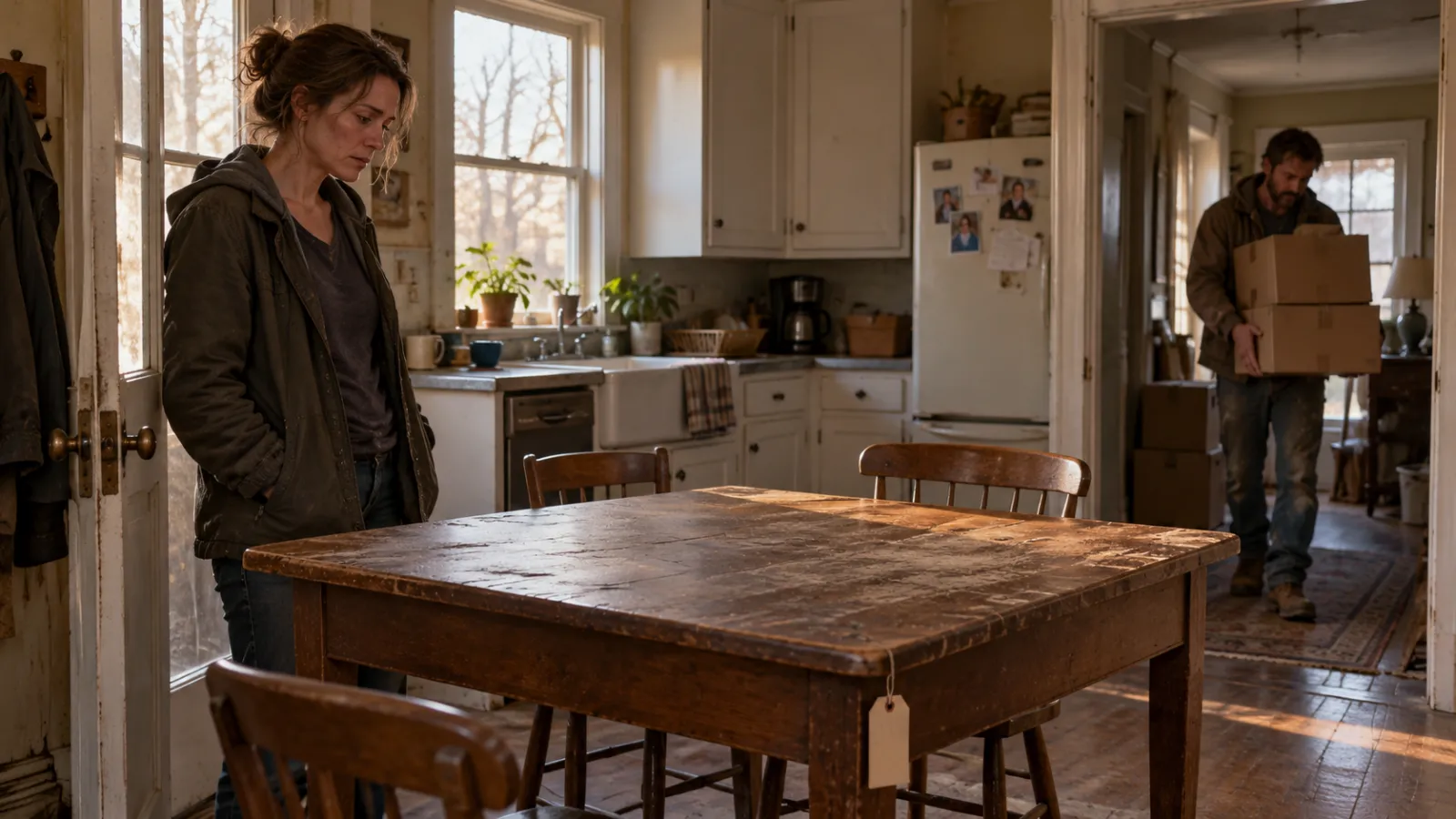
Six weeks after Mom’s death, I came home to help clear her rented house. My brother had already sold her kitchen table, and the buyer was at the door.
Chapter 7: A Place to Sit
Four months after we delivered Mom's table, I brought a bag of groceries to Owen's apartment and put it on the wrong counter.
“Not there,” he said. “That outlet's loose. I need to get it fixed.”
I moved the bag instead of offering to arrange an electrician before I had taken off my coat.
His kitchen smelled of onions. A pan sat on the stove, and a bag of potatoes waited beside the sink. Through the doorway I could see Mom's blue blanket over the arm of his couch.
“You got here on time,” he said.
“I left on time.”
“That helps.”
We had made the dinner plan two weeks earlier. Before that, there had been Wednesday calls, a legal appointment I attended by phone, and an afternoon when I drove down to help organize the remaining papers. None of those things had ended with Owen saying he forgave me.
One Wednesday, I missed the call because I stayed late at work. He sent a single question mark. I nearly wrote Crazy day, sorry and left it there.
Instead, I called during my walk to the parking lot, asked if the next evening worked, and called then. He was still irritated. He answered anyway.
The fourth three-hundred-dollar payment had gone through the previous month. Twelve hundred dollars so far, with more scheduled. It hadn't cleared his card. He had reduced some spending and spoken to the card company himself; he didn't ask me to manage that conversation.
The estate work had moved slowly. There was a written accounting for the rental deposit and more questions about expenses. We hadn't treated the whole care worksheet as approved, or helped ourselves to what money remained. The amount of any eventual reimbursement still wasn't ours to announce.
Our personal agreement stayed in its separate folder. I had stopped opening the balance on my banking app after every call, as if a transfer confirmation could tell me how my brother felt.
“Wash those?” Owen asked, pointing at the potatoes.
I pushed my sleeves up. “How many?”
“All of them. Leftovers.”
He had a little round table with a gray laminate top. One edge was chipped, exposing a brown layer underneath. I had eaten at it once before, years earlier, balancing takeout on a stack of unopened mail.
Tonight it was clear except for salt and a folded dish towel. There was no place on it where I remembered Mom's hand. Nothing to save from a stranger.
“Should I bring the bowls over?” I asked.
“Second cupboard.”
I found two ordinary cereal bowls. The plates were in the next cupboard, mismatched but unchipped. He caught me checking a rim.
“I don't keep the sharp ones,” he said.
“I noticed.”
We worked around each other without doing it particularly well. I opened a drawer into his hip. He moved my cutting board because I had left it beside the hot pan. Once, he took the knife from me to show how he wanted the potatoes cut, and I told him I knew how to cut a potato.
“Then do it,” he said, putting it down.
I did. We survived that conversation without needing a new agreement.
While the food cooked, he brought an envelope from the living room. Inside were two clearer copies of old receipts he'd obtained. I checked them against the missing-records list on my phone.
“I'll add these tonight,” I said.
“Tomorrow's fine.”
“I won't send them anywhere until you've checked the notes.”
He nodded and put the envelope away. We didn't spread the whole estate across the table.
I had brought a container of potato salad as well as groceries, made that morning in my own kitchen. When I took it out, Owen lifted the lid.
“Mustard?”
“A little.”
“Mom would've said more.”
“Mom always said more after somebody else had made it.”
He tasted a spoonful and went to the refrigerator. I thought he was getting mustard. He got the milk for the pan instead.
“Fine as it is,” he said.
I put the lid underneath the container. My fingers had started to tremble, not much, just enough to make the plastic rattle. I held it still against the counter until they stopped.
Owen stirred the pan.
“She used to tap the spoon first,” I said.
“On the table.”
“To get us listening.”
“Usually because you were talking.”
“I wasn't always.”
He looked over his shoulder.
“Okay,” I said. “Frequently.”
He laughed once, then turned back to the stove. I didn't stretch it into a speech about what she would have wanted. I couldn't know what she would make of the papers, the payments, or Denise's tablecloth. I knew how she had tapped a spoon.
Owen turned off the heat. I carried the potato salad to his table and set it beside the salt. He brought the hot pan on a thick folded towel.
“Don't make a burn,” I said.
“Wouldn't be the first one you blamed on me.”
“I'm never going to hear the end of that.”
“Probably not.”
He pulled out the chair closest to the kitchen. I took the other one. Its cushion was flatter than I expected, and the table rocked until Owen reached down to adjust something under one foot.
“Folded cardboard,” he said. “Works.”
I waited until he sat again, then passed him a plate.
We ate. He asked about my drive. I asked which shift he had next week. Halfway through dinner, I reached for the potato salad while he reached for the salt, and our hands knocked together over the chipped gray tabletop.
Neither of us moved our plate away. Owen slid the bowl between us, and I held it steady while he served himself.
The end