Family4 min read
My Brother Put a Price Tag on Mom’s Kitchen Table
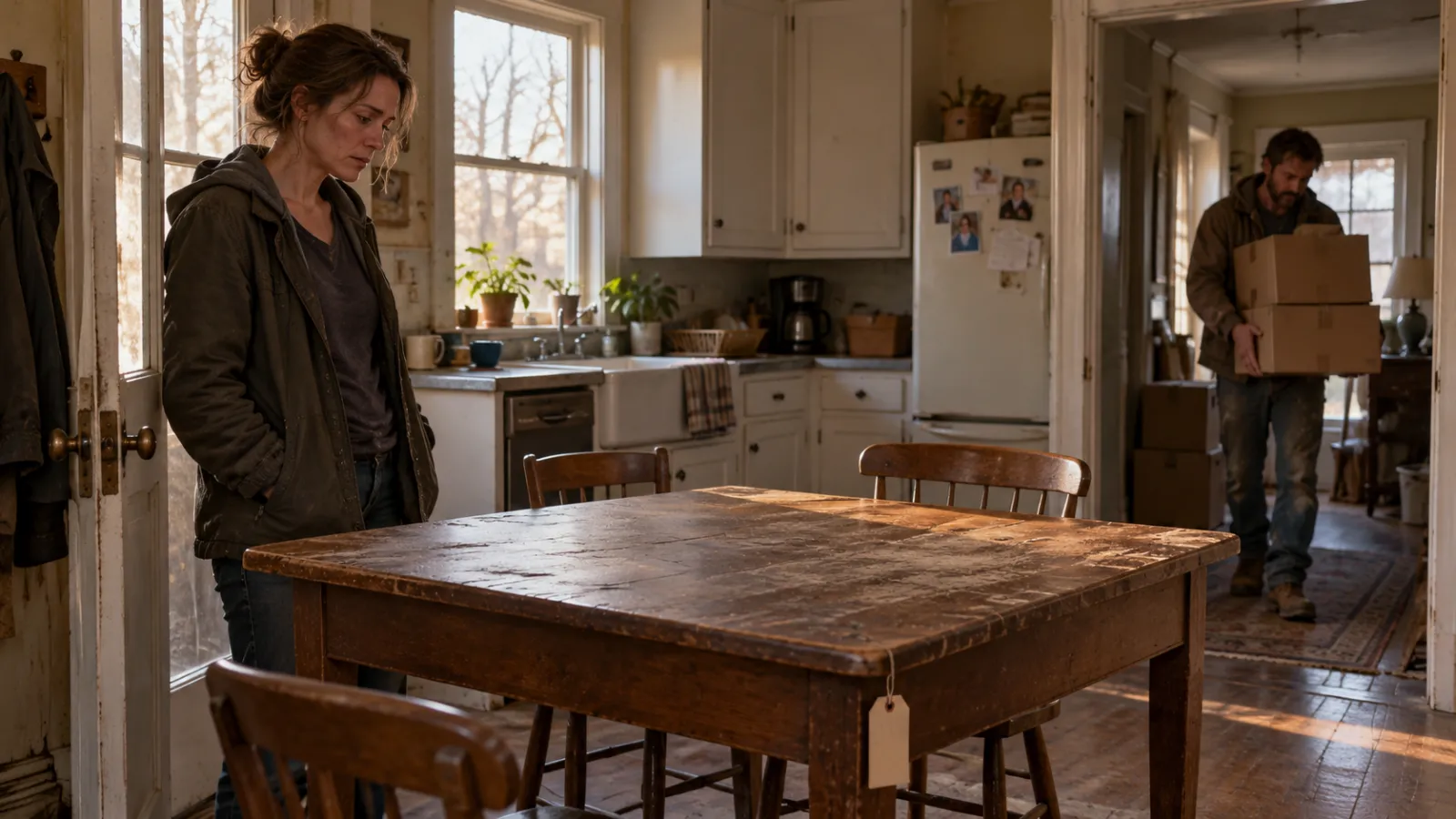
Six weeks after Mom’s death, I came home to help clear her rented house. My brother had already sold her kitchen table, and the buyer was at the door.
Chapter 3: What Mom Called Extra
The question mark beside my name was small enough that I could have pretended it meant something else.
I opened my messages instead.
Owen's text from that week was still there. Any chance you can stay Thursday night? They've moved my shift. She can't be alone that long.
My answer came five hours later. Payroll close. Can't get away this week. Can you get extra help?
Below it, he had written, I'll figure it out.
I had put a heart on that message. Looking at the little symbol now, I felt foolish enough to remove it, then left it alone. Changing an old reaction would not change that night.
“What was the extra?” I asked.
“Someone here when I wasn't.”
“Mom said it was an hour or two.”
“Sometimes it was.” Owen took a carton down from the cupboard. “Sometimes it wasn't.”
I matched the Thursday to an invoice. Eight overnight hours. The charge had been paid from his card.
Across the room, he packed Mom's everyday mugs in newspaper. I had asked him to let me read the calendar; now I wanted him to stand still and explain each square. He had a house to empty.
“Can you stop for a minute?”
He put one mug down. “What do you need?”
“I don't understand how she had nurses coming and still needed all this.”
“Nurse came to check her. Change a dressing. Go over medicines. Then she left.”
“And the agency?”
“Helped her wash. Made food. Stayed so she wouldn't try to get up alone. Different job.”
I found an agency number on the invoice. It was late Friday afternoon, still before their office closed. “Would they explain the charges to me?”
“They can explain their service. I don't know what they'll give you off her account.”
He found a statement on which the visit hours were listed without medical details. I called and asked about the rate and the overnight line. The woman answering explained the minimum block of hours and confirmed that the invoice was for nonmedical assistance. She did not discuss Mom's records with me.
I didn't push. That limited answer was enough to show that these were not duplicate nursing visits Owen had ordered for convenience.
When I ended the call, my phone screen showed a photograph of Mom from two summers earlier. She was standing beside the table with a bowl in her hands. I had cropped Owen's elbow out because it spoiled the picture.
I locked the screen.
On that visit, Mom had made potato salad sitting down. She insisted it was easier to reach everything that way. I had put the potatoes beside her, then watched her slide the bowl toward the edge so she could lift it without standing.
“Do you have enough help?” I'd asked.
“Oh, your brother likes everything organized,” she said. “He's getting a little extra.”
“Expensive extra?”
She waved her spoon. “Don't fuss. You've got your own bills.”
I'd told her to call if anything changed. Then I'd asked whether she wanted more mustard.
That was the conversation I remembered when I sent two hundred dollars each month. A little extra. Don't fuss. Her own income, insurance, my help, Owen nearby. I had arranged those facts into something I could afford to believe.
“She didn't want me worrying,” I told Owen.
“No.”
“And you didn't want me worrying.”
“I didn't want her worrying about us arguing.”
He wrapped the mug he had put down. A piece of tape stuck to his finger, and he shook it loose impatiently.
“You could've said she was minimizing it.”
“Would you have believed me over her?”
I thought of calls on which Mom sounded cheerful, followed by Owen's flat little updates. I had called him negative once. He hadn't brought it up. I remembered anyway.
“Not always,” I said.
He nodded without looking pleased.
I turned the calendar back another month. There were nursing appointments in blue, pharmacy times in black, blocks of paid help in Mom's handwriting. On evenings without an agency entry, Owen's initials filled the space.
Some days had no words at all, only a line drawn from afternoon into morning.
“Were those you?”
“Mostly.”
“Why aren't they on the sheet?”
“Because I didn't pay myself.”
I started to say he should have kept track, then saw how many dates were already tracked. He had kept track so Mom wasn't left alone, not so he could hand me a bill.
Outside, a car door slammed. I nearly went to the window, grateful for anything that would interrupt us. Instead, I took a newspaper sheet from the pile and wrapped the next mug.
It was chipped near the handle. I put the chip facing upward so whoever unpacked it would see it.
“Donate?” I asked.
“Not that one. Trash. It'll cut somebody.”
Mom had drunk from it for years. I put it in the trash box rather than making him argue another memory away from me.
We worked until the paper grew dim at the edges. Owen switched on the light above the stove, but the bulb over the table had burned out. He said there was a replacement in a drawer.
I found it myself.
When the kitchen brightened, he was holding the calendar open at the Thursday with my name. His thumb rested over the question mark.
“I was supposed to leave tomorrow afternoon,” I said. “I'm staying through Monday.”
“Okay.”
He didn't thank me. I could hear the van agreement, the table leg, and the empty cupboards in that one word.
“Tomorrow,” I said, “will you tell me what happened on that Thursday?”
He closed the calendar carefully.
“While we work,” he said. “There's still plenty to do.”
End of chapter 3