Kindness5 min read
The Lunch Lady's Second Tray
Donna fed hungry kids a second tray and paid for it herself, logged as waste. The district fired her over $41. Then the three-strike rule hit the one child nobody could afford to name, and I had to decide what I was willing to lose.
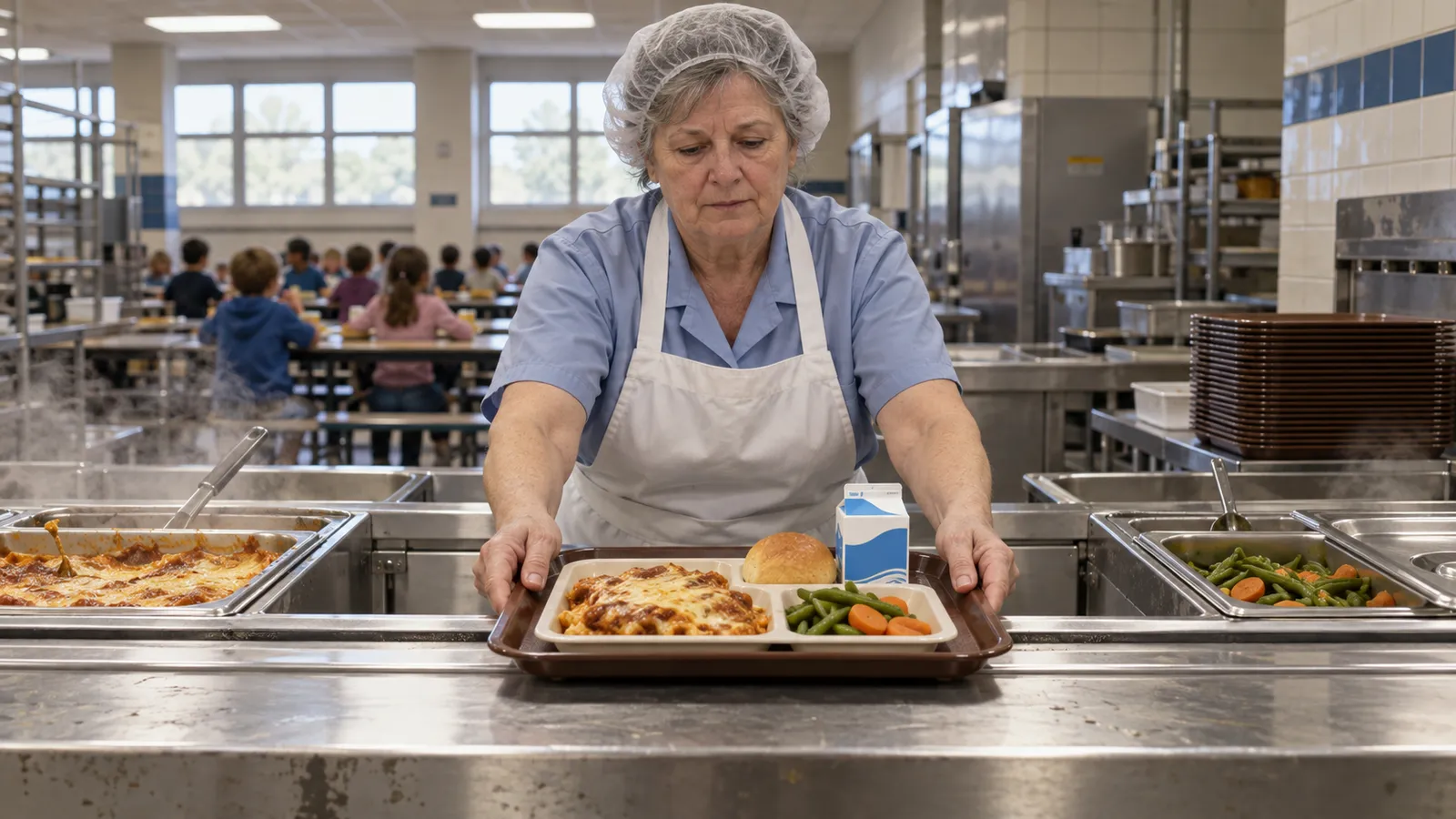
Chapter 1: Forty-One Dollars of Food
They fired Donna over forty-one dollars of food.
Not forty-one hundred. Forty-one dollars, and they had the number typed on the letter, which is how I know it was exact.
At 7:40 on Monday morning, October 6, Mr. Abney came through the kitchen and asked Donna Fairchild if she had a minute. He was humming. He hums when he has already decided something, and in nineteen years at Pike Hollow Elementary I have never heard him hum on his way to good news.
Donna put down the tongs and went with him in her apron. She did not take it off. That told me she expected to come back.
The office door closed. Rosa and I portioned four hundred and ten servings of chicken and noodles without speaking.
Then the door opened and Donna walked past us toward the loading dock instead of the cafeteria, and I understood she was not coming back.
I should explain what I do, because it matters to everything after.
I am the cashier. Donna cooked for twenty-six years; for nineteen I have sat at register two, and when a child's balance drops below negative ten dollars the screen prints ALTERNATE, and my job is to take the hot tray out of the child's hands and give them a cold cheese sandwich and a carton of milk. Forty cents, charged to an account already underwater.
I am the one who physically does it. Not the board. Not the superintendent. Me, with my hand on the tray.
Policy 412 came in with the new school year. Three parts people remember. One, no student under negative ten dollars gets a reimbursable meal. Two, they get the sandwich instead. Three, and hold on to this one: after three alternate meals in any thirty-day window there is no service at all. Not the sandwich. Nothing. The screen prints DENY and the child steps out of line.
That third part, 412.3(c), was not switched on in August. Verna Stafford at the district office phased it to the start of the second grading period so the software and the parent letters could catch up. Second grading period began Wednesday, October 15.
There was a fourth part, and people liked it. The registers now show only a first name and a four-digit student ID. No last name, no household. The woman at the register is not supposed to look at a child and know which family in town is behind on its bill.
Gerald Lockwood wrote that policy. He is on the board and owns a title agency on Water Street, and in August the Beacon ran a quote somebody clipped and taped inside the cupboard above the slicer, where it stayed all fall. The district is not a credit union. We cannot keep running one out of a steam table.
I thought that was a hard thing to say and probably a true thing to say, in that order.
The letter was still on the prep table at the end of the day, under the salt where Donna had left it.
Falsification of the daily production record. Unauthorized distribution of district food inventory valued at $41.00. Termination effective immediately.
I read it twice, then did the only thing I know how to do with a number, which is take it apart.
An entrée costs the district two dollars and five cents. It is on the cost sheet in the binder and I have heard Verna Stafford say it in three meetings. Two oh five.
Forty-one dollars divided by two dollars and five cents is twenty.
Twenty entrées. Twenty school days, September eighth through October third, not counting the in-service day, and I did not need a calendar for that, because I had worked every one of them next to her.
One hot entrée a day for a month, and somebody had finally counted.
I went to the clipboard in the office cubby where the daily production record lives. One sheet per day: planned, served, waste. The waste column is for trays that get dropped and pans that sit past temperature, food that cannot be served and cannot be counted toward the meals we claim.
Twenty sheets, every one with a single entrée in the waste column.
I understood exactly what she had done and nothing at all about why it mattered.
I caught her in the staff lot the next morning. She had come back for her knives, which she had every right to do, and was putting them in the trunk of a blue Corolla, rolled in a towel.
"Donna."
"Frances." When she is being serious she uses whole names. The rest of the time everybody is hon.
"Forty-one dollars."
"That's right."
"You paid for them."
She shut the trunk. "Three sixty a tray, adult price. Rang it through à la carte and paid cash, every day. They've got the drawer tape."
"Then what did you steal?"
"The entrée," she said. "Food came off the line as a meal and I wrote it as waste so the count would reconcile for the state. That's the falsification, and it's a real one. I'm not going to stand here and tell you it isn't."
She said it the way she would tell you the oven ran forty degrees hot.
"You should fight it," I said.
"No."
"Donna."
"They'll make me explain who." She got her keys out and looked at me, and her eyes were not wet, which somehow made it worse. "Twenty days, and it wasn't twenty kids. You want that in the paper? A ten-year-old reading about himself at the library?"
"So you just let them —"
"Frances." She got in the car. She said the next part through the open door, with the engine already going, and it is the only thing anybody said to me that whole autumn that I wrote down. "Whatever you do in there, don't let them tell you which kids."
Then she drove out of the lot and I went inside and worked a lunch rush alone. On the shelf above the slicer, where it had sat for twenty-six years, was a yellow pencil worn down to two inches with a flat place where her thumb went.
The production record for that Monday had a zero in the waste column, because she had not been there to write anything in it.
End of chapter 1