Kindness5 min read
The Lunch Lady's Second Tray
Donna fed hungry kids a second tray and paid for it herself, logged as waste. The district fired her over $41. Then the three-strike rule hit the one child nobody could afford to name, and I had to decide what I was willing to lose.
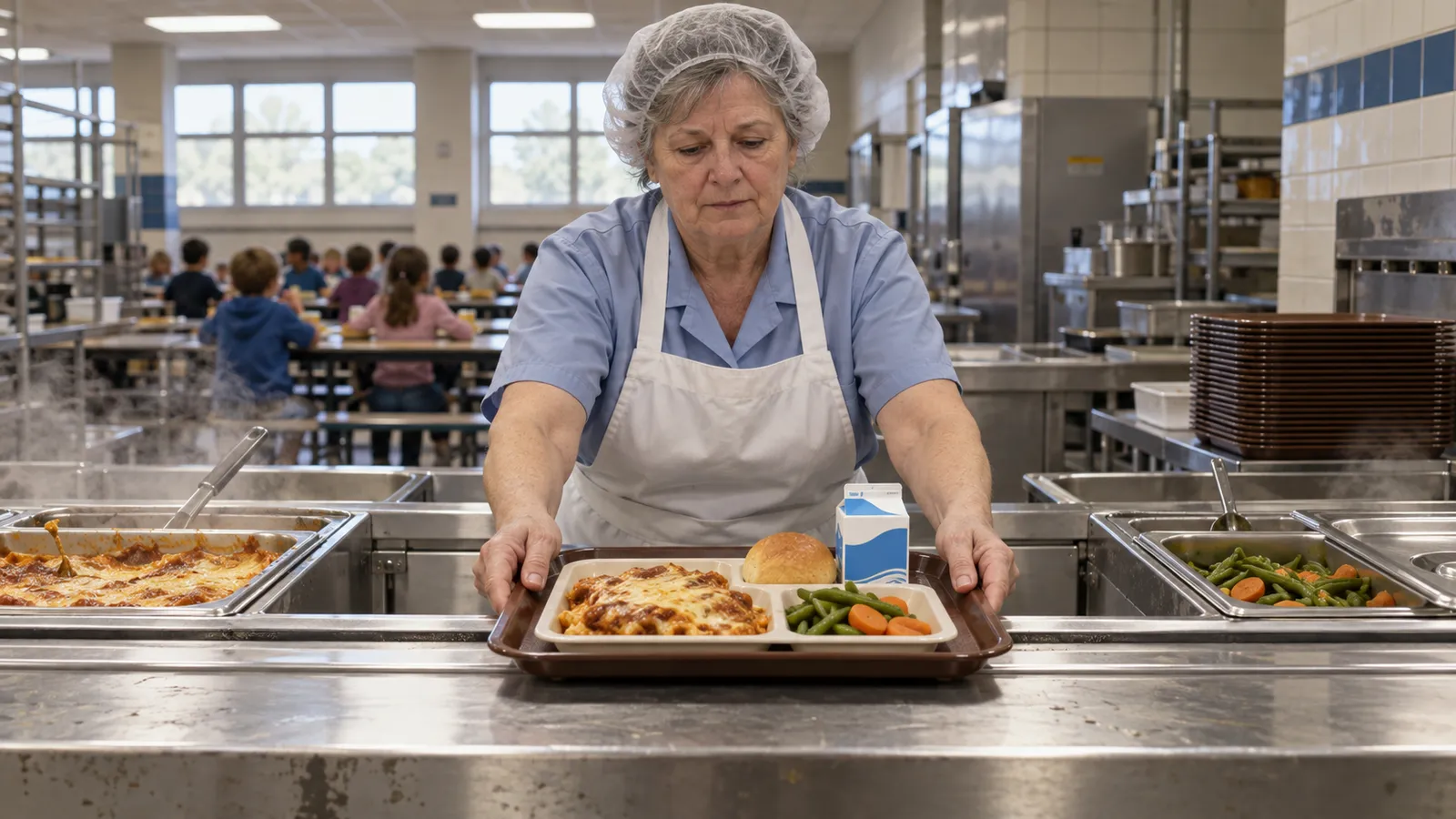
Chapter 3: Three Dollars Sixty
I had nineteen dollars in my coat pocket on Wednesday, October 8, and a pencil that was not mine.
Three sixty a tray. Nineteen dollars is five trays and a dollar left over, and payday was the seventeenth.
I did it anyway. I rang three sixty through à la carte at the end of service, plated an entrée, carried it down to the end table by the window, and set it in front of TOBY, ID 40118, who looked at it and then up at me.
"I didn't order this."
"It's extra," I said. "It'll get thrown out."
That was the lie Donna must have used, because he took it without another word, which meant he had heard it before.
Then I went and wrote one entrée into the waste column with her pencil and left the spoilage code blank, because there was no code for what I had done and I was not going to invent one.
Thursday I did it again. Friday I did it again. That was ten dollars and eighty cents gone.
Monday the thirteenth I had four dollars and change, and I plated the tray, and I did not ring anything through, and I wrote the waste line anyway.
That is theft. I want to be plain about it the way Donna was plain about it. On Monday the thirteenth and again on Tuesday the fourteenth, I took two dollars and five cents of other people's food and wrote a false line in a state record to cover it, and the only thing separating me from Donna Fairchild is that she paid and I had run out of money.
Wednesday the fifteenth I borrowed three sixty out of the coffee tin in the staff room and left a note in it, and that was six trays over six school days. Four paid, two not, one borrowed.
The fifteenth was also the day 412.3(c) went live. I did not think about that at the time, because I was busy congratulating myself on the coffee tin.
I went to see her on the Saturday. She lives past the grain elevator in a house with a ramp her husband built when her mother was dying in the front room.
She did not want to talk about it. She fed me.
"I'm doing it," I said. "The second tray."
"Mm." She put a casserole dish in front of me that I had not asked for.
"The fourteen-day one. Toby."
She stopped with the serving spoon in the air, maybe a second, maybe less, and then she kept going. "Eat that while it's hot."
"Donna."
"I'm not doing this, hon."
"You're the only person in the county who knows how this works."
"I know exactly how it works. It worked for twenty days and then it stopped, and the stopping is the part you're not looking at." She sat down across from me. "What happens when you run out?"
"I'll —"
"You've got nineteen dollars a week in you. I had thirty years of a husband's pension in me and it still came to twenty days." She pointed at me with the spoon. "It's the wrong size, hon. One woman's pocket against four hundred and ten kids."
"Then tell me what the right size is."
"Not my job anymore." She got up and started the water. Then, with her back to me: "You remember what I said in the lot."
"Don't let them tell you which kids."
"That's half of it." The water ran. "The other half is don't you go telling them either."
I sat with that a while. "You knew whose kid he was."
She shut the water off. "I knew he was ten and he wasn't eating. That was all the information I needed and it's all you need, and if you go collecting more you'll start deciding who deserves it, and the day you start deciding is the day you turn into them."
She sent me home with the casserole. I ate it for three days.
Walt's concentrator alarmed at two in the morning on Wednesday the fifteenth. It does that when the filter is loading up. You pull it, rinse it, reset it, and the business takes four minutes and knocks a night out from under you.
He sat on the edge of the bed with the cannula in his hand and apologized, which is what he does, and which I hate.
The insurance card is on the fridge under a magnet shaped like a pepper. Dunbar, Frances E., and under it Dunbar, Walter J., dependent. Nineteen years at the district buys that card, and the card buys the concentrator and the tank delivery and the pulmonology appointment in Zanesville every eight weeks.
After he went back down I did the arithmetic I had been refusing to do: what it costs me to buy a ten-year-old a hot lunch is three dollars and sixty cents up front and everything on the refrigerator door on the back end.
Mr. Abney called me in on Thursday the sixteenth, at 7:35, and he was humming.
"Frances. Sit down. How's Walt?"
"He's all right."
"Good. Good." He had the production records on the desk, six of them, squared up. "Verna's office flagged six waste entries out of this building in the last seven days. No spoilage code."
"That's right."
He waited for me to say something else. I did not.
"I have to ask you directly, because if I don't, I'm the one who's lying. Are you putting food out that isn't being rung?"
"Four of them I paid for. Two of them I didn't."
He put his hand over his eyes for a second.
"I'm not going to write up what you just said," he said. "I'm going to write that I counseled you about waste documentation and that you understood. Verbal warning, note to file. If there's a seventh, Verna doesn't send it to me, she sends it to personnel, and then it's a termination and I can't stop it."
"Like Donna."
"Exactly like Donna." He opened his desk drawer for the counseling form, and the drawer was half full of granola bars, the kind in the yellow wrapper, forty-eight to a box from the warehouse club.
He saw me see them. Neither of us said anything about it. He has been handing those out for eleven years to kids who come in shaky at ten in the morning, and he buys them himself, and there is no line anywhere in any record where they appear, and if anybody from the district ever opens that drawer with a clipboard in hand he is finished too.
I signed the form. I meant it when I signed it. I had six trays in me, a card on the refrigerator, and Donna's own verdict on the size of the thing.
It was not until I was back at the slicer, tying my apron, that I did the arithmetic that mattered. The register had already done it. I only had to read it.
Wednesday the fifteenth, the day the clause went live, Toby's card printed ALTERNATE, because it always printed ALTERNATE; what I did afterward at the window table had never been visible to the system at all. Strike one.
That morning, the sixteenth, there was nobody left to carry a second tray down to the end table. Strike two would print in four hours, with my hand on the keypad.
And then there was Friday.
End of chapter 3