Kindness6 min read
The Lunch Lady's Second Tray
Donna fed hungry kids a second tray and paid for it herself, logged as waste. The district fired her over $41. Then the three-strike rule hit the one child nobody could afford to name, and I had to decide what I was willing to lose.
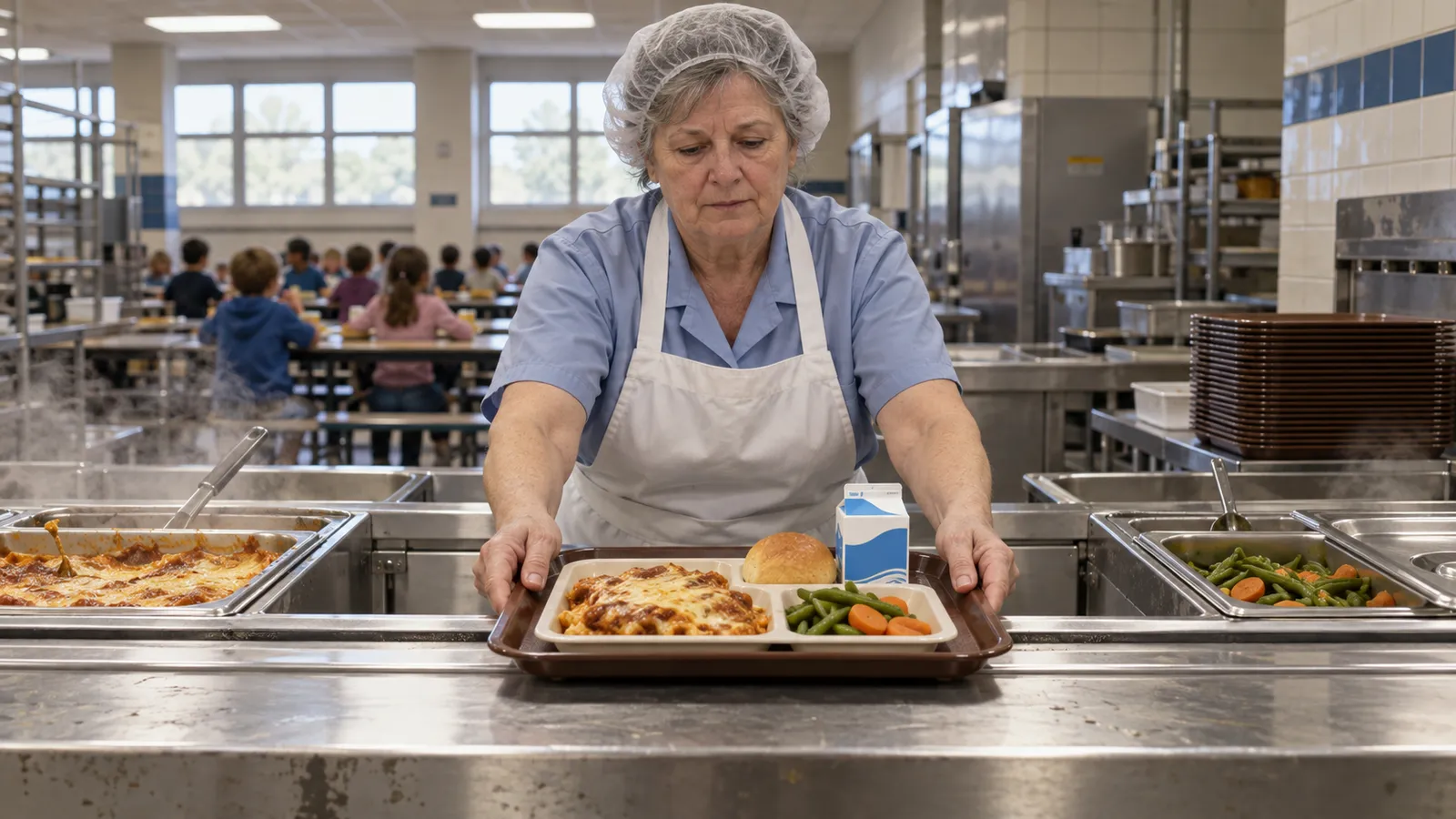
Chapter 9: Executive Session
They hold the board meetings in the high school library, in the open part between the stacks and the circulation desk, and they set out forty-one folding chairs. I counted them while I waited, because I count things, and I have never once in nineteen years seen more than nine of them used.
That night there were thirty-some people in them. Donna Fairchild was in the back row in her coat with her purse on her knees, and she had not told me she was coming.
Five board members at a long table with name cards. Gerald Lockwood at the far right end in a gray suit, turning his ring. Verna Stafford at a side table with the tote bag. Mr. Abney at the back by the periodicals, which is where principals stand.
They did the flag, the minutes, and a bus bid, and then the president said public participation, three minutes each, address the board and not individuals.
The first three speakers were a bus stop on Township Road 12.
Then the clerk said, "Frances Dunbar."
I had written something out and I did not read it. I went up with the production records in my hand, the actual sheets, twenty of them and then six, salt-cellar rings still on the corners.
"My name is Frances Dunbar, I'm the cashier at the elementary, and I've got the thing in my hand that this is all about, so I'm going to read it to you.
"September eighth. Planned four hundred and ten. Served three hundred eighty-six. Waste: one entrée. Spoilage code: blank.
"September ninth. One entrée. Blank.
"September tenth. One entrée. Blank."
The president said, "Mrs. Dunbar —" and I kept going, because three minutes is a hundred and eighty seconds and the twenty days took me forty of them.
"That's twenty school days and twenty entrées, and the district valued them at forty-one dollars and fired Donna Fairchild for it on the sixth of October.
"Over the same twenty days there are twenty cash lines on the drawer tapes at the adult meal price. Three dollars and sixty cents each. Seventy-two dollars, out of her own pocket, into your drawer.
"Forty-one dollars out. Seventy-two dollars in. You are thirty-one dollars ahead on the theft you fired her for, and that thirty-one dollars went into the general fund in September and it is still there."
Somebody behind me said something, and the president put his hand up for quiet, and not at me.
"Here's the rest of the numbers and then I'm done. District-wide negative balance as of the thirty-first of October: six thousand two hundred fourteen dollars and eighty-eight cents. Children who got the cheese sandwich at least once in October: a hundred and six. Children who got it twice: forty-one. Children this district served nothing at all to: eleven.
"Mrs. Stafford can carry all of them and the arrears for about seven thousand five hundred dollars, which is four tenths of one percent of what runs through her office. She'll confirm that; it's her sheet, not mine.
"And I will tell you the one thing a cashier knows that none of you do. The reason you never heard about any of this until tonight is that for twenty days it was in the waste column. Donna hid it to protect the children, and it worked, and because it worked your own reconciliation showed a kitchen with a sloppy cook instead of a school with hungry kids.
"So I'm not asking you to thank anybody. I'm asking you to strike 412.3(c), the part that says after three times they get nothing, because I'm the one that has to say it to them, and on the twenty-first of October I said it to a fifth-grader with eleven kids behind him in line, and I am not willing to do it again."
My three minutes were up. The clerk said so.
Then Pauline, who is on the board and who taught my youngest in third grade, leaned into her microphone and asked the question I had been told in that dentist's-office waiting room that somebody would ask.
"Mrs. Dunbar, the child who received fourteen of those twenty trays. Is that a child in a family that could pay?"
The room got very quiet. Thirty-some people and the hum of the heat.
"I'm not going to answer that," I said.
"I'm not asking for a name."
"You're asking for the next three questions after the name, ma'am, and I'm not going to answer it."
And that was going to be the end of it. I want to be clear about that, because people in this town have since told the story as though I did something brave at that microphone, and what actually happened is that I stood there having run out of everything I had, and the clause was going to survive by one vote.
Gerald Lockwood put his hand on his microphone and turned it on out of turn.
"Mr. President, I'd ask the board's indulgence for a minute, because Mrs. Dunbar is protecting my family and she shouldn't have to do it twice."
I have gone over the four sentences he said after that many times and I cannot improve them, so here they are.
"The child who took fourteen alternate meals in September is my son. My wife and I separated in August and a temporary order has frozen our accounts since the second of September; the income on his meal application is from a tax return and the formula cannot see a court order. He was denied service in that cafeteria on the twenty-first of October, and the reason no one in this district was able to tell me that was happening is the identification screen I insisted on and still believe in.
"I wrote 412.3(c). I'd move to strike it."
Nobody said anything for a second or two. Then Pauline said, "Second," and she said it fast, and the president asked Mrs. Stafford to come to the table with her numbers.
It took twenty-five more minutes, which is the part nobody remembers.
Verna Stafford went up with the flowchart and the state letter and walked them through the one dollar ninety-six, the February review and the seven thousand five hundred, and she said the words bridge account for the first time: a line out of fund balance to carry negative balances up to twenty-five dollars so a child always gets the reimbursable meal, reconciled monthly, reported in January.
Dale asked what happens when the seven thousand five hundred runs out. She said they would be back in the spring with a real number instead of a column of waste. Dale said that was not an answer. She said it was the only honest one she had.
The motion to strike 412.3(c) and authorize the bridge account carried three to two. Pauline and the president and Lockwood for. Dale against, on cost. The fifth member against, because she said a fund balance is not a plan.
The alternate meal stayed. The ten-dollar floor stayed. The identification screen stayed, and Lockwood said on the record that he would resign before he let anybody take it out, and I agreed with him, which I did not expect to be doing at nine o'clock that night.
Then the president said that the matter of a personnel action concerning a former food service employee would be taken into executive session, and asked the audience to clear the room.
Donna stood up in the back row and put her purse over her arm.
Thirty people filed out past the circulation desk. The five of them and Verna Stafford went into the conference room behind the stacks, and the door closed with Donna Fairchild's name on the other side of it.
We stood in the lot at twenty to ten. It had gone cold that week.
"You read my sheets out loud," Donna said.
"I did."
"Did you give them the boy?"
"No. His father did."
She looked at the one lit window at the back of the building. She did not ask what I thought they were saying in there, and I did not offer. We had both worked for that district long enough to know better than to guess.
"Thirty-one dollars ahead," she said. "I never did add it up that way."
"You should have. It's the only part of it anybody understood."
She got out her keys. Twenty-six years, a stub pencil, twenty hot trays, and a woman standing in a parking lot at forty degrees waiting on five people behind a door to decide whether she could come back to work.
"Go home, hon," she said. "Walt'll be up."
The offer came out of that room on Wednesday, and it had a written reprimand in it.
End of chapter 9