Kindness5 min read
The Lunch Lady's Second Tray
Donna fed hungry kids a second tray and paid for it herself, logged as waste. The district fired her over $41. Then the three-strike rule hit the one child nobody could afford to name, and I had to decide what I was willing to lose.
Chapter 4: Strike Three
Strike two went through at 11:54 on Thursday, October 16, and it did not look like anything.
That is the part nobody understands who has not stood behind a register. The screen prints ALTERNATE, the same as it has printed all autumn, and you hand across a sandwich in a triangle of plastic film and a half pint of two percent, and the child says thank you, and the line keeps moving, because there are a hundred and four children behind him and nineteen minutes to get them through.
He said, "It's fine. My dad put money on it this morning."
He put the sandwich in his backpack. He drank the milk.
In the system, somewhere in the district office, a counter moved from one to two.
Friday I was at register two at 11:40 with my hands clean and the note to file in my locker in an envelope with my name misspelled.
I had told myself four different things on the drive in. The one I settled on was that if I lost this job the oxygen company would want nine hundred dollars a month, and we do not have nine hundred dollars a month.
That is what I was thinking about. Not him. The nine hundred dollars.
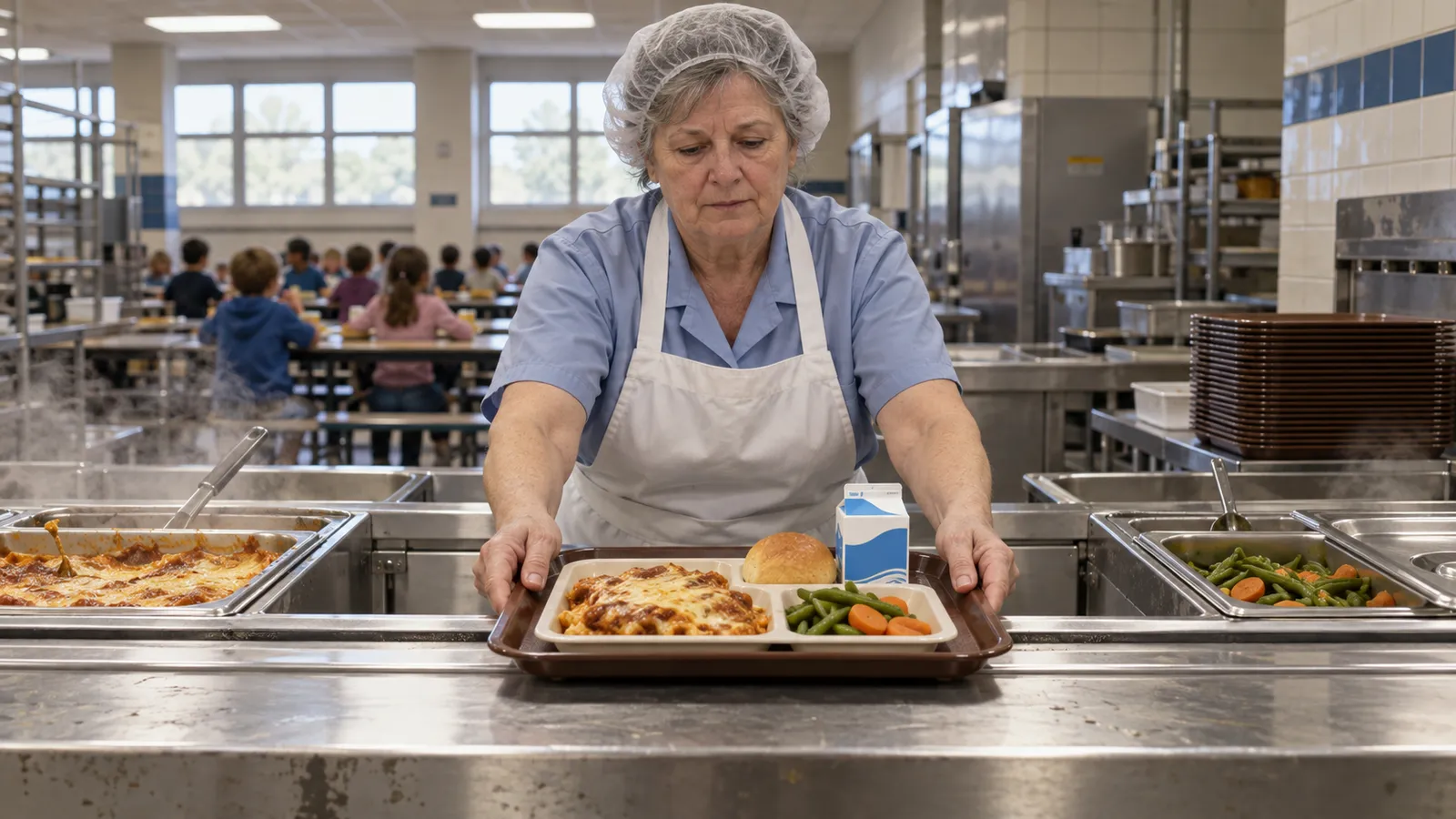
Fifth grade comes down at 11:50. He was eleventh or twelfth in line, behind the Kessler twins, and he had a hot tray on the rail: turkey, mashed potatoes with the skin in, green beans, roll, peaches. He keyed in 40118.
The screen did not turn amber.
It turned white, and the letters came up bigger than ALTERNATE ever did, and the printer beside the keypad spat out a slip the size of a receipt.
DENY. NO SERVICE. 412.3(c). ID 40118.
I had never seen it before. I had been told in an in-service in August that I would see it and what to do, which is: no reimbursable meal, no alternate meal, direct the student to the office.
The line stopped. Not dramatically. Children do not gasp. The line stopped because I stopped, and the Kessler twins turned around to see what was taking so long, and a girl two back said what in that tone they have, and that was eleven children looking at the end of the rail.
"Toby," I said. "Hold on a second."
"My dad put money on it this morning." Same sentence. Same polite receptionist voice. Then, when I did not move: "It went through this morning. It probably just hasn't gone through."
He heard himself say it both ways. I watched him hear it. He was ten years old and he was standing in front of a hundred and four people with a tray of turkey in his hands, and he was patching a lie in real time, and that is a thing a child learns at home.
"I need you to set the tray down, honey."
He set the tray down on the rail.
"Can I have the sandwich?"
"There's no sandwich today."
He did not ask why. That is what I think about. He did not ask why, he did not argue, he did not cry. He said, "Okay," and he picked his backpack up off the floor, and he walked out of the cafeteria past a hundred children, and the line started moving again.
Rosa was at the second well. She turned around and faced the wall and started wiping down a surface that was already clean.
I rang up eleven more children. I remember doing it. Milk, milk, à la carte cookie, milk.
Then I turned the register key to the stop position, which I have the authority to do when the drawer needs changing and at no other time, and went to my locker for the paper sack with my own lunch in it: the last of Donna's casserole in a margarine tub, pretzels, an apple.
He was sitting on the floor in the hallway outside the gym with his back against the tile and his backpack between his knees.
"Here."
He looked at the margarine tub. "What is it?"
"Chicken and rice. There's a fork in the bag."
"Is it extra?"
"No," I said. "It's mine. I'm giving it to you."
That was the first true sentence anybody had said to him in that building in six weeks, and I watched it go in, and he got very red and very still.
"You don't have to."
"I know."
He took it. He ate about half of it sitting on the floor because there were nine minutes left and he was not going to be able to eat in the cafeteria now, not that day, probably not for a while.
Mr. Abney was standing in the doorway at the end of the hall. He had come down because the office had a fifth-grader in it with no lunch and a DENY slip, which is an incident, and incidents go on a building's record.
He watched me hand a district employee's personal food to a denied student in a public hallway. He did not hum. He went back up the hall and he did not say one word to me about it, that day or ever, and I have thought a great deal about what that silence cost him.
Here is what I want to be honest about, because if I am not honest about this part then the rest of it is just a nice story about a lunch lady.
My lunch was not a tray.
It was a margarine tub of somebody else's casserole given to one child in a hallway where no auditor could ever see it, and it fed him for one day, and it did not move a single number anywhere in the world. The next day he would key in 40118 and the screen would print DENY again, and the day after that, until the balance cleared or until the thirtieth day rolled the first flag off the back of the window, and no part of that was affected in any way by what I had done.
I had done the smallest possible good thing in the largest possible way, which is to say I had made myself feel better in front of an audience of eleven children.
Donna bought twenty trays and kept it off every record on earth and it worked.
I bought one and a half of them, got caught, promised to stop, kept the promise, and a ten-year-old carried his backpack out of a cafeteria at 11:52 on a Friday.
At the end of service I took the DENY slip out of the printer well, folded it once, and put it in my apron pocket next to the two-inch pencil. I did not know yet what I wanted it for.
It had the ID on it. 40118. It did not have a name on it, because the policy does not allow the printer to have one.
But a four-digit number is a four-digit number, and that Wednesday afternoon, while I was waiting on the copier to finish the field-trip rosters for the fifth grade, I found out that the policy does not govern a bus list.
End of chapter 4