Kindness6 min read
The Lunch Lady's Second Tray
Donna fed hungry kids a second tray and paid for it herself, logged as waste. The district fired her over $41. Then the three-strike rule hit the one child nobody could afford to name, and I had to decide what I was willing to lose.
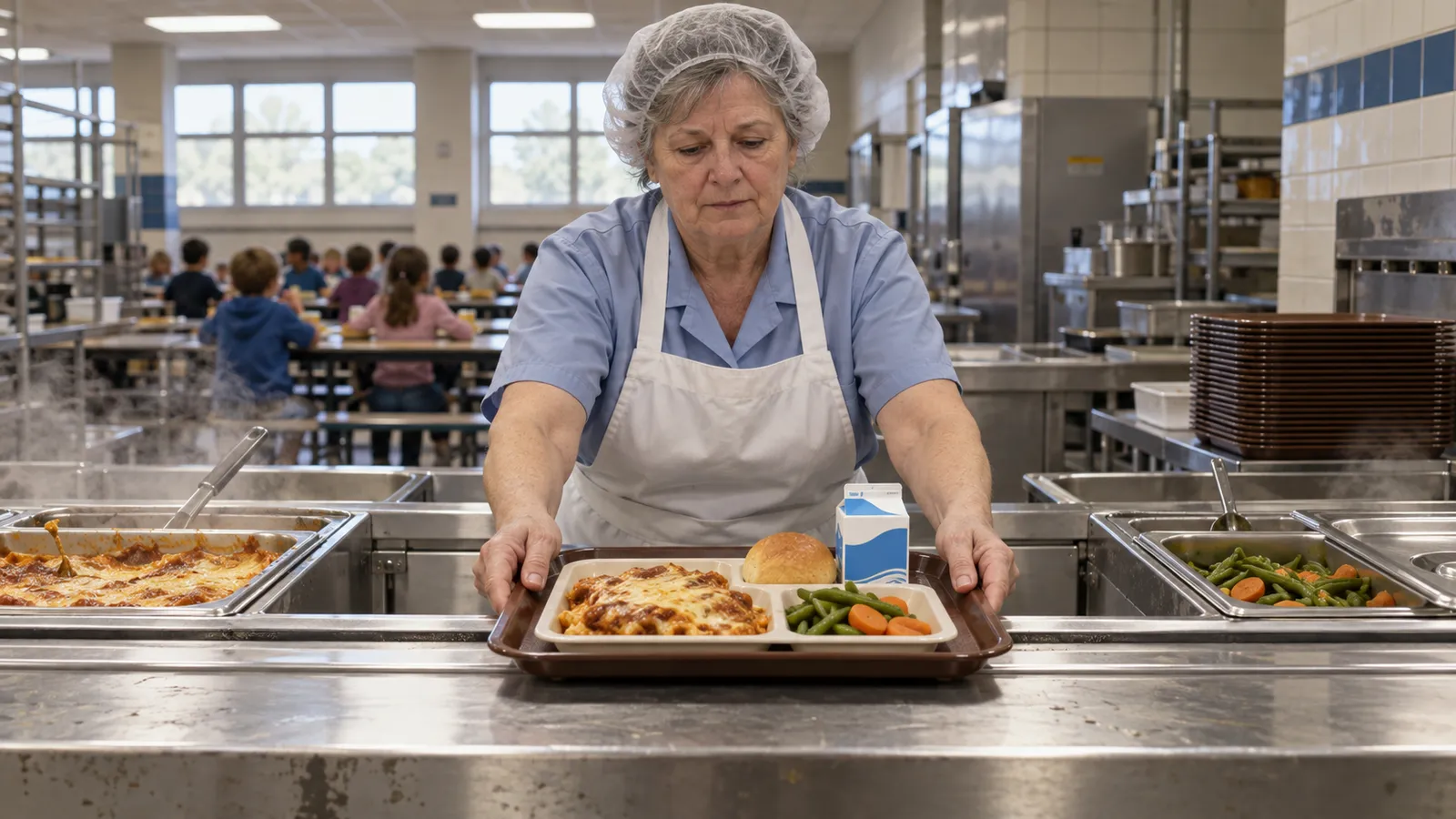
Chapter 6: The Far End of the Lot
The booster meeting broke up at twenty to nine on Friday night and his was the last car on the far side of the lot, under the light that has been out since the spring.
I was standing by the trunk of it when he came across the asphalt with a folding chair under his arm, and I watched him decide, somewhere around thirty feet out, that I was not a person he knew and then that I was.
"Mrs. Dunbar."
"Mr. Lockwood."
"Is everything all right?"
"ID four-oh-one-one-eight," I said.
He stopped. He put the folding chair down on the asphalt, carefully, which I have decided since was him buying three seconds.
"I'm going to have to ask what that is."
"You know what it is. You wrote the form it prints on." I had the DENY slip in my hand and I did not hold it out, because this was not a courtroom. "Fourteen alternate meals in September. Three strikes between the fifteenth and the twenty-first of October. On Tuesday the twenty-first the register printed DENY and I took a tray of turkey out of your son's hands in front of eleven children and sent him to the office."
He turned the ring on his right hand with his thumb. Once around.
"That's a student record."
"It's a bus list," I said. "The names are on the bus list."
What he did then was the thing I had not prepared for.
He did not deny it, he did not threaten me, and he did not get angry. He stood in an empty parking lot and told me the truth in about ninety seconds, in flat short sentences that did not sound anything like the man in the newspaper.
Separated since the third week of August. A temporary order out of the domestic relations court on the second of September freezing the joint accounts, both of them, pending a full hearing that had already been continued twice and was now set for January. House on Delphine listed quiet, no sign, because a sign in the yard in this town is a public announcement. An apartment on Rowan Court month to month. Everything he earns at the title agency goes through an account he cannot draw on without filing a motion, and a motion costs four hundred dollars of lawyer to ask a judge for permission to buy groceries.
"I have money," he said. "I have more money than most people in this district. I cannot touch it. Do you understand that those are two different sentences?"
"I understand it fine."
"The income on his meal application is from last year's return. One hundred and forty thousand dollars. By the formula he is ineligible for everything. There is no box on that form for a court order."
"So fill out a new application."
"It asks for current household income and requires documentation. I would have to attach the order." He said this evenly. "That document goes in a file at the district office that is read by the treasurer, the food service director, and anyone those two people mention it to at church."
Then he made his offer, and I want to set it down exactly, because he thought it was generous and it was generous and it was also the reason nothing changed for another nineteen days.
He would write a personal check for forty-one dollars to reimburse the district for the food Donna Fairchild distributed. He said he had intended to do that since the sixth of October and had not found a way to do it that did not raise the question of why.
And he would put two hundred dollars on his son's meal account on Monday morning, in cash, at the office counter, which he could do because he had two hundred dollars of his own in his pocket from the sale of a boat trailer.
"That clears him through the end of the year," he said. "He eats. The arrears come off. Whatever your concern is, it's resolved on Monday."
"And the clause?"
"The clause stays."
"There are forty-one other kids —"
"I know the number," he said, and that was the only time his voice went up. "I know it better than you do, I read the reconciliation. Forty-one children hit a second alternate meal in October."
"Then strike it."
"On what grounds, Mrs. Dunbar? Mine?" He picked the folding chair back up. "If I go to that board in two weeks and move to strike the three-strike provision, and three months later the hearing in Zanesville puts my name in a newspaper, then every person in this county understands that a board member rewrote a district policy for the benefit of his own household. That is not a scandal I would survive and it is not one the policy would survive either. It would come back harder and it would come back with somebody else's name on it."
"So the honest thing to do is let it stand."
"The honest thing to do is not write exceptions for myself." He said it without any pleasure at all. "I believe that. I've believed it in rooms where it cost me. I'm going to go on believing it on Monday while I put two hundred dollars on his account like any other parent, because that is the one thing in all of this that is available to me."
I took the two hundred dollars.
That is to say: I told him to do it. Monday morning, office counter, cash, get a receipt. I did not refuse it to make a point, because the point would have been made on a child's stomach and I am not willing to do that, and anybody who tells you they would is lying or has never had their hand on the tray.
And I did not take the check for forty-one dollars.
"Why not?" he said.
"Because forty-one dollars is the only number in this whole business that can still be read by somebody who doesn't work here," I said. "The minute you pay it, Donna was fired over nothing. I'd rather it stay owed."
He looked at me for a while across the top of the folding chair.
"You've thought about this more than I would have expected."
"I'm a cashier," I said. "Thinking about numbers is the entire job. You people just never ask us."
He got his keys out. I thought that was the end of it. Then he stood with the door open and the interior light on him and he said one more thing, and it is the only reason anything happened at all.
"The regulation is Verna Stafford's," he said. "The policy is three sentences I wrote. Everything that happens at your register — the ten-dollar floor, the thirty-day window, the alternate charge, the denial step — is operational regulation under it, and she has the authority to amend any of it administratively without a vote, provided she can defend the change to the state."
"You're telling me to go around you."
"I'm telling you that if the clause goes away because an administrator corrected a mechanism, no child's name is ever attached to it." He got in the car. "Her direct line is 740-555-0128. She's at her desk by seven. Do not tell her you got the number from me."
He drove out of the far end of the lot, and I stood there in the dark with a slip of paper and a pencil and a child fed through Christmas and forty-one other children exactly where they had been at four o'clock that afternoon.
I wrote the number on the back of the clipping.
End of chapter 6