Kindness6 min read
The Lunch Lady's Second Tray
Donna fed hungry kids a second tray and paid for it herself, logged as waste. The district fired her over $41. Then the three-strike rule hit the one child nobody could afford to name, and I had to decide what I was willing to lose.
Chapter 2: The Waste Column
I got to school at 6:50 on Tuesday and pulled all twenty sheets off the clipboard before anybody else was in the building.
I laid them out on the prep table in date order, September eighth at the left end, October third at the right, weighted at the corners with salt cellars because the vent over the dish machine moves paper.
Twenty sheets. Twenty single entrées in the waste column. And in the little box beside each one, where you are supposed to write the spoilage code — 1 for dropped, 2 for over-temperature, 3 for returned uneaten — there was nothing. Twenty blanks.
That is what caught her. Verna Stafford at the district office runs a reconciliation every quarter, and she does not read sentences, she reads columns. Twenty blanks is not a mistake. A mistake happens twice.
Then I pulled the drawer tapes out of the cash binder, because Donna had told me they existed and I wanted to see them with my own eyes.
There she was. Every one of those twenty days, a single à la carte line at the adult meal price. Three dollars and sixty cents, cash.
I added them on the back of the October menu. Seventy-two dollars.
Seventy-two dollars of Donna Fairchild's money into the drawer. Forty-one dollars of district food out the door.
The district came out thirty-one dollars ahead on the crime it fired her for.
I sat down on the milk crate by the slicer. Not because of the thirty-one dollars. Because nobody in that whole process had put those two numbers on the same sheet of paper, and it had taken me eleven minutes.
Here is the part I want to be careful about, because everything turns on it.
Donna did not pick a child.
The register picked. That is how the policy works. The child comes down the line, puts a hot tray on the rail, keys in the four-digit ID, and if the balance is under negative ten the screen prints ALTERNATE and the tray comes back. The screen tells you the first name and the ID and the words. It does not tell you the last name, the household, the address, the income form, anything.
Rosa likes that part. Rosa said it to me that same morning, standing at the second well, when I asked what she thought about Donna.
"The screen's the good part, Frances. You remember before? Lisa used to have to say 'Honey, your mom hasn't sent the check' right out loud with eight kids listening. Lockwood fixed that, at least."
She is right. He did fix that. I want that written down, because of what came later.
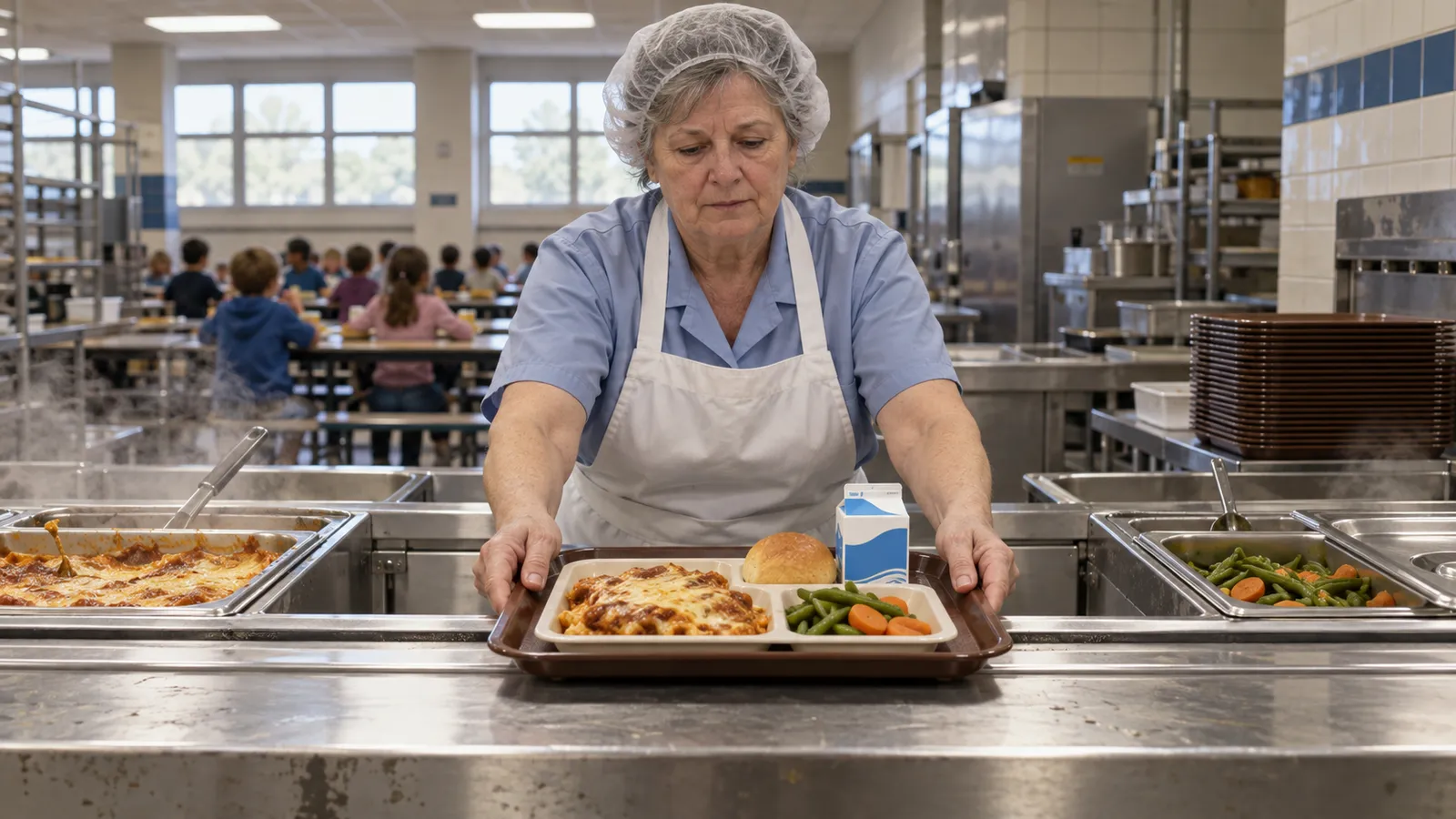
So the way it worked was: the screen said ALTERNATE, I made the sandwich, and Donna watched from the line, and then at the end of service she would ring three sixty through à la carte, plate an entrée, carry it around the end of the rail and set it on a table where a particular child was sitting with a cheese sandwich he had not opened.
And then she went and wrote one entrée into the waste column, so the number of meals the district claimed from the state still matched the number of entrées that had left the pan.
That is the whole machine. It took one woman, a stub pencil, and three dollars and sixty cents a day.
I wanted to know who.
I am not going to pretend I was noble about it. Donna had said don't let them tell you which kids, and inside of eighteen hours I was in the office with the door shut, running the register's own report.
The report is called Alternate Meal Detail and it is two keystrokes, and it does exactly what the screen does: first names and IDs, no surnames. Twenty days of flags.
There were nine children on it. Pike Hollow Elementary has four hundred and ten students and nine of them hit negative ten dollars in September.
Eight of those nine showed up one, two, three times.
One showed up fourteen times.
TOBY. ID 40118. Fourteen days out of twenty.
I looked at that line a long time. Fourteen days is fourteen trays Donna bought out of a cook's wages. Fifty dollars and forty cents. Most of a week of her groceries.
And it is fourteen flags on a report, because a sandwich that gets handed over and then quietly replaced at a window table still prints as an alternate meal. Donna fed him. The register never knew it.
In September that cost him nothing, because 412.3(c) was not switched on yet. Every one of those fourteen flags sat in a column doing no harm at all.
On Wednesday the fifteenth of October the clause goes live and the counter starts at zero for every child in the district, and after that it takes three.
I had a first name, an ID, and nothing else, and the policy was built so that nothing else was available to me.
So I did the only other thing I could think of, which was to pull the household record. Cashiers can see one screen of it: balance, payment history, and a line of flags.
Balance: negative sixteen dollars and forty cents.
Payment history: paid on the first of every month, by card, on time, from August of last year all the way through to the first of August this year. Then nothing. Not one payment after August first.
And a flag at the bottom, in the dry little way that system has of saying things.
ADDR CHG 9/15.
Somebody in that household had changed the billing address on the fifteenth of September. The screen would not show me what it changed from or what it changed to. It showed me that it changed.
Paid on time for a year. Stopped in August. Moved in September. Fourteen alternate meals and a cheese sandwich a day.
That is not a family that cannot afford lunch. I have worked this register for nineteen years and I know what a family that cannot afford lunch looks like on this screen. They are late in October and late in February and they pay in cash in uneven amounts and there is a free-and-reduced form on file.
There was no form on file. The household income on record disqualified him.
At 11:52 that day TOBY came down the line, and because of the screen I still did not know his last name, and because of my eyes I knew everything else.
Navy spirit polo, the one they sold for four dollars at the fun run, the same one he had worn Thursday and Friday and Monday. Cuffs chewed. Hair cut at home, you can always tell at the back.
The screen printed ALTERNATE. I took his tray.
"That's okay," he said. "My dad put money on it this morning. It probably just hasn't gone through."
He said it politely, like a receptionist. He had said some version of it to me three times before and I had never once thought about it, because a hundred kids a day tell you something at that register.
I gave him the sandwich and the milk. He said thank you. He carried them to the end table by the window, and he put the sandwich in his backpack without unwrapping it, and he drank the milk, and that was his lunch.
That afternoon I took the two-inch pencil down off the shelf above the slicer and put it in my apron pocket.
End of chapter 2