Family5 min read
The Night My Sister Called Me by Her Daughter's Name
My sister has early-onset Alzheimer's. At two in the morning she started calling me Wren and apologizing for four days in August. I thought it was confusion, until I found the shoebox in her hall closet.
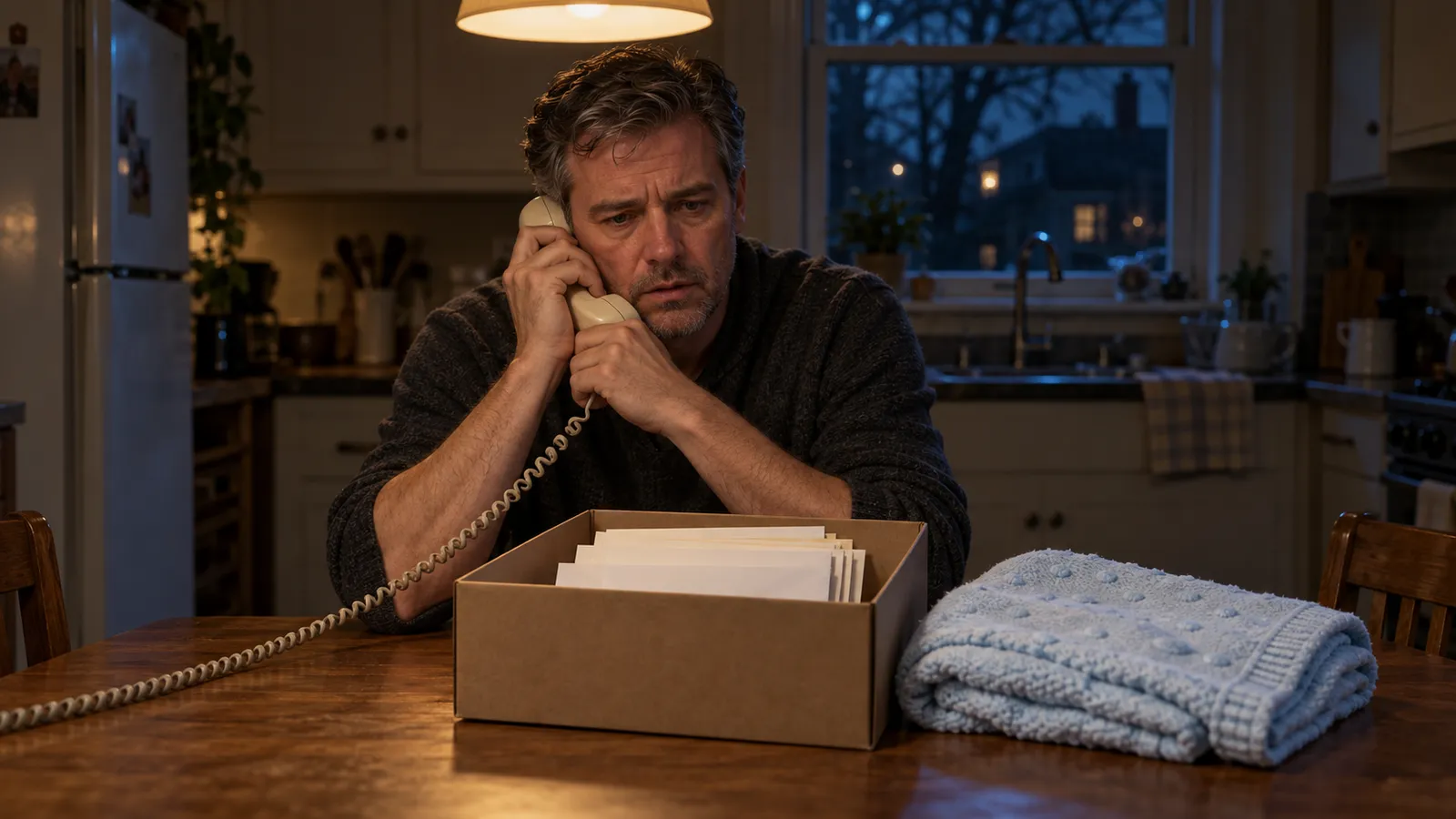
Chapter 1: Two Oh Four
At two in the morning my sister called me Wren and kept talking, like we were halfway through a conversation I had never been part of. I said, "Adrienne, it's Martin," and she said, "I know it's late, sweetheart, but I have to finish telling you about the ninth."
The clock on the stove said 2:04. I had a compressor call at six, a walk-in cooler at a grocery on Dell Road that had been climbing two degrees a night for a week, and I was lying on top of the covers in my work pants.
"Adrienne. It's your brother."
"They said four days." Her voice had the warm, carrying sound she used at the pool, the one built to cross forty feet of water. "Four days, and then a woman came with a clipboard, and I didn't even argue. I want you to know I didn't argue because I thought arguing would make it worse for you. Not because I didn't want to."
"Who came with a clipboard?"
"You're not listening."
"I'm listening."
"Then say something back."
I sat up. The room was cold. I keep the thermostat at sixty-two because I spend nine hours a day inside refrigeration and my body stopped believing in warm rooms a long time ago. I put my hand flat on the mattress and tried to think of what someone named Wren would say back.
"I'm here," I said.
That worked. She exhaled like she'd been holding something up.
"The ninth," she said. "It was a Friday. I keep telling people it was a Saturday because that sounds better, and it was a Friday, and it was hot, and the window in that room didn't open. They painted it shut. I counted the ceiling tiles. There were sixty-four and one of them had a water stain shaped like Ohio."
"Adrienne—"
"Don't call me that," she said, and she laughed. "You've never called me that in your life."
There it was. Not confusion. Correction. She was not groping for a name. She had one, and I was using the wrong one.
Eighteen months earlier a neurologist had sat us both down and said early onset in the same tone a mechanic says it's the compressor, not the fan. Adrienne was fifty-one then. She had taught swimming for the city for nineteen years. She asked three good questions and wrote the answers on the back of her hand, and on the way out to the parking lot she told me she was going to be a nightmare and I should get a notebook.
"Okay," I said. "Tell me about the ninth."
She told me. For twenty minutes she told me about a hot room with a painted-shut window, a nurse who kept saying honey in a way she hated, a blanket that was the wrong blue, and somebody's mother standing in a hallway with her coat still on. She apologized four times. Twice for the four days. Once for not arguing. Once for a form she said she hadn't read, which she admitted was a lie, because she had read every word of it and signed it anyway.
In the middle of it she started humming. I knew the tune before I knew I knew it. "Shenandoah." She hums it when she's working something out — over a crossword, over a tax form, over the engine of her car the year it kept dying at lights.
I said, "Who's Wren?"
The humming stopped.
"That's not funny," she said.
"I'm not being funny."
"It's two in the morning and I am not doing this tonight," my sister said, and she sounded completely sane, and she hung up on me.
I drove over.
She lives in the left half of a brick duplex on Pell Street, twenty minutes from me if the lights go my way. The porch light was on, which it always is, because I put a photocell on it in June after she left the stove going. The front door was locked. The chain was on from the inside, which meant she had put it on herself, which was good.
I let myself in with my key and listened in the dark hallway.
She was asleep. I could hear the rhythm of it through the bedroom door, the sort of breathing you only get when nobody is faking.
I checked the stove knobs. I checked the back door. I checked the thermostat and it said sixty-eight, and I took the little thermometer out of my shirt pocket and set it on the hall table, because I check things, that's what I do instead of worrying.
On the kitchen counter was Tomasa's logbook. Tomasa comes Monday through Friday, nine to three, and writes down what happened in a composition notebook with a yellow cover.
Mon — good day. Walked to mailbox. Lunch: tuna. Asked about Martin's truck twice.
Tue — good day. Sorted photographs. Tired after 2.
Wed — good day.
Three good days. No wandering, no agitation, nothing worth writing down.
I stood in my sister's kitchen at twenty past three in the morning holding a yellow notebook and feeling like a man checking a cooler that is holding temperature perfectly while the product inside it goes bad anyway.
In the hall, her swim bag was still on its hook the way it had hung for nineteen years. She had not taught since February of last year. I had not been able to make myself move it.
There was a closet beside it that I had never once opened. It was full, I knew that much, because it did not close flush. I had been telling myself for a year that I would clear it out before the winter.
I left it alone. I turned off the hall light, locked the front door behind me, and sat in the van in the dark for a while before I started it.
At six I replaced a failed start capacitor on Dell Road and told the grocery manager his condenser coils were packed with dust and it was going to keep costing him.
It was not until that afternoon, eating a sandwich in the van with the radio off, that I opened my phone and looked at the call log, because some part of my head had been running the numbers all day the way it runs numbers on a failing system — not what broke, but in what order.
The call had lasted twenty-six minutes. And the number that dialed me at 2:04 in the morning was hers.
End of chapter 1