Family5 min read
The Night My Sister Called Me by Her Daughter's Name
My sister has early-onset Alzheimer's. At two in the morning she started calling me Wren and apologizing for four days in August. I thought it was confusion, until I found the shoebox in her hall closet.
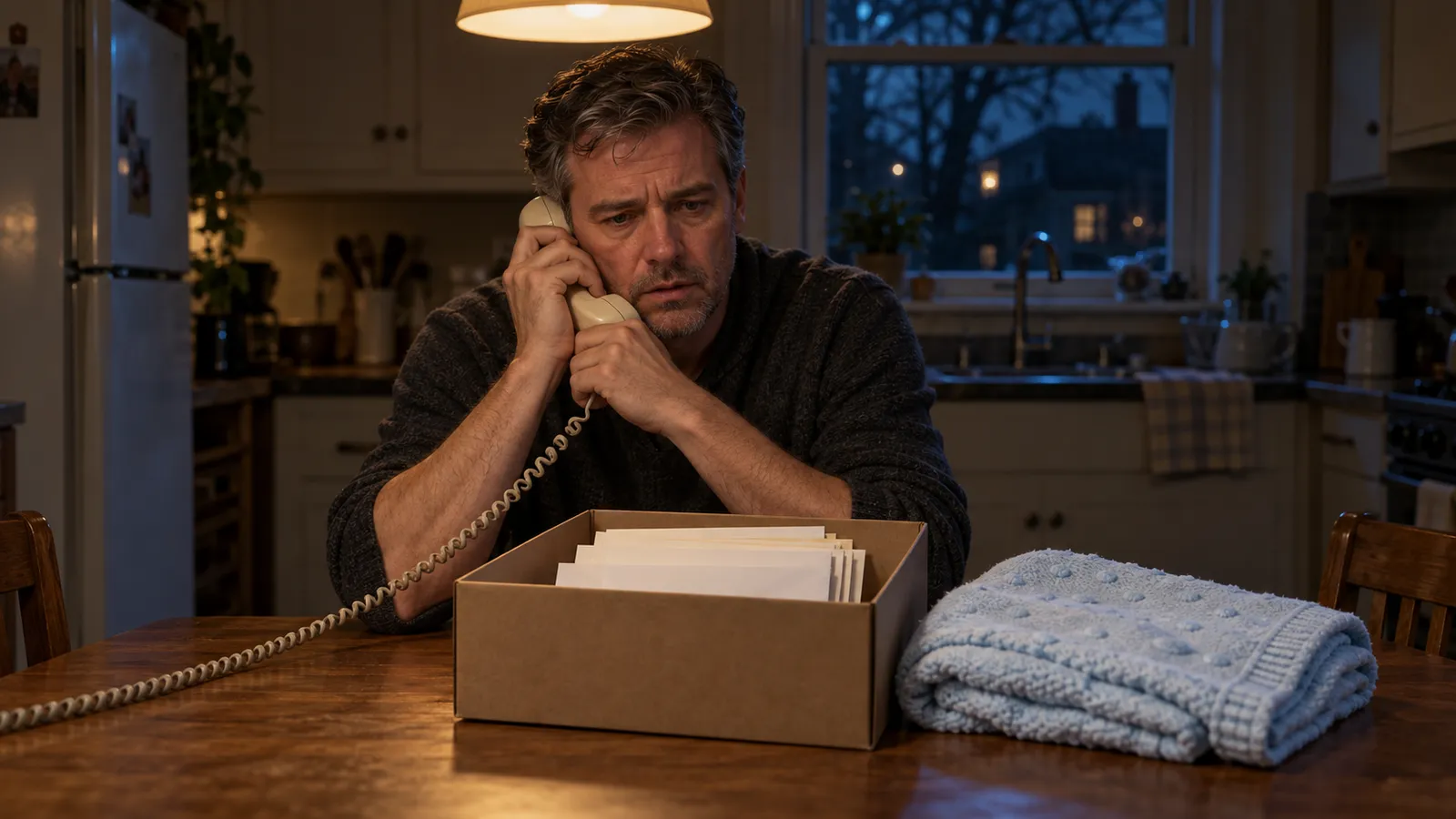
Chapter 7: What I Left on Her Table
Her house is behind the bakery, a rented one-story with a chain-link fence and a dog next door that barked at me the entire time I was there.
She made coffee at half past midnight the way people on nights make coffee, without discussing it, and she put a mug in front of me and sat down across the table with her back very straight.
"Your request for contact has been reviewed," Wren said. "The birth parent has declined contact at this time and in the future. This agency is not able to provide further information. We wish you well. Two paragraphs. There's a line at the bottom where somebody signed it with a stamp."
"I'm sorry."
"I didn't tell you so you'd be sorry. I told you so you'd know I'm not working from a feeling." She wrapped her hands around her own mug and did not drink from it. "I was seventeen. Connie wrote it for me because I couldn't make the sentences come out right. I wanted to know three things: if she was all right, if I looked like her, and if there was a reason."
"She was all right," I said. "She was thirty-five. She had a job and a car and a condo on the north side."
"I know. That's worse. You get that that's worse?"
"Yes."
"If she'd been in a bad way, I'd have had somewhere to put it." Wren turned the mug a quarter turn, the way you do. "She was fine, and she thought about it for forty minutes, and she checked the box."
I said, "How do you know it was forty minutes?"
"Connie told me what the lawyer said." She looked at me. "Why?"
"Because she wrote it down too," I said. "Same number."
I had brought letter eighteen in my jacket pocket in a plastic bag, because it had rained on the drive and I was not going to be the man who delivered it wet. I put it on the table between us and did not push it toward her.
"That's the one from the August after," I said. "I read the first paragraph and I stopped, and then I read the rest of it, and I'm telling you that so you know it's not sealed and I'm not pretending it is."
She did not touch it either. We sat there with a letter on a table between us like it was a third person.
"Here's what I think you want," Wren said. "You want me to get in a car and drive four hours and sit in a room with a woman who won't know she's being forgiven, and then you want me to say something nice, and then she dies in a year or two, and you get to have had a family where that happened."
"That's a fair description of what I want."
"At least you didn't argue."
"I'd argue if I thought you had it wrong."
She got up and leaned against the counter, which put her out of the light.
"I'm not performing it," she said. "That's the part I keep coming back to. You're asking me to do a thing that only works if I mean it, in front of somebody who won't retain it, for the benefit of people in the room. That's not forgiveness. That's a favor to you and a woman who's dying."
"She's not dying this month."
"You know what I mean."
"I do." I put my hands flat on her table. "Can I say the stupid version of my argument, so you can knock it down and we're done with it?"
"Go ahead."
"The illness changes the math. She didn't refuse you in a way she can defend anymore, and she's been apologizing to a wall for thirty-five years, and now there's a window."
Wren nodded slowly, like she had been waiting for exactly that.
"It changes nothing about May of 2009," she said. "She was well. She was thirty-five. Nobody was in the room with her. The fact that her brain is now eating itself from the top down does not make the box she checked a different box." She crossed her arms. "And I want to say the other thing, because you've been polite and you drove four hours. I'm glad she's sorry. I'd rather have a woman who's sorry than one who isn't. But sorry is not a thing I owe a response to."
"No," I said. "It isn't."
"So that's a no."
"Okay."
She blinked. "That's it? Okay?"
"What do you want me to do, Wren? Negotiate?" I stood up and put my jacket on. "You're the only person in this whole thing who gets to decide anything. My mother decided for her, she decided for you, and everybody's been deciding for thirty-five years. I'm not getting in that line."
I left the letter on the table. I left the hospital bracelet on top of it, in its own bag, because it had her weight on it and her date and it was hers and it was never mine.
At the door she said, "You can tell me where she is."
"Lindenhouse Memory Care, room twelve. It's forty minutes past the city, there's a sign for a dairy on the exit." I wrote it on the back of a work order and left that too. "Her good hours are between about six and ten in the morning. After lunch she's somebody else."
"I'm not saying I'm coming."
"I know."
"Don't tell her I might."
"I won't," I said. "She wouldn't keep it anyway."
I drove home with the dog still barking behind me. It was a quarter past one in the morning and I got in at about twenty to six and lay on top of the covers in my work pants and did not sleep, and at nine I went and sat with my sister while she told a story about a swim meet in a year I could not place.
The next night I was asleep at eleven for the first time in a month.
The phone woke me at 11:40. Lindenhouse. I had the number saved under the name of the place, and when it comes up at that hour your whole body makes a decision before you answer it.
"Mr. Vogel, it's Gail. Nothing's wrong. Your sister's asleep, she had a good evening, she ate."
I sat on the edge of the bed with my heart going.
"Okay."
"There's a woman in the parking lot," Gail said. "She's been out there about twenty minutes. She came to the door and asked whether visiting hours start before seven, and I said they start at nine but that families work it out with me, and she went back and sat in her car."
"Did she give you a name?"
"She said her name is Wren Mercado and that you'd know who that was." Gail's voice went careful. "She's holding a blanket, Mr. Vogel. A blue one, folded up. She's got it in both arms. I need to know whether that's going to be a problem."
End of chapter 7