Family6 min read
The Night My Sister Called Me by Her Daughter's Name
My sister has early-onset Alzheimer's. At two in the morning she started calling me Wren and apologizing for four days in August. I thought it was confusion, until I found the shoebox in her hall closet.
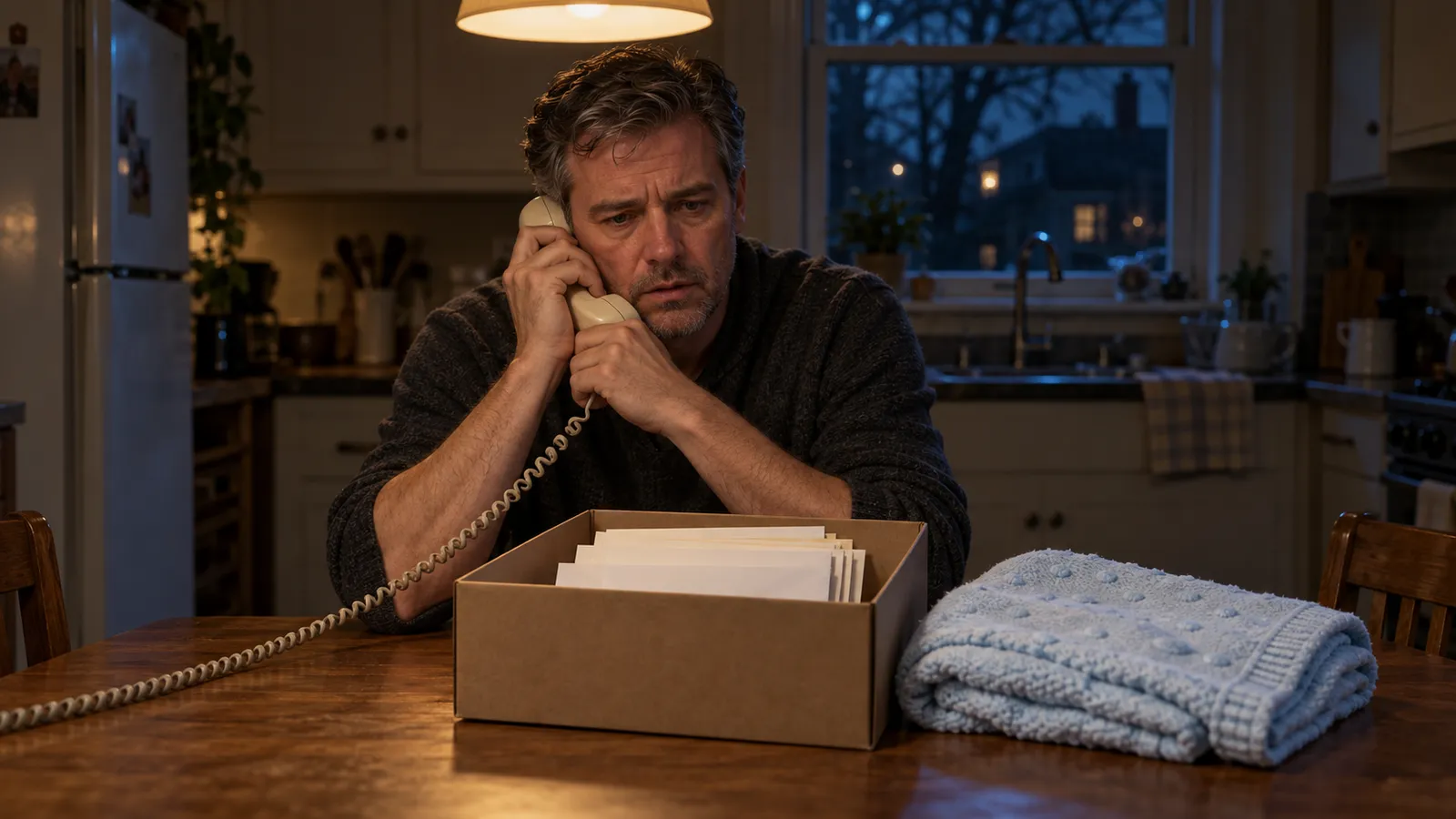
Chapter 5: What She Signed in 2009
I laid them out on my own kitchen table in date order, thirty-four envelopes in two rows of seventeen, and I started at 1992 and I read my sister's whole adult life in one sitting.
They are not what I expected. I expected grief. There is grief in them, but mostly they are reports.
The early ones are arithmetic. You are one today. You are two today and I think about whether you talk yet. You are four and I have decided you have dark hair, I don't know why, your father's was light. She apologizes in every single one, somewhere, usually near the end, usually in the same words: I'm sorry about the ninth. I'm sorry they only let me have four days.
The 1995 letter is the one with the Polaroid in it. Rudy brought me a picture. I had sent forty dollars through him at Christmas and they sent it back with the picture, which was the right thing for them to do and took me a week to agree with. I am not allowed to have any more and I did not ask for any more, because asking would be for me. The last line of 1995 is: She is not a swimmer yet. I have decided not to teach the fours anymore. Nobody will notice and I am not explaining it to anybody.
1997 is angry. It is two pages and the handwriting gets bigger toward the bottom, and it is not angry at our mother. It is angry at Adrienne. You would be six and I would be twenty-three, and twenty-three is old enough, and I could have waited six years and been old enough and I did not, because I was told it was already finished. I let it be already finished.
2001 is short. You are ten. I taught a ten-year-old today who was afraid of the drain.
2004 is a grocery list. I am serious. It is a torn piece of paper with milk, bread, coffee, dish soap, paper towels on it, and then underneath, in the same pen: I couldn't do it this year. Next year. She stamped it and put it in the box with the rest.
2011, 2014, 2019: pool renovations, a car, our father's headstone, the swim meet where a girl she taught broke a city record. You are twenty-eight today. I would be a terrible mother and a good coach. Maybe those are the same job, done at different distances.
The last one is August 9, 2025, seven months after the diagnosis, and the handwriting has changed in a way I had to stop reading for a minute. You are thirty-four. I am going to forget you. I want it written down somewhere that I knew you were born on the ninth, in case there is a day when I say I don't.
I read thirty-three letters in four hours and never once put my hand on the one with the resealed flap.
Then I opened it.
August 9, 2009. One page. It starts without a greeting, which no other letter in the box does.
I have to write down what I did in May.
They sent a letter through Rudy. You are seventeen and you will be eighteen in August, and the law in your state lets you ask at eighteen, but your mother wrote on your behalf and asked early, and she asked nicely. She said you had been asking since you were fifteen and she wanted it done properly.
Rudy brought me a form. It had two boxes. One said I consented to contact and one said I declined contact at this time and in the future.
I sat in his office for forty minutes. I want to be exact about this because you deserve exact. I was thirty-five years old. Nobody told me which box to check. Mother was not in the room. I was not seventeen and I was not frightened of anybody.
I checked the second box.
I am not going to write that I did it for you, because that is what I said to Rudy and it was a lie I could tell at the time. I did it because you were going to ask me why, and I did not have an answer that would survive you looking at me while I said it.
You wrote to me and I said no. That is the whole sentence. Everything else I have written in this box for seventeen years is smaller than that sentence.
I'm sorry about the ninth. I'm sorry they only let me have four days. I'm sorry about May.
I sat at my table with that in my hand and I found out something about myself, which is that I had been carrying my anger very carefully, in a particular direction, toward a woman in a matched apartment across the river. And it got up and went somewhere else.
My sister, at thirty-five, well, with a job and a car and a mortgage, was asked by a seventeen-year-old girl whether they could meet, and she said no in writing, and then she went home and wrote the girl a letter about it and did not mail that either.
I was furious with her for about two days. I want that in the record, because what comes after it is a lot of driving and phone calls on her behalf, and I do not want any of that to look like it came from a clean place.
After that it was work, and work I am actually good at.
The Polaroid had a stamp on the back border, under the handwriting, the kind drugstore photo counters used to print: a four-digit store number and a town. Mineral Springs. I had looked at that picture for three days and never turned it to the light.
Rudy was not dead. Rudy is eighty-four and lives in a care apartment forty minutes north, and he could not remember my sister, and he was perfectly clear about his own records.
"Everything went to a storage unit when I closed in '08," he said. "My nephew pays for it. It's climate controlled. I made him promise."
It took him two days to find his nephew's number and the nephew one afternoon to meet me with a key, and the two of us stood in a ten-by-ten unit in the cold going through banker's boxes for three hours. The files were alphabetical by client. Mine was in the fourth box. Eleven pages.
There was a county in Indiana. There was a case number. There was a form with my sister's signature on it, dated May 2009, with the second box checked and her initials beside it in her big round hand.
And there was a cover letter from 1991, typed, from the adoptive family's attorney, with one first name in it that nobody had bothered to redact because nobody imagined anybody looking: My clients, Mr. and Mrs. Mercado, and in particular Constance, wish me to convey.
A county. A surname. A first name.
Constance Mercado had been a county clerk for thirty-one years, which is a thing a person leaves a trail for. Her retirement was written up in a weekly paper in 2016 with a photograph of her holding a sheet cake, and the same two-paragraph item named the town she lived in, and there was a landline listed under that name at that town, the way there still is for people of a certain age.
I wrote the number on the back of a work order and put it in my shirt pocket next to the thermometer, and then I did not call it for sixteen hours, because I had no right to it and I knew exactly what I was about to do with it anyway.
I dialed it at nine the next morning, and a woman named Constance Mercado answered on the fourth ring.
End of chapter 5