Family6 min read
The Night My Sister Called Me by Her Daughter's Name
My sister has early-onset Alzheimer's. At two in the morning she started calling me Wren and apologizing for four days in August. I thought it was confusion, until I found the shoebox in her hall closet.
Chapter 4: The Summer I Spent at Lake Carro
My mother opened her door at twenty to eight in a cardigan, with her hair already done, because she has been dressed by seven every day of her life.
"You should call first," Ilse said.
"I did. Three times."
She let me in. The apartment smelled like coffee and the carpet shampoo they use in the halls. Everything matches: the chairs match the drapes, the drapes match the runner, and there is one framed photograph on the side table, of my father, who died in 2003.
There is no picture of Adrienne in that apartment. I had never noticed before. I noticed that morning.
I put the hospital bracelet on her kitchen table, on the placemat, where she could not avoid it.
She looked at it for a long time without touching it. Then she went and got the coffee pot and filled my cup, which I had not asked for, and set the pot down on a trivet.
"Where did you find that?"
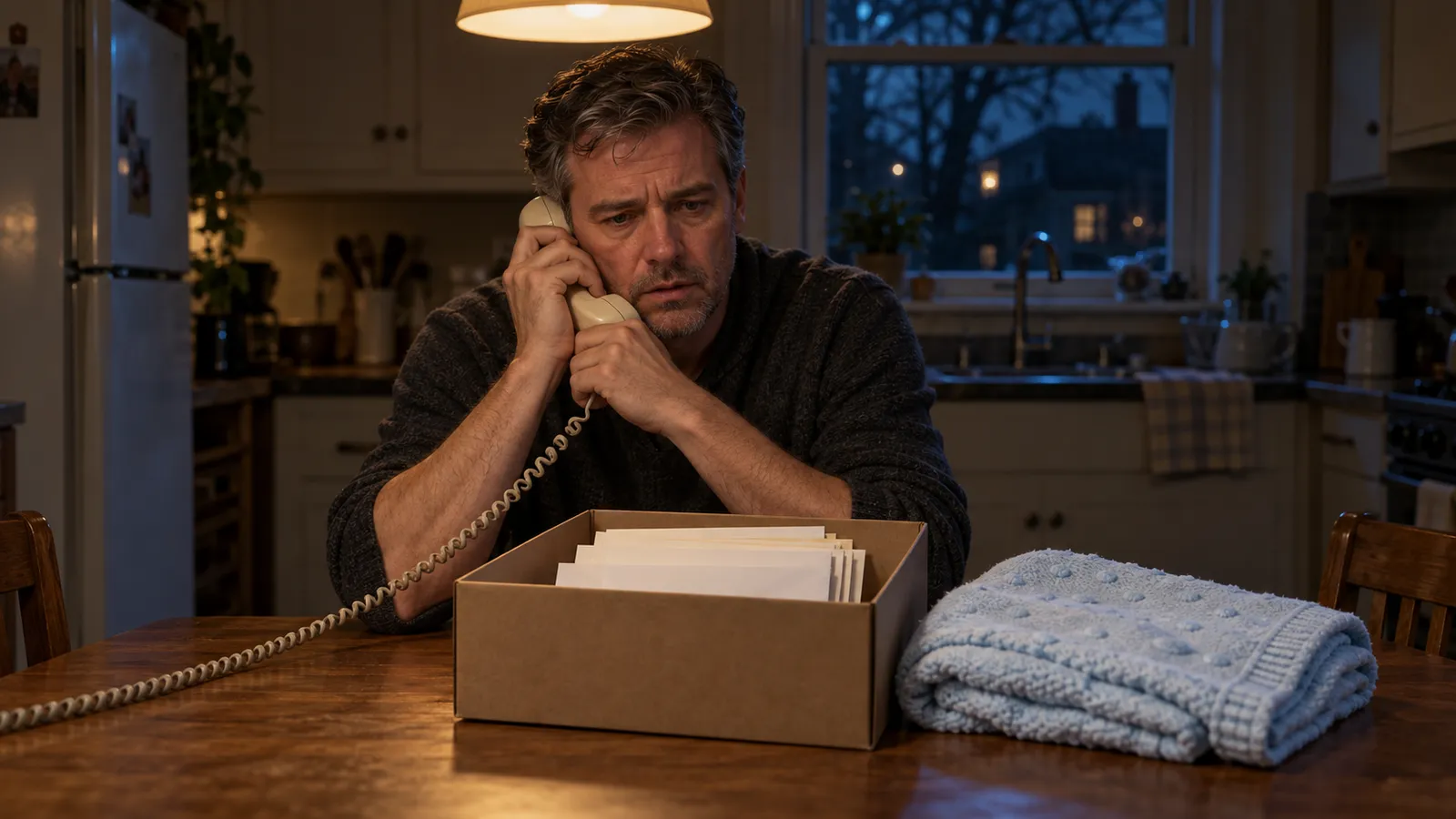
"Her hall closet. In a shoebox. With thirty-four letters and a photograph of a four-year-old."
"She kept them." My mother sat down. "I told her not to keep anything."
That is what I got instead of a denial. I had driven across the river with four arguments loaded and she took them all out of my hands in nine words.
"Say it," I said.
"Say what, Martin?"
"Say the word."
"I don't know what word you want."
"Adoption," I said. "My sister had a baby on August ninth, 1991, and you gave her away, and I want to hear you say the word."
My mother folded her hands. She has beautiful hands, old now, and she folded them the way she folds them in church.
"It was handled," she said.
"That's not the word."
"It was handled. Properly, through a lawyer, with a good family who had a house and two incomes and could not have their own. Your sister was sixteen when it started and seventeen when it finished. She had a year of high school left. The boy was nineteen and gone to Fort Benning by March and I will not have his name in my kitchen." She said all of it at a steady pace, like a woman reading minutes from a meeting. "She agreed to it."
"She was seventeen."
"She agreed."
"You told the neighborhood she had mono."
"I told the neighborhood she had mononucleosis," my mother said, "because in 1991 that was a kindness, and you can sit there in a different year and call it something else if you want to."
"And me?"
She did not answer that.
"Eleven weeks," I said. "Lake Carro. June, July, half of August. I was ten. I thought I was being given a summer. I was being moved."
"You were being spared."
"I was being used," I said. "If I'm at Bettina's, there's nobody in the house who asks why Adrienne isn't at the pool."
My mother picked up her coffee and did not drink it.
"You have always had a very high opinion of what you would have done at ten years old," she said.
"Who handled it?"
"A lawyer. Rudy. He did the wills and the house, and he did private placements, which was ordinary then." She set the cup down. "He must be dead by now."
"I want the file."
"There is no file, Martin. There's a lawyer who's probably dead and a woman in another state who has a daughter, and a paper your sister signed." My mother smoothed the placemat with two fingers. "Twice, if you want the whole truth of it. She signed it in 1991, and again later."
"Again later, meaning what?"
"Meaning she signed it twice," my mother said, "and it is not my business to explain your sister to you."
That was the end of what she would give me. She asked whether I wanted to take some coffee cake home, and I said no, and she wrapped some anyway and put it in my hands at the door, which is how that woman says the things she will not say.
Here is the thing I could not get past, sitting in that matched apartment.
I was happy that summer. That is the part that turns my stomach. I had eleven weeks at my aunt's house on a lake, a raft with a rusted ladder, a screened porch that smelled like citronella and old cushions. I came back in August brown as a boot and taller, and my sister was on the couch and she was thin and she said hi, monkey, and I showed her a rock.
I showed her a rock.
She was two weeks out from giving away a child and I came in the door holding a piece of quartz with a stripe in it, and she looked at it and said it was a good one.
And nobody ever told me. Not that summer, not when I was twenty, not when I was thirty-five and sat at her table after my divorce while she told me that people survive things.
I called Bettina from the parking lot of my mother's building. She is eighty-three and sharp and she answered on the first ring because she thought I was her pharmacy.
"Martin! How's your sister?"
"Aunt Bettina, the summer I stayed with you. Was it eleven weeks?"
A pause with a lot in it.
"Eleven weeks and two days," she said. "June fourth to August twentieth."
"Why?"
"Your mother asked me to take you," she said. "I said yes because she's my sister and because you were a nice kid and I had a lake. I asked her twice if Adrienne should come too. She said no. That's all I've got, honey, so don't ask me a third question, because I'll answer it and then I'll think about it all week."
I said okay. I thanked her. She asked me to tell Adrienne she said hello, and I said I would, and I have not, because I do not know which year to deliver it to.
I went to Pell Street in the afternoon.
Adrienne was in the living room, standing up, talking to the coffee table. Tomasa was in the kitchen doorway with a dish towel, giving me a look that meant she's been at this twenty minutes and she's happy, leave it.
My sister was teaching.
"Flat," she said to nobody. "Flat on the water like you're lying on a bed, Owen, not sitting in a chair. Chin up. If your chin comes down your hips go down. There — look at that, everybody, look at Owen."
She reached out and put her hand under an invisible back, in the air, at the exact height of a child floating in four feet of water.
Nineteen years of that. And nineteen years of trading away every four-year-old class, every session, until it became a joke in the front office.
She saw me and her whole face opened up.
"Marty," she said. "Did you see Owen float?"
"I saw it," I said.
I made her a sandwich. I checked the stove, the back door, the thermostat, the smoke detector battery, and I put my thermometer on the hall table and left it there.
Before I went home I stood in front of the hall closet with the shoebox under my arm, and I did the arithmetic I had been avoiding since six in the morning.
She had said it twice in that kitchen and I had been too angry to pick it up either time.
She signed it in 1991, and again later.
Again later. I drove home to find out what my sister had put her name to the second time.
End of chapter 4