Family5 min read
The Night My Sister Called Me by Her Daughter's Name
My sister has early-onset Alzheimer's. At two in the morning she started calling me Wren and apologizing for four days in August. I thought it was confusion, until I found the shoebox in her hall closet.
Chapter 2: The Ninth
The second call came three nights later, at 1:52.
I was awake for it. I had been going to bed with the phone face up on the nightstand, which is a thing you start doing and then cannot stop doing.
"Wren," she said. "Are you up?"
I had decided in advance what I was going to do, and what I had decided was not to fight her.
"I'm up," I said.
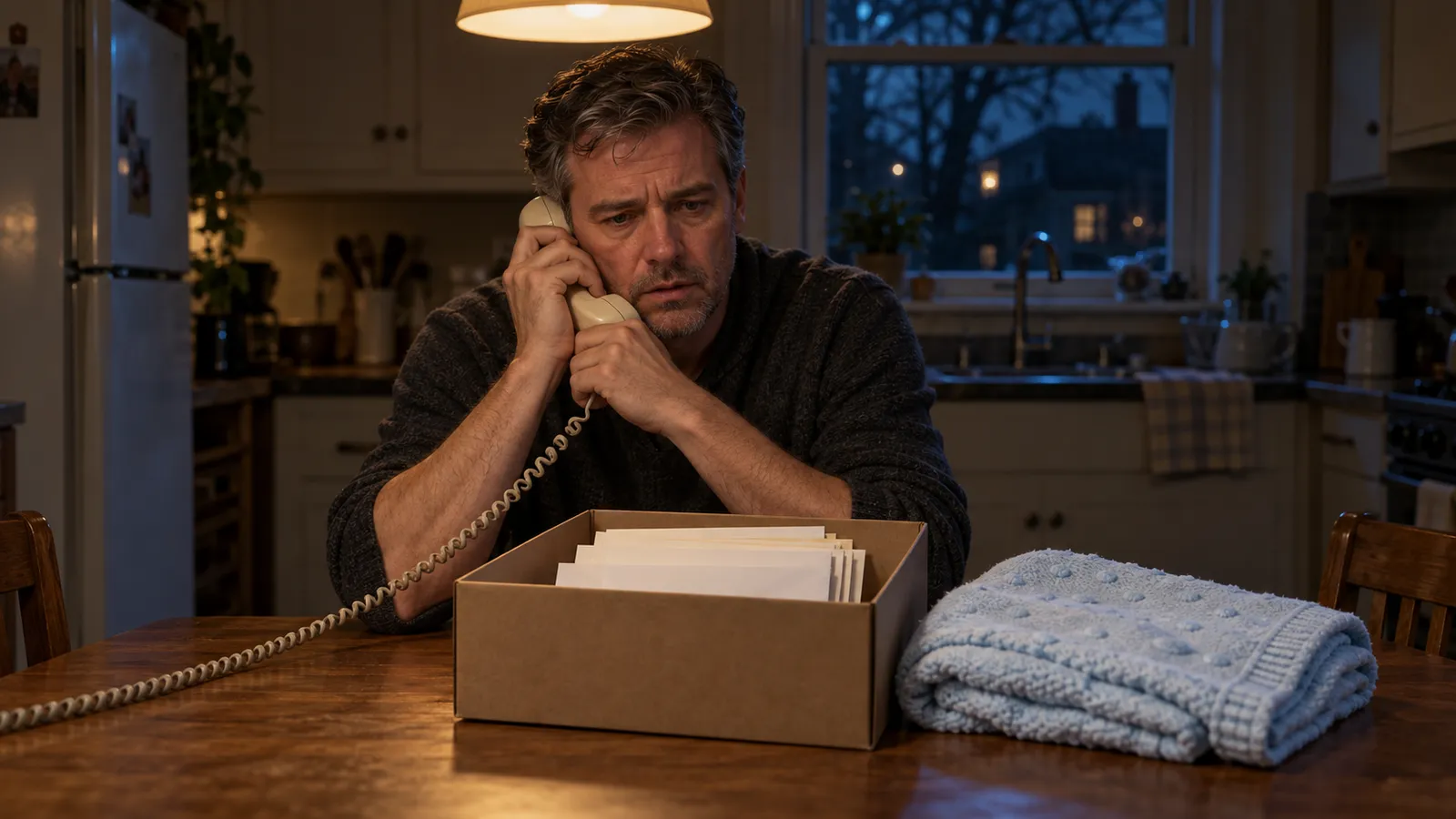
"I never told you about the blanket."
"Tell me about the blanket."
"It was the wrong blue." She said it with real irritation, like a woman complaining about a contractor. "I asked for white. I don't know why I asked for white, I think because white is what they had in the catalog at the drugstore, and you cannot pick anything in that place, you just take what's folded on the cart. It was blue. Not a nice blue. A blue like the inside of a swimming pool in a motel."
"Okay."
"Six pounds four ounces," she said. "I want you to know I remember that. People say you forget, and I did not forget. Six pounds four ounces and you had a scratch on your cheek from your own hand, because they don't cut them, the nails, they don't cut them because they're too soft."
I had the phone against my ear and both of my hands were shaking. I put the free one flat on the kitchen table to stop it.
"Four days," she said. "They only let me have four days."
"Who's they?"
"Don't," she said. "Don't make me say it out loud, I'm asking you not to make me say it out loud tonight, I will say it, I'll say all of it, just not —" She stopped. She hummed about eight bars. Then she said, perfectly clearly, like a woman reading a line off a card: "I was seventeen."
The refrigerator in my kitchen cycled on. I remember that because I remember thinking, with the part of my brain that is always on the clock, that's running long.
"Adrienne."
"Hm?"
"Adrienne, who am I?"
"You are being strange tonight," my sister said, and then, gently, the way you talk to a kid who has asked a stupid question in the shallow end: "You're mine."
The third call was on the twenty-ninth, at 2:19, and I recorded it.
I want to be honest about that. I did not ask her. She could not have told me yes in any way that counted, and I pressed the button anyway, and I am not going to pretend I thought about it for more than a second. I pressed it because three nights earlier I had gotten off the phone and could not reconstruct what she had said, and the not-knowing had followed me into a cooler at a deli on Ninth and stood there with me at four in the afternoon.
Ninth. I noticed it that day for the first time, the name of the street, and felt like an idiot.
I transcribed the recording at my kitchen table the next morning with a legal pad, stopping and starting it, the way you do a deposition. It took me two hours to get eleven minutes down.
Here is what was in it.
Nine apologies. I counted them twice because the number seemed wrong, and it was not wrong.
A blanket that was the wrong blue. A birth weight. A room with a window painted shut. A nurse who said honey. A hallway with a woman standing in it in her coat. A form she read and signed. Four days. The ninth. A promise that she would explain the rest "when you're older, when you can hear it," which she said twice, and which made the back of my neck go cold both times.
And a name. Wren. Eleven times in eleven minutes.
I called the city pool.
The woman in the front office had worked there since 2003 and she was happy to help and she was thorough about it, which I appreciated and which also killed the only theory I had. Nineteen years of class rosters. Little kids, adult beginners, the senior arthritis class on Tuesday mornings, the lifeguard certifications. She searched the name three ways.
"No Wren," she said. "Not a student, not a staff member. I'd remember a Wren. That's a name you'd remember."
"Could it be a nickname? Somebody she'd have called that?"
"Honey, I've got Brittanys and Madisons and about forty Jacobs." She paused. "You know what's funny, now that you've got me in here. Adrienne wouldn't take the fours."
"The what?"
"Four-year-olds. Preschool class, the Tuesday-Thursday one. Nineteen years she traded it off to somebody else. Every session. It got to be a joke — don't put Vogel on the fours, she'll swap it before the ink's dry." The woman's voice changed a little. "How is she? I heard she wasn't well."
"She's not," I said.
I sat in the van outside the pool for a while with the window down. A kid came out with wet hair and no coat and his mother made him put a coat on.
Nineteen years is not a preference. Nineteen years is a rule.
That evening I called my mother.
Ilse is seventy-nine and lives in a one-bedroom at a senior complex across the river, in an apartment where everything matches and nothing has fingerprints on it. She answers the phone on the second ring, always, like she has been waiting with her hand on it.
"Martin."
"Hi, Mom."
"Is she all right?"
"She's calling me at two in the morning."
"That's the disease," my mother said. "They get the days and nights turned around. Mrs. Kerrigan down the hall, her husband—"
"She's calling me Wren."
Nothing. Not a gasp, not a question. A very specific nothing, the kind you hear on a phone line when someone has put their hand over their own mouth.
"That's not a name," my mother said.
"It's a name, Mom. She says it eleven times in eleven minutes. She's apologizing to somebody named Wren about four days in August. She said she was seventeen."
"She's confused."
"She knows exactly who she's talking to. She corrected me."
"Martin."
"What happened the summer I was at Lake Carro?"
I had not planned to ask that. It came up out of somewhere underneath, the way a number comes up when you've been adding without meaning to. Eleven weeks at my aunt Bettina's, the summer I was ten. The lake, the raft with the rusted ladder, the smell of her screened porch. Adrienne had mononucleosis that year. That is the whole of what I was ever told, and I had never once, in thirty-five years, asked a follow-up question.
"You had a wonderful summer at Bettina's," my mother said. "There's someone at my door."
"Mom—"
"There's someone at my door, Martin."
She hung up. It was seven forty in the evening in a building where nobody rings a bell after six.
I went back to the legal pad and read my own handwriting again, all eleven minutes of it, and what stopped me was not any single thing she had said. It was the arithmetic.
Nine apologies in eleven minutes, and every one of them was for the same four days in August.
End of chapter 2