Family6 min read
The Night My Sister Called Me by Her Daughter's Name
My sister has early-onset Alzheimer's. At two in the morning she started calling me Wren and apologizing for four days in August. I thought it was confusion, until I found the shoebox in her hall closet.
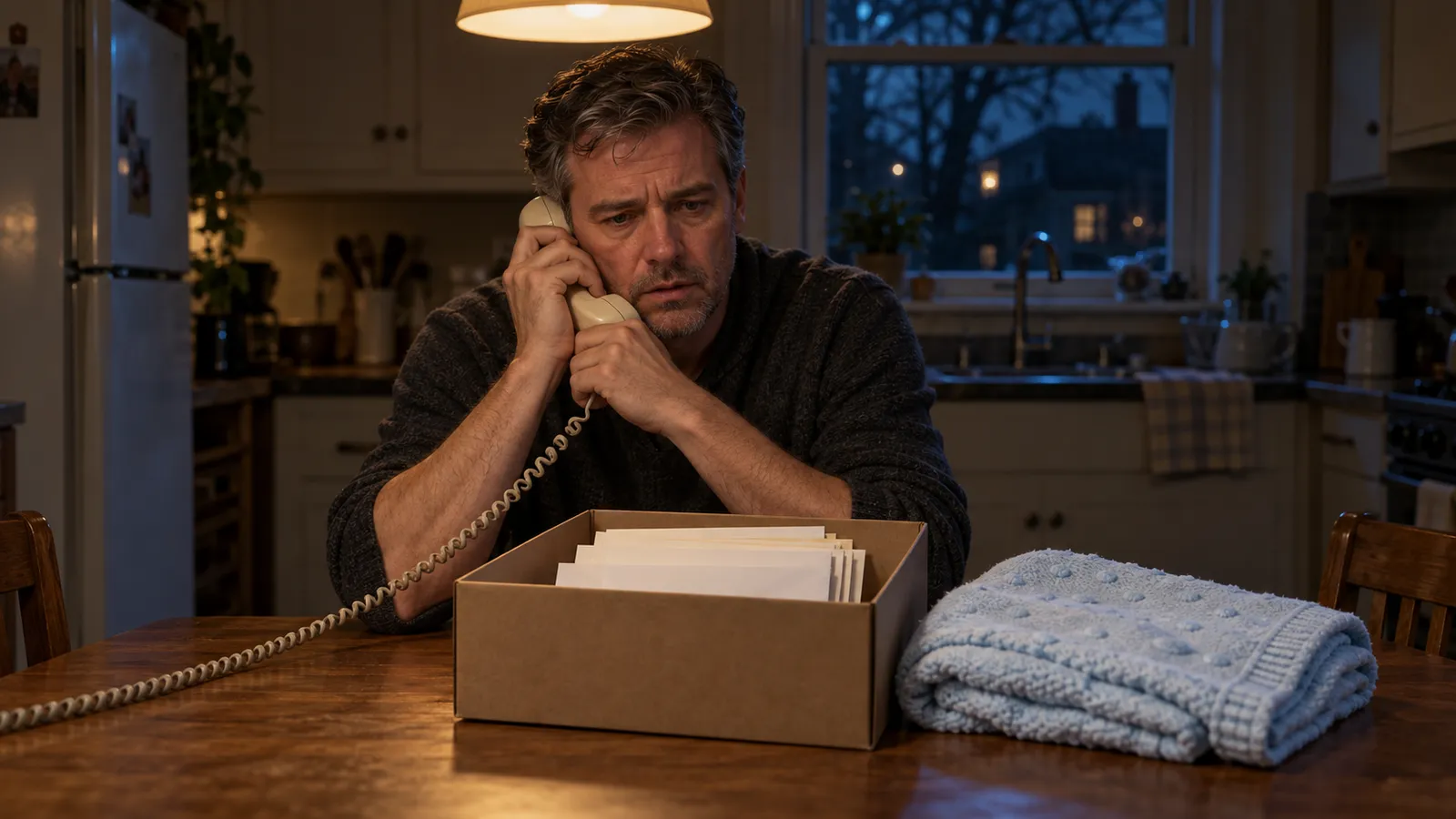
Chapter 6: The Loading Bay
"I'm going to ask you to say that again," Constance Mercado said, "slowly, and then I'm going to ask you to put it in writing."
I was standing in my driveway in the cold with the phone against my ear. I said it again slowly. Adrienne Vogel's brother. Early-onset Alzheimer's, diagnosed last year, fifty-two. Calls at two in the morning to a person named Wren. Thirty-four letters. A hospital bracelet. A Polaroid of a four-year-old on a porch step with thank you for the money, it is not necessary on the back.
The silence on her end was not the silence my mother makes. It was somebody thinking.
"Does she know you're calling me?"
"She's the one who told me the name," I said. "She just doesn't know what year it is when she says it."
"That is not the same as consent, Mr. Vogel."
"No, ma'am. It isn't."
"All right." A chair creaked. "I'm going to tell you what I have, and then I'm going to tell you what I'm not going to do. I have a blue receiving blanket I was handed in a lawyer's office in August of 1991 with a baby inside it. Folded in with the blanket was one page of handwriting, which the lawyer told me was not supposed to be there, and which I kept, because I was thirty-six years old and I was not going to be the person who threw that away."
"Do you still—"
"I gave both of them to Wren the summer she turned eighteen," Constance said. "Along with the form she got back from your sister. All in one afternoon, which I have since thought was poor planning on my part, but I was not going to hand her one without the other."
She read me the page. I did not ask her to. She just started, and I had to put my hand on the cold hood of the van.
Four lines. Her name is going to be whatever you choose. She was born on the ninth. She likes to be held upright, against the shoulder, not flat. There is a song that gets her to sleep and it is "Shenandoah," and you will feel foolish singing it, and do it anyway.
"I sang it for eleven years," Constance said. "I did feel foolish."
"What's she like?"
"She's thirty-five and she runs the night shift at a bakery, and she is a difficult, careful person, which is her own and not anybody's fault." Constance paused. "She was refused once, Mr. Vogel, in a form letter in a blue folder, and she read it about forty times. I am not handing you her phone number so you can do it again from the other direction."
"That's fair."
"Write to me," she said. "Your name, your sister's name, the doctor's name, what you want, and what happens if Wren says no. I'll read it, and if it's honest I'll put it in front of her myself, and then it's hers. Don't send the letters. Those are not yours to send."
I wrote it that night in longhand, two pages, and I drove to the post office at six in the morning to put it in the box before the first pickup.
She called me on the evening of the ninth of October. She said: "She wants to know why now."
"Because of the mornings," I said. "The mornings are the only part of the day that's still hers, and they're getting shorter."
"That's the answer I'll give her," Constance said. "She works nights. If she calls you it will be at a terrible hour. Don't read anything into the hour."
On the tenth, at four in the morning, a man two doors down from my sister found her on the sidewalk on Pell Street in her coat and her slippers and nothing in between, trying her key in his door. He is a decent man and he recognized her and he called me before he called anybody else.
She was not frightened. That is the part I keep. She was annoyed with the lock.
Tomasa and I had been on the list at Lindenhouse since May. There was a bed in room twelve because a man named Albert had died on the Tuesday, and that is how the whole thing works, and anybody who tells you different has not done it.
We moved her on the eleventh. I took the swim bag. I took the lesson plans with the cartoon fish, and her own quilt, and the lamp from the bedroom, and I did not take the shoebox, because the shoebox was in the back of my van and had been for a week.
The whiteboard in room twelve is screwed to the wall beside the bed, and the staff writes the day's date on it every morning in dry-erase marker, because orientation helps most people.
Gail, who has the night shift, wrote Sunday, October 11 on it in front of us.
My sister looked at it, picked up the marker from the tray, and corrected the year.
Gail said, "That's a new one."
"It's not new," I said.
I drove four hours on the twelfth with the shoebox on the passenger seat under a seatbelt, which I am aware is a thing a crazy person does.
Mineral Springs is a town with one through road, a grain elevator, and a commercial bakery on the east end that makes hamburger buns for the whole region. You can smell it from the gas station. It is the best smell I have ever been miserable in.
The night shift ends at eleven. Constance had told me that much, which meant Wren knew I would know it.
I parked at the far end of the employee lot at a quarter to eleven and stood by the loading bay where three men were smoking under a sodium light, and I did not look at the door, because looking at a door is a thing that makes people decide not to come out of it.
She came out at ten past, last, in a hairnet she pulled off as she walked.
I would not have picked her out. People want that in a story and it is not true. She looks like her father, I think, or like nobody. She is medium height and square-shouldered and she walks like someone who has been on concrete for eight hours.
Her hands, though. Flour in every crease of her knuckles, gone white and set, the way grease sets in mine.
"You're Martin," she said.
"I am."
"You drove four hours."
"I did."
"Why not just keep calling Connie?" she said. "That was working out great for you."
"Because she told me to write to her and then it was yours," I said. "And because it's a four-hour drive, and I wanted it to cost me something."
She looked at me for a while. The men under the light finished their cigarettes and went in and the door banged.
"You want to tell me she's sorry," Wren said.
"No."
"That's what this is."
"She's been sorry for thirty-five years. That's not news, and it's not worth a drive." I put my hands in my pockets because they wanted something to do. "I came to tell you that in about three or four months she won't be able to say your name, and right now, in the mornings, she can."
"That's a different sentence," she said. "That's the same sentence with a clock on it."
"Yes."
"I don't love that."
"No."
She put the hairnet in her jacket pocket. "You know she said no."
"I know. I've got the form in my van. I've also got the letter she wrote about signing it."
Wren laughed, one syllable, not a nice sound.
"I don't need a letter about it," she said. "I kept the one they sent me in 2009. It's two paragraphs and I can tell you the exact words on it without going inside to look."
End of chapter 6