Family6 min read
The Night My Sister Called Me by Her Daughter's Name
My sister has early-onset Alzheimer's. At two in the morning she started calling me Wren and apologizing for four days in August. I thought it was confusion, until I found the shoebox in her hall closet.
Chapter 3: Thirty-Four Envelopes
Dr. Priya's exam room has a window that looks out on the roof of the parking structure, and my sister always goes to it first and says something nice about the view, which is gravel and three vents.
"Look at that light," Adrienne said.
"It's good light," Dr. Priya said.
She is maybe forty-four, and she does a thing I have come to depend on: when she explains something she turns an appointment sheet over and draws on the back of it.
Adrienne did the intake form herself. She likes doing it herself. Name, address, emergency contact, which is me, and then the date.
She wrote 8-13-91.
She did not pause before it. She did not look up at the wall calendar or at my face. She wrote it the way you write your own phone number.
Dr. Priya took the clipboard, looked at the date, and did not react either, which is a professional skill I will never have.
"Adrienne, who's the president?"
"Oh, don't," Adrienne said. "I hate that one."
"I know. Humor me."
My sister told her, and she was thirty-five years out of date, and she was completely confident, and she laughed afterward at something private.
"Do you have children?" Dr. Priya asked.
"One," my sister said. "A girl."
The room got very quiet. I could hear the vent on the parking structure roof.
"What's her name?"
"Wren," Adrienne said. "She's four days old. She's at the hospital, they've got her under the lights because of the jaundice, they said it's common, they said it's nothing." Then her face changed and she looked at the window again and said, "Martin, did you lock the van? You never lock the van."
Afterward, Dr. Priya walked me out to the corridor by the water fountain, which is where she says the things she does not say in front of her patient.
"I need to ask you something clinical," I said. "Can she invent a person?"
"Can she? People with Alzheimer's can confabulate, yes. They fill gaps." She leaned against the wall. "Is that what you want me to say?"
"I want you to say what's true."
She took an appointment sheet off her clipboard and turned it over and drew a long horizontal line, left to right, and then put a tick mark at the far right end.
"Her life," she said. "Birth here, today here. What this disease does, mostly, is take the line away from this end." She tapped the right. "Newest first. Last year goes before last decade. Your face as it is now goes before your face at ten. She will lose this room, and this conversation, and me, long before she loses the summer she was seventeen." She drew a short bracket around a stretch near the left-hand end. "Right now she is living in here. Not remembering it. Living in it. The date she wrote on that form is the date she believes it is, and she has no reason to doubt it, because everything after it has been erased."
"So the person she's talking to at two in the morning—"
"Is whoever she was talking to then."
"And if that person is real."
"Then she is not confabulating," Dr. Priya said. "She is continuing."
I looked at the drawing. It was a line with a bracket on it. Twenty years in refrigeration and I have never had a schematic knock the wind out of me.
"Nine apologies in eleven minutes," I said.
"That tracks."
"How long do I have? Before she can't—" I did not know how to finish it. "Before the bracket moves."
"I don't answer that question," Dr. Priya said. "Not because I'm being careful with you. Because I don't know. It could be months. Her mornings are her best hours. If there's something you want her to be able to do, do it in the morning, and do it soon."
I cleared the hall closet that night. I want to be clear that this was not detective work. It was nine o'clock, I could not sit still, and there was a closet beside the swim bag that did not shut flush, and I had told myself for a year I would do it before the winter.
It was packed the way a person packs a closet over nineteen years. Pool towels gone stiff. A bread machine. Christmas lights in a grocery bag. A box of her old lesson plans, laminated, with cartoon fish on them. A vacuum cleaner that did not work when I plugged it in.
On the floor at the back, under a folded card table, was a shoebox.
Fidelity Shoe Company. Brown, with the lid taped at one corner, the tape gone amber and brittle. It was heavy the way a box of paper is heavy.
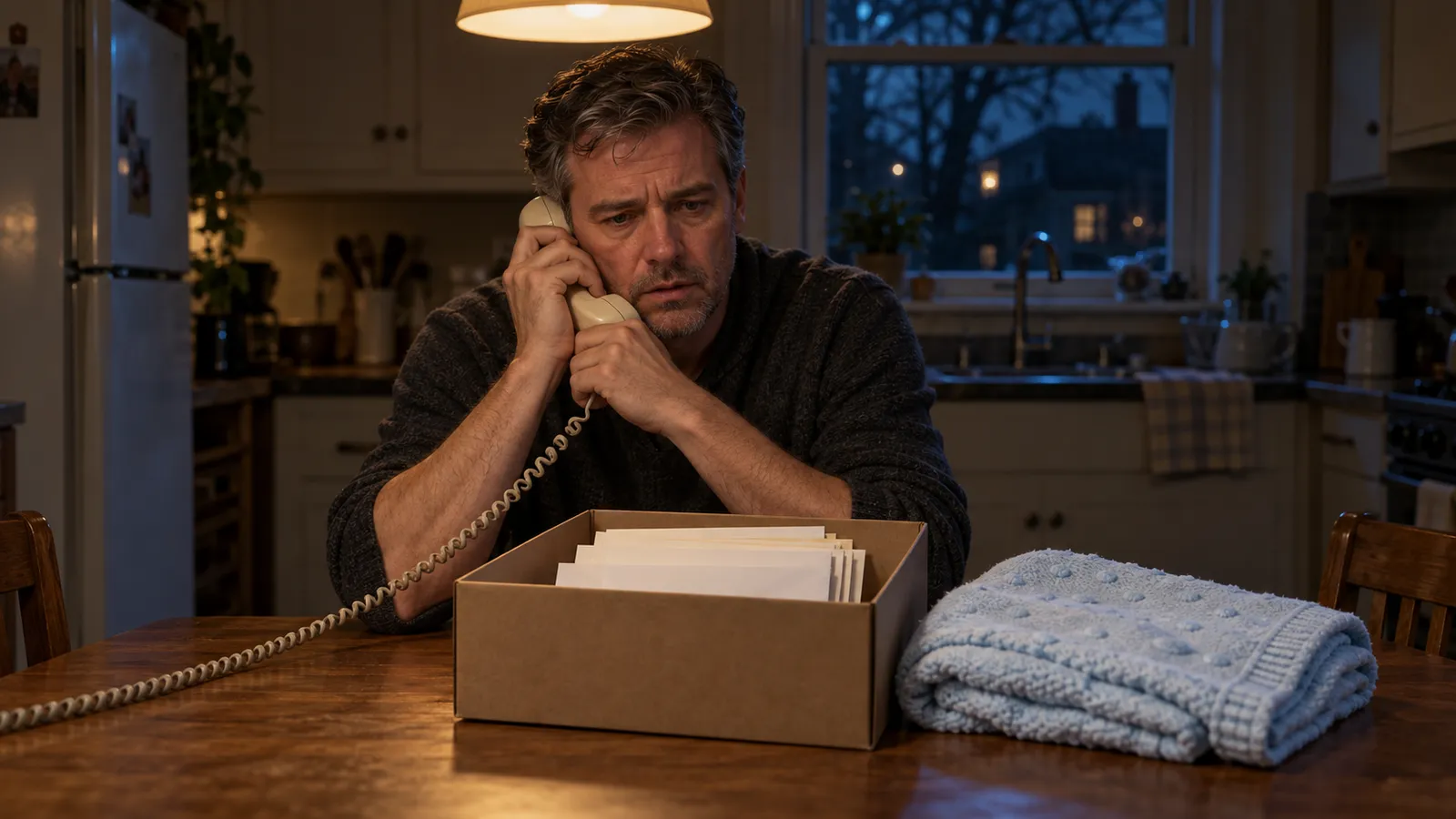
I took it to the kitchen table and I opened it, and then I sat down, which was lucky, because I was going to.
Envelopes. Standing on edge in rows, four rubber-banded bundles, the rubber bands cracked and in two cases broken into pieces at the bottom of the box.
They were stamped. Every one of them. First class stamps across four decades, flags and birds and lighthouses and one with a cartoon of a dog on it.
And every single one of them was blank where the address goes.
I counted thirty-four.
Each one had a date in the upper left corner where a return address ought to go, in my sister's handwriting, the big round hand she used on class rosters.
August 9, 1992.
August 9, 1993.
August 9, 1994.
All the way to August 9, 2025.
Under the envelopes, flat on the bottom of the box, were two things.
A hospital bracelet. The little plastic kind with a snap, sized for an ankle the width of my thumb. Typed on the insert, in a typewriter face with the letters punched in hard:
VOGEL BABY GIRL — 8-9-91 — 6 LB 4 OZ
And a Polaroid.
A girl on a porch step, maybe four years old, in a yellow swimsuit, squinting with her whole face. Dark hair cut straight across. A plastic cup in one hand. The white border of the picture had gone the color of weak tea.
I turned it over. Two lines, in handwriting that was not my sister's — smaller, more careful, the hand of someone who fills out forms for a living.
Wren, four years old. She is not a swimmer yet. Thank you for the money, it is not necessary, but thank you.
I sat at my sister's kitchen table with a photograph of a four-year-old in my hand and did the only arithmetic there was. Born August 9, 1991. Four years old in the summer of 1995. Thirty-five years old now, this autumn, somewhere.
Nineteen years of trading away the four-year-old class.
I put the Polaroid down and I did not touch the letters for a long time, because they were addressed to nobody and that meant they had never been read, and once I read one it would be read.
Then I took the first bundle out and slid the 1992 letter open with a butter knife.
It was one page. It started Dear Wren, you are one today, and I don't know what you look like. It was four paragraphs. It ended with a sentence I have not been able to put down since: I am not going to send this, because sending it would be for me.
I read 1998 next, out of order, because my hand went to the middle of the bundle. That one was mostly about a swim meet and a car that kept dying at lights, and it had a joke in it, and the joke made a sound come out of me that I did not recognize.
At the bottom of the fourth bundle I found the one dated August 9, 2009, and the flap on that envelope had been opened and resealed with a piece of tape.
I set it aside without reading it. I could not have told you why at the time. I think I knew that whatever was in a letter she had gone back into once was not going to be about a swim meet.
It was ten past one in the morning. The furnace at Pell Street came on and I listened to it run and then I put all thirty-four letters back in date order, which took me three tries.
My sister has a daughter. I am forty-five years old, I was ten the summer they sent me to Lake Carro, and my family removed a person.
At six in the morning I put the hospital bracelet in my shirt pocket and drove to my mother's apartment.
End of chapter 3